
Standard 40 mm Droz obverses.
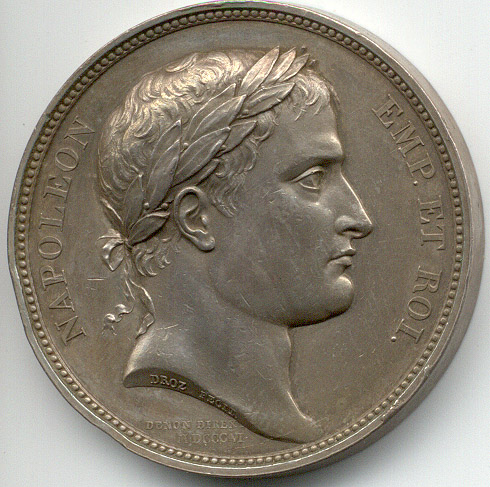


Although medallic artists and art critics have generally agreed that both sides of a medal should be designed by the same artist, mint directors have often paired an obverse designed by one person with a reverse by another. In the case of Napoleon's medal mint it was almost always the case that a forty millimeter medal had an obverse portraying the bust of Napoleon (or, in the earlier years, Bonaparte).
The four main obverse dies for forty millimeter medals were engraved by Droz, Andrieu, Depaulis, and Brenet. Denon ordered two obverse dies from Droz for use with the 1806 medals. The following year he switched to Andrieu, and obverse dies from Andrieu were used almost exclusively for the forty millimeter medals until the closing years of Napoleon's reign, when a head by Depaulis appeared. The fourth common head was carved by Brenet, apparently in or after 1830.
Standard 40 mm Droz obverses.
The only standard forty millimeter obverses with beaded edges are those by Droz. Denon ordered two dies from him to be used with the medals for 1805. These dies bore the date in which they were used, 1806, so the dies were later altered by carving out the date before using them outside the mint for striking medals from other years. Several dies of the Droz obverses were used in England, purloined from the Paris Mint during the occupation of Paris by foreign troops in 1814 according to Bramsen, who probably found that information in the Tresor. Medals made using one of the obverse dies can be identified as English by the size of the letter Z in the signature of Droz, it being taller than the other letters.


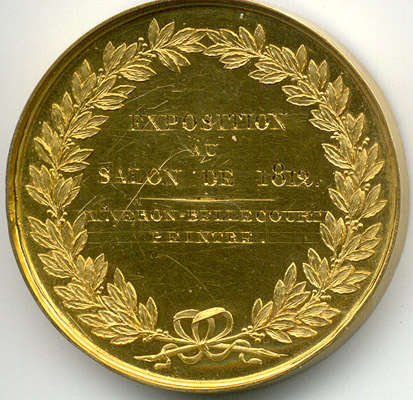
Most of these gold medals ended in the melting pot, the artists needing to buy bread for their families, so it would be difficult to find enough of them to establish the order of the Andrieu signatures. Several years later a new director of the mint proposed that since the Salon metals were not kept anyway, it would be better just to award cash prizes and not waste the effort and expense required to produce the medals.
The punches apparently had only the head of the Emperor Napoleon; different dies prepared by using the punches had differing inscriptions and signature varieties. Andrieu's signature is found on the truncation of the bust, or in the field. The signature in the field may be curved to follow the truncation or to follow the rim of the medal. Often the signature of the mint director, Denon, is also found on the medal.


Although the most common obverse inscription is NAPOLEON EMP. ET ROI, there are examples with that inscription in Latin, NEAPOLIO IMPERATOR REX (Bramsen 537) and a couple with completely different obverse inscriptions, such as Bramsen 631, with NAPOLEON A OSTERODE.
Standard De Paulis obverses.


Many of the later forty millimeter medals bear obverses by De Paulis. It appears that he produced an obverse for the Paris Mint in 1814. A different De Paulis obverse die was used in England. The Paris die differs from the English die in the number of dots on the epaulet attachment, Paris having eleven dots and England twelve.


Some examples of the die used in England bear the engrailed rim which is a characteristic of many of the English strikes.

Standard Brenet obverse.

The standard Brenet obverse was produced for the Paris Mint after the 1830 revolution. Any medal bearing it must, therefore, be a post-Napoleonic production, plain rim to the contrary not withstanding.