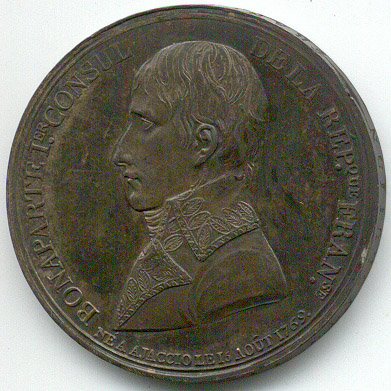
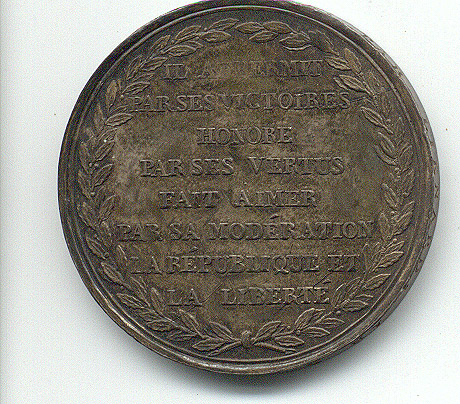
Shortly after General Bonaparte became First Consul Bonaparte, an engraver named Lienard began to issue a series of small medals portraying important men of the time, taking advantage of the fact that the revolution had abolished the prohibition against
issuance of medals by anyone except the government. Of course the government could not allow
this, so Lienard's project did not survive for long. He did, however, produce several, the first in his series being dedicated to the First Consul:
From "Le Moniteur":
Paris, 12 ventose. On the fourth of this month citizen Poultier, member of the Legislative Corps and citizen Lienard , Parisian artist, presented to the First Consul a list of a set of medals of famous men of the French revolution, a set composed of medals of Bonaparte, Kleber, Desaix, Bailly, and Lafayette, with characterizing descriptions.
Citizen Poultier told the First Consul that the next set would be composed of medals of Moreau, Menou, Mirabeau and Maury, and that the following volumes would appear very rapidly. He said, "History will tell what you have done for public glory and happiness; that will not be enough: posterity will want to study the face of the hero who will have captured its admiration. We foresee its justified desire by preserving your image in metals proper to resist the ravages of time.
After having paid this tribute to future centuries we shall reproduce before your eyes the men who have paid an important role in the terrible drama of the revolution. Because your firm hand has halted that stormy course, it is for you, General, to decide those whom it will honor for their virtues or dishonor for their crimes.
-- Le Moniteur, 13 ventose, l'an 9.
A second article shows that the first group of medals were produced:
"M�dailler g�n�ral des hommes c�lebres de la revolution fran�aise" produced by the artist citizen Lienard.
In our 13 ventose number, under Paris, we announced that the artist Lienard had been admitted to an audience with the First Consul and had presented him with the five numbers of the first group of a set of medals which he proposed to make up of the people who acquired the most fame during the course of the revolution.
These five numbers have been put on sale. They offer the portrait of First Consul Bonaparte, of Generals Desaix, Kleber and Lafayette, and of citizen Bailly, first president of the National Assembly and first mayor of Paris.
Antiquaries and distinguished artists have realized after seeing these medals that the artist has united with the primary merit of resemblance that of clean drawing and a precious finish in all the parts of his composition. He therefore deserves no less encouragement because of the merit of his execution than of the intention which has dictated the choice of such subjects.
The medals of which we have announced here the first group and which appear to be going to increase to six groups, or thirty medals, 32 centimeters [sic] in diameter (14.5 lines), and struck in gold and in silver. The first, 22K, are sold for 100 francs each, those of 968 silver, 6 fr. Groups will be published monthly. The medals can be purchased in groups or individually from the author, rue du grand Chantier, in the Marais, No. 1, and at his shop,rue de l'Echelle, near the Tuileries, No. 567.
-- Le Moniteur, 5 prairial, l'an 9.
The response of the government was to restate the prohibition against the striking of medals anywhere except in the government mints. It is possible that there was some connection with the fact that one of Lienard's first medals commemorated General Kleber, who had been a potential political rival of Napoleon. There was talk that Kleber had been left in charge of the French army in Egypt to keep him out of the way during the coup of Brumaire.
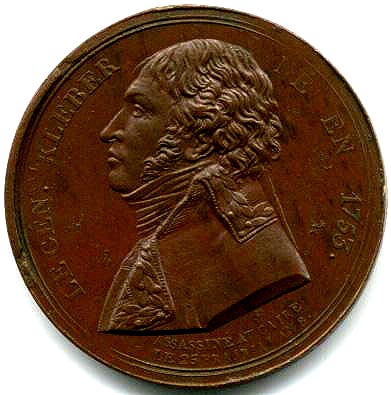
Obverse: LE GEN. KLEBER NE EN
1763 Uniformed bust left. Below: ASSASSINE AU CAIRE/ LE 29 PRAIRIAL AN 8.
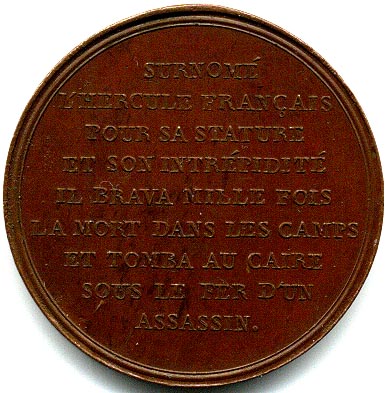
Reverse: SURNOME/ L'HERCULE FRANCAIS/ POUR SA STATURE/ ET SON
INTREPIDITE/ IL BRAVE MILLE FOIS/ LA MORT DANS LES CAMPS/ ET TOMBA AU CAIRE/ SOUS LE FER D'UN/
ASSASSIN
(Surnamed the French Hercules for his stature and his fearlessness, he braved death a thousand
times on battlefields and was felled in Cairo by the knife of an assassin).