A noble experiment.
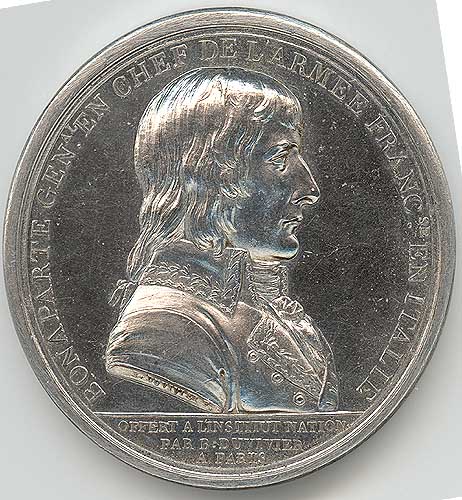

Although this medal was struck from the same dies as the copper example illustrated elsewhere on this site, it is an example of the platinum medals with which the medal mint was experimenting in and after 1800. A treaty between revolutionary France and Spain provided that Spain supply an annual contingent of soldiers to France, but since France had plenty of cannon fodder but needed money, precious medals were accepted. In addition to silver and gold, Spain was receiving the new precious metal platinum from her South American colony, so platinum was included in the payments. The French government gave the medal mint platinum from Spain for experimenting. Although at about the same time the British chemist Wollaston was developing a successful business purifying and and selling malleable platinum, this specimen shows that Spanish and French techniques were not as advanced. The planchet from which this medal was struck was not well prepared, showing numerous defects: voids, laminations . Apparently the better side of the planchet was used for the obverse, since it shows fewer defects, but a medal can be no better than its planchet! This platinum medal cannot be called a striking success, The breaks in the dies did not help. It is likely that they were caused by striking this very medal.
There is very little information available about early platinum medals
from the French mint. Articles in "Le Moniteur Universel" in 1800 and in 1805
state that platinum medals were included in a couple of foundation deposits,
The aborted 1932 auction of the great Julius collection had platinum copies
of Bramsen 54 and Bramsen 534v, as well as a platinum medal from Louis XVIII's
medal mint, and the 1975 Bank Leu Sale #14 of the Bonaparte collection included
a platinum Bramsen 557. In 1983 a Stack sale included a fifty millimeter platinum
medal commemorating the Henri IV statue erected in 1817. By 1833 the director
of the Paris mint apparently felt that the process of striking platinum medals
was perfected, since the sale catalog of that date quotes a price for custom
striking of platinum medals:
"Le prix de fabrication du kilogramme de Platine [m�dailles] sera la m�me que celui fix� pour les M�dailles d'or et d'argent, c'est-a-dire 340 fr. 55 c. avec les coins de la commission, ... mais la valeur du Platine sera regle de gr� � gr� entre l'Editeur et le Directeur."
I came across an account in Aulard, Paris sous le premier empire vol.1, p738 of counterfeit coins using platinum. Aulard quotes a police report of 5 floreal an XIII (25 April 1805):
"We have discovered and arrested the makers of counterfeit gold pieces of 24 and 48 livres which during the past eight years have been put in circulation in various departments of the Empire and even in Paris. The presses, the dies, the prepared blanks, platinum, gold dust and leaves, seventy six well-made pieces and twenty others which had been set aside because of some defects, and all of the tools necessary for the work have been seized. The individuals are Quartier, a self-styled businessman; Moisson, engraver; Senat, mechanic and machinist; and Brasseur, jeweler. The factory, which has often been moved, was last located in the small isolated house where we found it, on the left in front of the Sevres Bridge, on the road from that community to Boulogne. We succeeded in extracting from Quartier, the head of that company, all the possible facts and very detailed information on the quantity of pieces which have been made and on the means employed to put them in circulation; he indicated that the emitters were six money-changers working in Paris and declared that it was mainly through the cattle-buyers who supply Paris that they get their false pieces into circulation in the departments. These pieces are made of platinum covered with gold, of which they contain three livres worth at the very best. We are working on the indictment; these four accused, as well as those who are going to be arrested, will immediately be brought before the criminal and special court of justice, with their accomplices, the emitters already arrested in Paris and Limoges."
The police reported on 4 August 1805 that Senat, Quartier, Brasseur, Dubois, and Keller were condemned to death for having counterfeited; eight distributors were condemned to fifteen years in chains. Nine other people involved in the case were acquitted. The five were executed on 9 August 1805.


