CLICHES.
Numismatic clichés are uniface impressions made from engraved
dies. There are three sorts. The first sort is made by the engraver when he is
carving a die. Since he is working on a negative image, he may want to see how
the positive image will look. To do this he makes a puddle of molten tin or lead
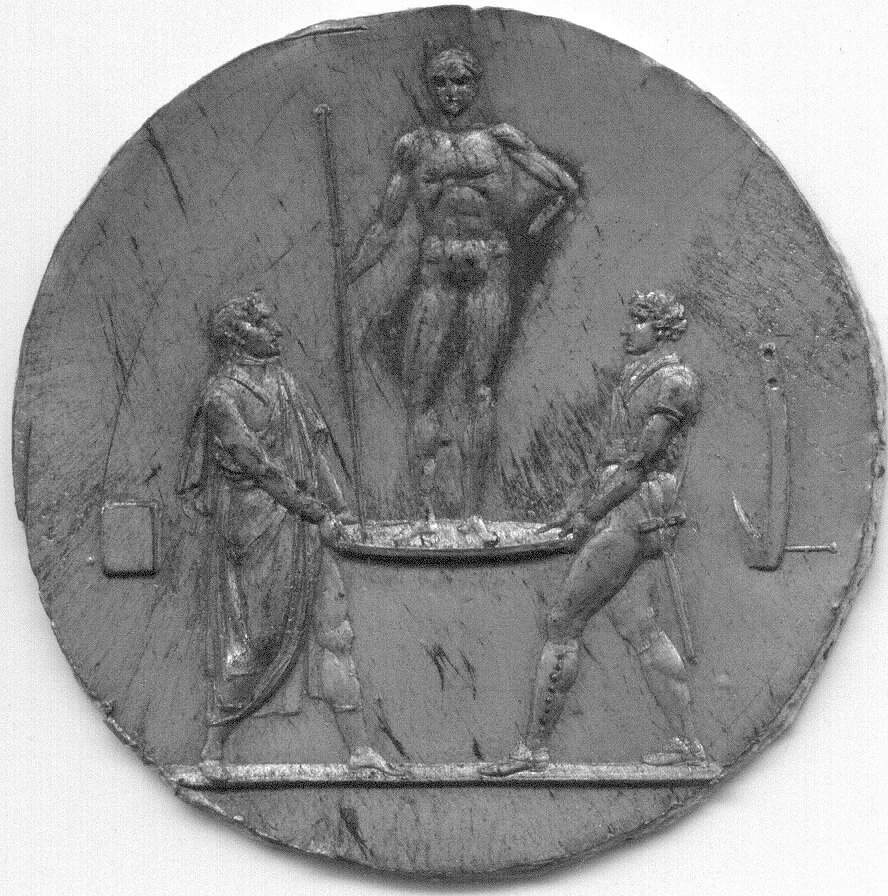
on his workbench and presses the unfinished die into it. The following example
was made by Jeuffroy when he was engraving his forty millimeter medal for the
coronation of Napoleon. In order to properly proportion human bodies, the die
engravers customarily engraved nude figures into the die, then dug deeper to dress
them. Jeuffroy wickedly gave copies of a cliche of his incomplete die for the
40 mm reverse to his fellow engravers:

The French kings did not allow the private striking of medals, so medal
engravers who wanted to sell copies of their work began producing a second
sort of cliche. Using a machine called a clichoir they forced a soft medal
(usually lead) into their completed dies, creating uniface medallions. These
cliches were usually colored to imitate bronze.
Hennin 809. The French Republic to its Defenders. 75 mm.

This cliché is from the obverse die engraved by N. Gatteaux for a medal described
in the following extract from the Trésor volume of medals of the Revolution:
"At the celebration of the Festival of the Republic on 1 vendemiaire year 6 (22
September 1797) the President of the Executive Directorate gave the fraternal
accolade to three wounded soldiers chosen by their comrades to receive for the
entire corps evidences of the national recognition and to offer them, in the name
of the French people, laurel wreaths and silver medals."
The reverse of the medal bears the inscription LA REPUBLIQUE
FRANCAISE A SES DEFENSEURS.
The famous engraver Andrieu had a shop in Paris where cliches from his dies were
sold. The individual impressions which were sold were mounted in more or less
elaborate frames, but there were also sets made up of several cliches, mounted
in cases, most of which have the outward appearance of being books. An extraordinary
example turned up in an estate sale, containing an impressive one hundred forty
millimeter cliche of Napoleon.

Index