The previous article in this series ended with the exile of Napoleon to
Elba. With the advent of Louis XVIII the medal mint became the
instrument of his propaganda. Griffiths published ("The end of
Napoleon`s histoire metallique" in "The Medal", Spring 1991) a list
of the planned budget for the royal medal mint for 1814:
Medals of the allied sovereigns 9400 francs First three medals of reign of Louis XVIII 9000 Gold, silver, and bronze medals: Return of Louis 7500 The same for Louis's entry into Paris 4000 Medals for the funeral of Louis XVI 4000 Gold medals for the Salon of 1814 5660 Medals for the king's collection 600
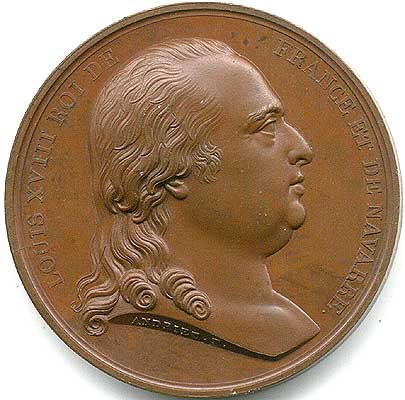
O: LOUIS XVIII. ROI DE FRANCE ET NAVARRE. Bust right, signed on truncation ANDRIEU
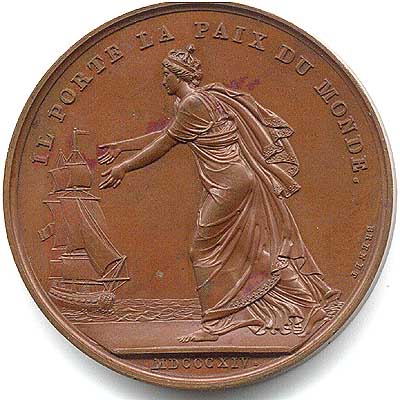
R: IL PORTE LA PAIX DU MONDE Crowned female welcoming arriving ship. Signed BRENET, Exergue: MDCCCXIV.
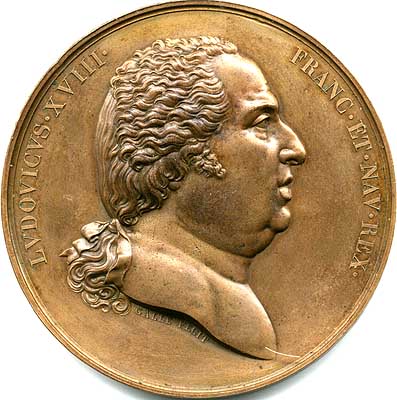
O: LVDOVICVS XVIII. FRANC.ET.NAV.REX. Bust left, signed
GALLE FECIT
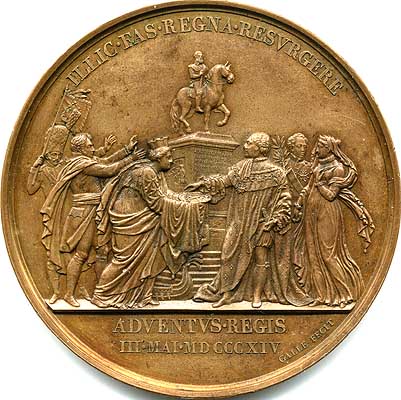
R: ILLIC.FAS.REGNA.RESURGERE King Louis XVIII accepting the keys to the city from Paris personified. Behind him a couple holding hands; behind her a welcoming subject and a hussar bearing the flag of Paris with ship and fleur-de-lys. In the background a statue of Henry IV with inscription HENRICI.MAG. PATER IN POPVL./NOTISSIMI.PRINC./SACRAM.EFFICIEM/CIVILES.INT.../POS.../E....
The "medals of the allied sovereigns" must refer to those commemorating the medal-mint visits of Alexander of Russia, Francis of Austria, and Friedrich Wilhelm of Prussia. These medal-mint visits were nothing new; for many years that mint and its collection of dies for striking medals has been the pride of France. The mint catalog of 1833 quotes with pride Voltaire's "It is an admirable thing, the arrangement in historical order of these punches and dies in the part of the Louvre occupied by artists. They are worth two million, and most of them are masterpieces." Important people were given tours of the coinage and medal mints in Paris, and often medals were struck commemorating their visits.
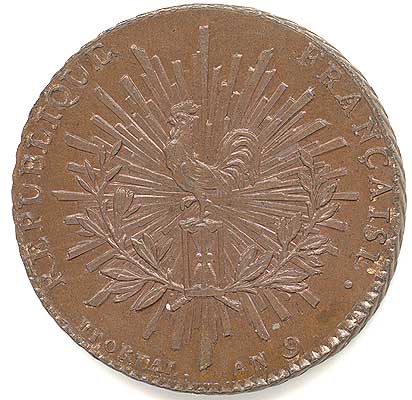
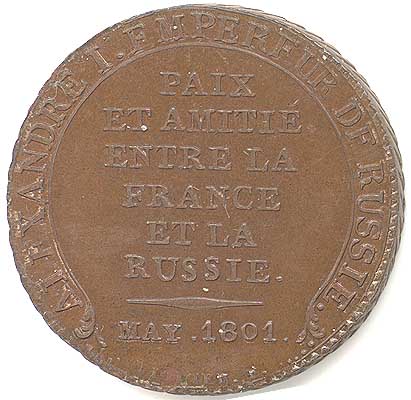
Obverse: REPUBLIQUE FRANCAISE. Rooster l. on
framed hour glass between olive branches, with a glory behind all.
Below, FLOREAL AN 9.
Reverse: ALEXANDRE I. EMPEREUR DE RUSSIE. In the field,
PAIX/ ET AMITIE/ ENTRE LA/ FRANCE/ RT LA/ RUSSIE./
[BAR]/ MAY 1801.
The module of the medal reveals that this was a visit to the currency mint.
The first important visitor to the medal mint in Napoleonic times was the pope, who had come to Paris to consecrate Napoleon Emperor of the French. There is some chicanery involved in these mint visits. Striking the forty millimeter, high relief medals was not as simple as would appear from the account of that visit. To bring up the high parts of the image on these medals requires several strikes, and between strikings the medal-to-be must be annealed, softened, since its metal is hardened by each strike and the dies will rapidly become worn or even damaged if the intermediate annealing is dispensed with. The high relief medals struck and presented during the mint visits must have been prepared beforehand and a pretense made of striking them during the visit.

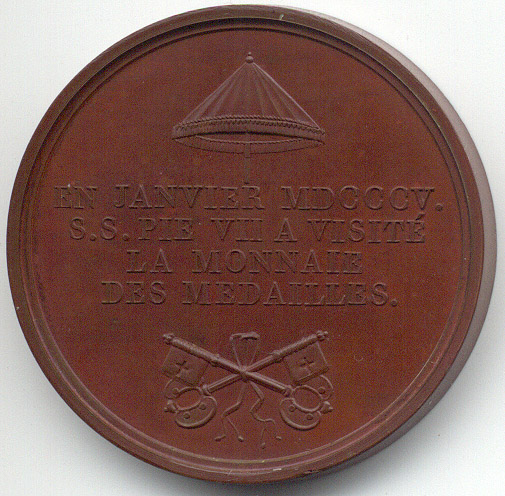
The medal is sufficiently described in the following article which
told about the visit:
"Then His Holiness went to visit the Medal Mint. He examined in
the greatest detail all the operations which precede the minting
of medals, that is to say, the forges, the rolling mills, the
cutters for preparing the flans. After he reached the presses,
the first medal was struck in gold and presented to him by M.
Denon, director of the Medal Mint. It represents His Holiness
wearing the tiara and pontifical robes, with this legend: PIUS
VII, P.M. HOSPES NEAPOLIONIS, IMP. [Pius Seventh, Pontifex
Maximus (Chief Bridge Builder, a title of the Roman emperors
adopted by the popes), guest of Napoleon, Emperor] On the reverse
is this inscription: EN JANVIER MDCCCV. S.S. PIE VII A VISITE LA
MONNAIE DES MEDAILLES.
"The second medal struck likewise represented the Holy
Father, and on the reverse the Cathedral of Paris... [Bramsen
350, described and illustrated in "Empire", the sixth article in
this series. Then the director had the large medal of the coronation of
His Majesty the Emperor [Bramsen 326, same article]
struck and gave it too to the Holy Father.
"The minting of the first two medals continued, and His
Holiness distributed them to all his entourage. Afterwards the
director took him into the cabinet where are placed all the dies
and punches of the medals struck in France from Louis XII to the
Emperor Napoleon. His Holiness viewed with a lively interest that
rich collection, perhaps unique, or at least the largest in
Europe.
"The medal of the Holy Father executed by M. Droz,
conservator of the establishment, joins to a striking resemblance
a very precious work; one must hope that it will be possible to
buy copies; everything connected to the great event which we have
witnessed is a historical monument."
"Le Moniteur Universel", 10 January 1805
Although the crown prince of Baden visited the medal mint in March of 1806, the scarce medal commemorating his visit (Bramsen 518-520) does not bear his portrait and is not illustrated here. The visit of the crown prince was in connection with his marriage to Stephanie Beauharnais, a relative of Josephine whom Napoleon adopted and married off to the heir to the State of Baden to cement the traditional alliance between France and Baden.

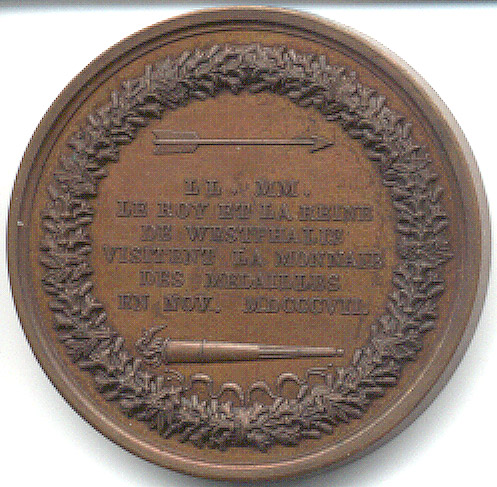
Obverse: Amor and Hymen weaving a garland of roses. In exergue:
J. NAPOLEON C. DE WURTEMBERG., an irradiated N,
MDCCCVII.
Reverse (all within a wreath):an arrow, LL. MM. LE ROY ET LA REINE
DE WESTHALIE VISITENT LA MONNAIE DES MEDAILLES ON NOV. MDCCCVII. A
torch, a symbol of marriage and of discord.
Napoleon selected his brother Jerome as the king of Westfalia, thus making Jerome the ruler of a buffer state between France and Prussia.
Three years later the king of Saxony was in Paris. With the advantage of hindsight we can hypothesize that the visit was connected with Napoleon's designs against Russia, although I have not found any evidence to support this idea. It will be remembered that Napoleon had installed Freddy as ruler of the Duchy of Warsaw, a buffer state designed to block Russian expansion westward.
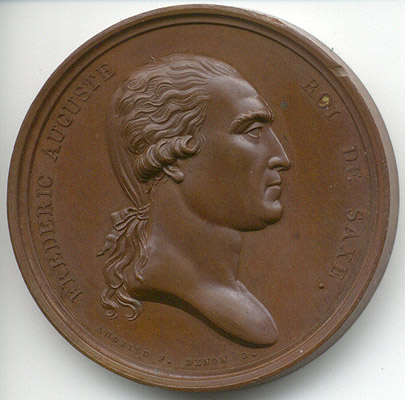
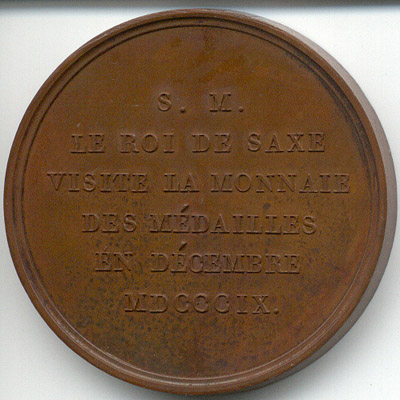
ObverseFREDERIC AUGUSTE ROI DE SAXE. Bust r. In field
below, ANDRIEU F. DENON D.
Reverse: Legend S.M. LE ROI DE SAXE VISITE LA MONNAIE DES
MEDAILLES EN DECEMBRE MDCCCIX.
"Le Moniteur" did not find room for a notice of this visit, lending
support to the idea that Napoleon did not want to call attention to
the presence of the duke of Warsaw in Paris.
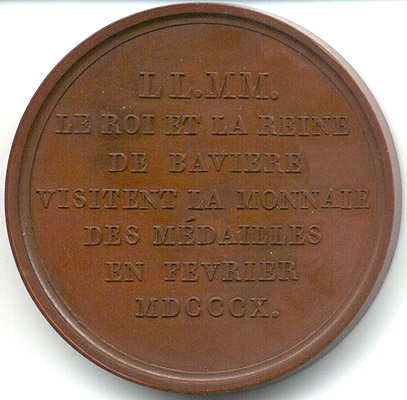
Two mint visits were commemorated with medals in 1810, the victims probably being in Paris for the wedding of Napoleon and Marie Louise:
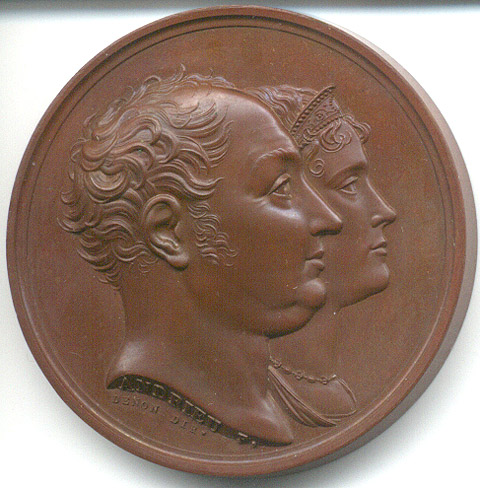
Accollate busts r., signed on the truncation ANDRIEU F.
and in the field below DENON DIR.
Reverse: legend, LL.MM. LE ROI ET LA REINE
DE BAVIERE VISITENT LA MONNAIE DES MEDAILLES EN FEVRIER MDCCCX.
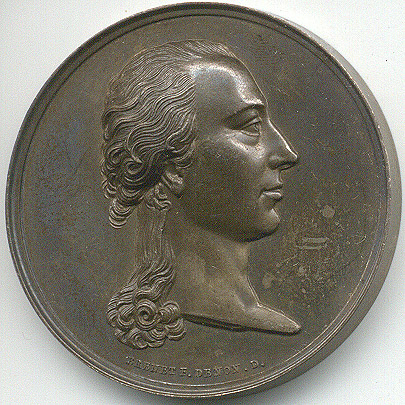
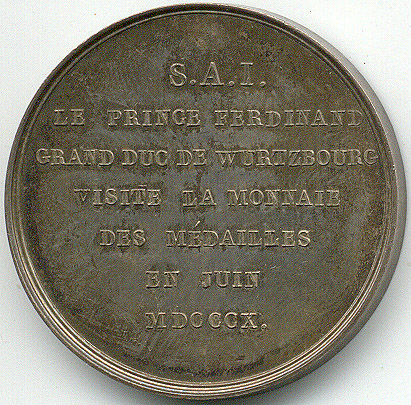
Obverse: Bust r., signed beneath BRENET F. DENON D.
Reverse:S.A. LE PRINCE FERDINAND GRAND DUC DE WURTZBOURG
VISITE LA MONNAIE DES MEDAILLES EN JUIN MDCCCX.
Denon conceived the notion of a series of medalets modelled after ancient Greek coins but portraying various imperial ladies, to be issued upon their visits to the medal mint. Most of the obverse inscriptions were in Greek, although French was used on most of the reverses. Some copies of these little medals were struck free, giving them an irregular edge and increasing their resemblance to the old coins. Apparently these visits never took place, but examples of these medals were struck and included in the mint sets of Napoleonic medals sold in 1815-16, and copies of five of the medals are today quite popular at the mint's salesroom. Each obverse except that of Marie Louise occurs with two reverses.
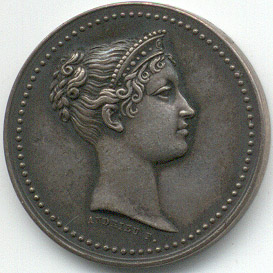
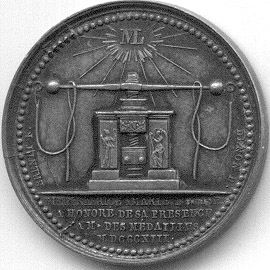
Unnamed female bust r., signed ANDRIEU F. Reverse: a medal press, above it ML in a glory. Exergue: L`IMPERATRICE MARIE LOUISE A HONORE DE SA PRESENCE LA M. DES MEDAILLES MDCCCXIII.
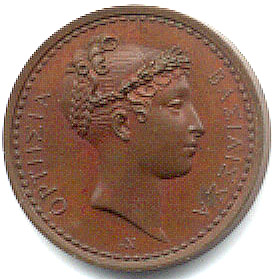
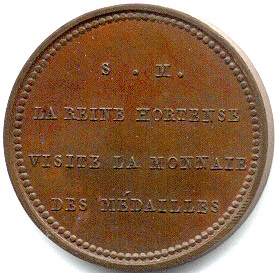
QUEEN HORTENSE in Greek. Female bust r., signed below
(monogram of Greek letters for And.
Reverse 1: an easel with a painting of a woman; the attributes of
painting and music. Exergue: HONOREES ELLES HONORENT
ANNEE 1813 in Greek.
Reverse 2: legend S.M. LA REINE HORTENSE VISITE
LA MONNAIE DES MEDAILLES.
Hortense, the daughter of Josephine and so step-daughter of
Napoleon, was the wife of Napoleon's brother Louis, who had been
made king of the Netherlands.
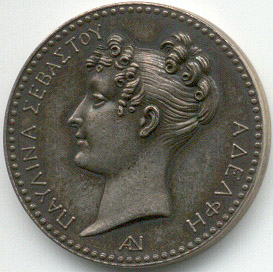
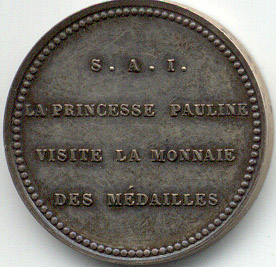
PAULINE, SISTER OF THE EMPEROR in Greek. Female
bust r., signed in the field below (monogram of ???) for Andrieu.
Reverse 1: Greek for BEAUTY, BE OUR QUEEN. Group
of the three Graces.
Reverse 2: legend S.A. LA PRINCESSE PAULINE
VISITE LA MONNAIE DES MEDAILLES.
Pauline, one of Napoleon's sisters, was the wife (at least in name)
of Prince Camille Borghese, one of the richest men in Europe.
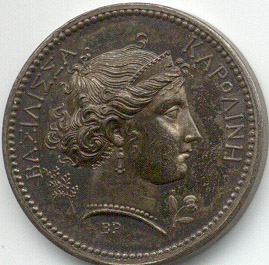
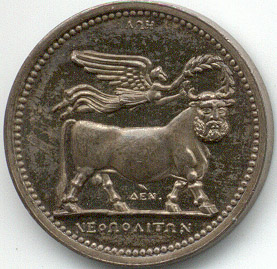
Greek for QUEEN CAROLINE. Female bust r., signed in the
field below ?? (Greek letters for Brenet).
Reverse 1: the Neapolitan bull being crowned by a flying victory.
In the field above are Greek letters which the designer thought
represented 1808; beneath the bull's pizzle, Greek letters for
Den. In the exergue is Greek for "of the Neapolitans".
Reverse 2: legend, S.A.I. LA PRINCESSE CAROLINE REINE
DE NAPLES VISITE LA MONNAIE DES MEDAILLES.
Sister Caroline was a queen because she was married to Napoleon's dashing Marshal Murat, whom Napoleon made king of Naples as a booby prize. Caroline had been expecting her husband to be made king of Spain, a position given to Joseph.
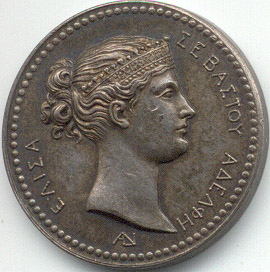

Greek for ELISA SISTER OF THE EMPEROR. Female bust r.,
signed in the field below (monogram of Greek letters for AND) for Andrieu).
Reverse: S.A.I. LA PRINCESSE ELISA
GRANDE DUCHESSE DE TOSCANE VISITE LA MONNAIE DES MEDAILLES.
Eliza, the oldest of Napoleon's three sisters, was the first of
them to receive a state from him. He made her princess of Piombino,
adding Lucca and Tuscany later to her kingdom, reportedly after she
stated that the crown of Piombino was too small for her head.
The illustrated medal was struck from the first dies cut by Andrieu
for Elisa's medal mint visit. Laskey relates in his Description of
the Series of Medals, p.236, that Andrieu's original dies for Elisa
broke on being proved, that Andrieu had not completed the second
set when Napoleon abdicated for the second time, that he sold his second
die for the obverse to someone in England. Uniface strikes from
this second obverse die do not have the Greek legend and are signed
ANDRIEU F. rather than with the Greek monogram. The uniface medal
struck in England is Bramsen 775. Bramsen 776 is a copy signed by
Brenet of the present medal, and his die was perhaps engraved
after 1830, when the Paris mint had resumed production of the
Napoleonic medals and commissioned the engraving of new dies to
replace dies which had been lost or were worn out.
When Napoleon retired to Elba, Denon retained as one of his charges the medal mint; the same engravers who had cut dies for the medals celebrating Napoleon's exploits now cut dies for their new master, Louis XVIII, including the medals of the allied sovereigns commemorating their visits to the medal mint.
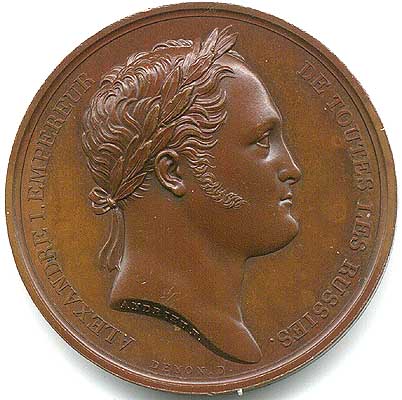
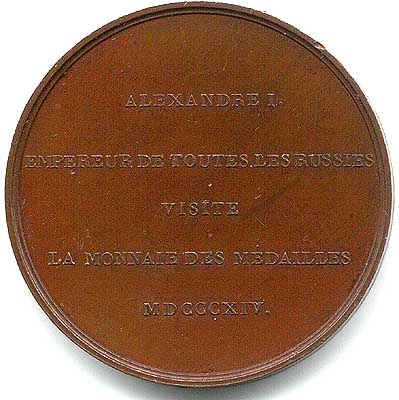
Obverse: ALEXANDRE I. EMPEREUR DE TOUTES LES RUSSIES.
Laureate bust r. Signed on truncation, ANDRIEU F.
and in the field below, DENON D.
Reverse: ALEXANDRE I. EMPEREUR DE TOUTES LES RUSSIES/ VISITE/ LA MONNAIE DES MEDAILLES/ MDCCCXIV.
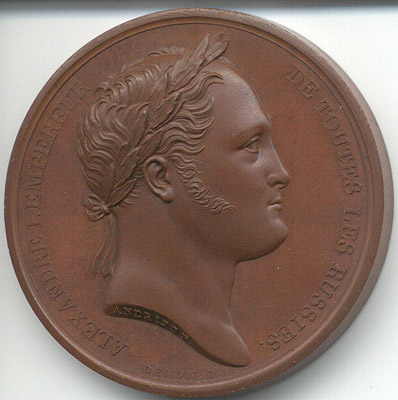
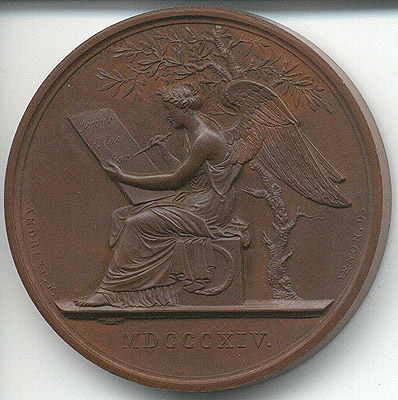
Obverse: ALEXANDRE I. EMPEREUR DE TOUTES LES RUSSIES.
Laureate bust r. Signed on truncation, ANDRIEU F.
and in the field below, DENON D.
Reverse: History, seated, writes on a tablet SEJOUR
DE ALEX I. A PARIS., signed DENON D.
and ANDRIEU F. Exergue: MDCCCXIV.
"Yesterday the Emperor Alexander went to visit... the Medal Mint,
where he was received by the director general [Denon]. When that
monarch had entered the workrooms many medals were struck in his
presence. One of them was an old medal of which the establishment
possesses the dies, which was engraved at the time of Peter the
Great's travels in France. On one side is seen the head of the
regent and on the other the face of the czar and that of Louis
XV, still a child, with this legend: PETRI RUSSORUM AUTOKRATORIS
CUM REGE CONGRESSIO. XDCCXVII [sic]. This last medal recalls a
curious anecdote. When the czar came into the presence of Louis
XV, His Majesty did not know what etiquette to follow with the
king, who was hardly eight years old; listening only to his heart
and to avoid all difficulty, he took the young prince in his arms
and embraced him.
"The Emperor Alexander received very graciously the
different medals and had explained to him in detail all the
machines used in their fabrication. His Majesty, who found his
portrait to have a great resemblance, deigned to express his
satisfaction to Mr Andrieux [sic], one of our better engravers
and member of the Imperial Academy of Vienna.
"In one of the workrooms the director general of the medal
mint pointed out to His Majesty an old press on which years ago
had been struck the large medal for the visit of Peter the Great.
At the same time he had the honor of presenting him with a medal
of the size of 32 lines, on one side of which is the head of Czar
Peter and on the other that of Emperor Alexander. His Majesty
looked with emotion at the portrait of his illustrious ancestor
and seemed flattered to see his image united to that of that
great prince.
"After having visited the various workrooms, the monarch
mounted to the cabinet of dies and punches. He examined with
interest that large collection, which offers the series of the
most memorable events which have occurred in France since Louis
XII. His Majesty said that he took great pleasure in seeing these
archives of the most civilized times of France and that he
realized how important it was for a powerful nation to possess a
history which spoke in such a way to the eyes and which was, so
to say, eternally alive."
"The Moniteur", 26 May 1814
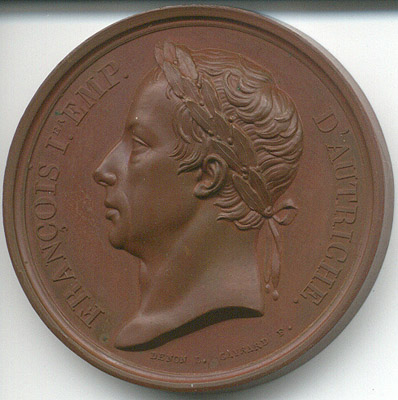
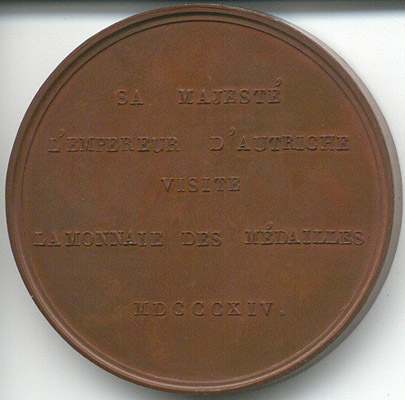
Obverse: FRANCOIS IER EMP. D`AUTRICHE.
Laureate bust r., signed below DENON D. GAYRARD F.
Reverse: legend SA MAJESTE L`EMPEREUR
D`AUSTRICHE VISITE LA MONNAIE DES MEDAILLES MDCCCXIV.
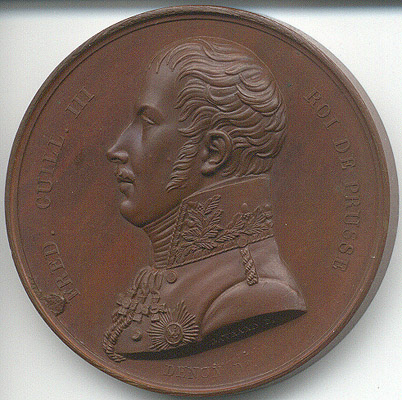
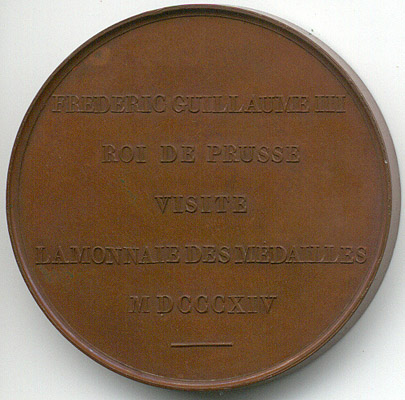
Obverse: FRED. GUILL. III ROI DE PRUSSE.
Uniformed bust r. Signed on truncation GAYRARD F.,
in field below DENON DT.
Reverse: Legend FRED. GUILL. III ROI DE PRUSSE
VISITE LA MONNAIE DES MEDAILLES MDCCCXIV.
The written list of at least one of the mint sets sold in 1814 or 1815 calls for a non-existent medal commemorating a mint visit by Louis XVIII. Either this was a scrivener's error or such a medal was planned but production was cancelled by Napoleon's unexpected return from Elba. The slightly later engraved lists call instead for the following medal:
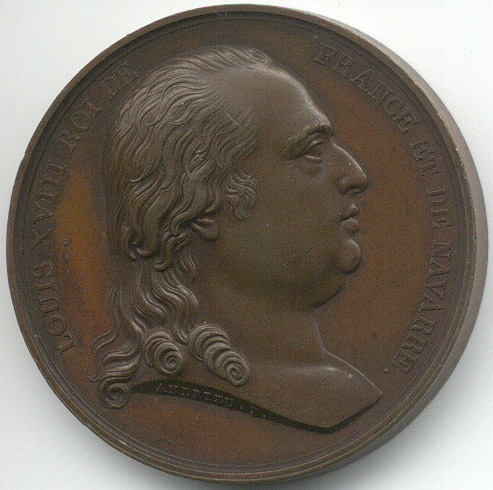
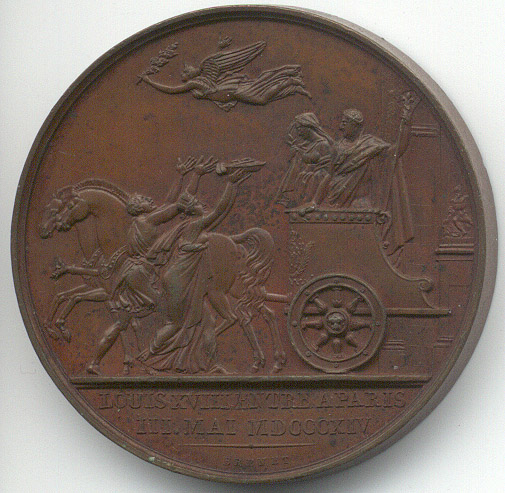
Obverse: LOUIS XVIII, KING OF FRANCE AND OF NAVARRE.
Bust r., signed on truncation ANDRIEU. F.
Reverse: A man and a woman standing in a chariot drawn left by two
horses, being welcomed by a man and woman standing with upraised arms.
Above flies a victory bearing a branch (olive?). Exergue: LOUIS XVIII.
ENTRE A PARIS III. MAI. MDCCCXIV. Signed
BRENET.
As we now know, this triumph of Louis was upset by Napoleon's return from Elba, a return which begins the next article in this series.
| previous | index | next |
|---|