
The understanding Napoleon had come to with Alexander at the close
of the Prussian campaign, embodied in the Treaty of Tilsit (1807),
turned into a misunderstanding. Napoleon's attempt to bar British
goods from the continent (a crackbrained economic scheme anyway)
threatened to undermine the Russian economy, then largely based on
the export of raw materials to England and the import of
manufactured goods from Great Britain. On 18 August 1810 Napoleon
issued the following order: "The territory of Lubeck, the
Principality of Lauenburg, the territory of Hamburg and all the
lands of the left bank of the Elbe from Wilhemsburg [sic!],
following the line of Die Sewe, Gross-Movr and the Wemme, up to
Bremen, finally the Principalities of Oldenburg and of Arenburg
will be occupied by the division under the orders of General
Morand, who will remain charged with taking all the measures
necessary to prevent contraband" (Corres. 16804). The object was
to eliminate British trade with the continent through the area
including Oldenburg, but the result was to anger Alexander, one
of whose sisters had married the heir to the Duchy of Oldenburg.
Alexander secretly resumed trade with Great Britain.
On 3 October 1810 Napoleon wrote to his minister of foreign
relations: "I have really offered thirty thousand weapons to the
King of Saxony for the Duchy of Warsaw. I don't intend to sell them
to him but to give them to him if he needs them. It is necessary to
act as if the King of Saxony had bought them, so that it does not
have the appearance of an armament plan and presents nothing
extraordinary... It is very simple that Saxony buys weapons and
doesn't look elsewhere than in France... It is not necessary for
this to have another color" (Corres. 16981). The Duchy of Warsaw,
created by Napoleon out of the Prussian share of the partitions of
Poland and awarded to the ruler of Saxony, whom Napoleon promoted
to king, was another irritation to Russia.
On 5 December 1810 Napoleon instructed his minister of foreign
affairs to write to the French ambassador in St. Petersburg: "Write
to the Duke of Vincenza [Caulaincourt] that the Russians are doing
a lot of work on the Dwina and also on the Dniester, that it is
necessary to stay awake to that and report on it to you; that it
can't be hidden that these works, being campaign works, show a bad
disposition among the Russians. After having made peace with the
Porte [Turkish Empire], do they want to make one with England and
thus violate the Treaty of Tilsit? Make the Duke of Vincenza
understand that that would immediately cause war" (Corres. 17187).
Due to pressure from commercial interests in Russia, Alexander put
a heavy duty on imported luxury goods, the bulk of them coming from
France, which wasn't buying the raw materials Russia formerly exported
to England. On 10 February 1811 Napoleon's minister of foreign affairs
was ordered to ask the Russian ambassador whether the latest ukase
applied to France and thus violated article five of the Treaty of
Tilsit, which had reestablished commercial relations between France
and Russia (Corres. 17346). By March 24th Napoleon was ordering
Marshal Davoust, commander of the French forces in Germany, to
prepare for war. "I do not want war with Russia, but I want to take
an offensive position and to make the movements for that now which
if undertaken later could make the war break out, since it is
evident that if these movements were made when the Russians had all
their forces available, they would no longer believe my
explanations and would immediately march to seize Warsaw" (Corres.
17516).
On 21 June 1811 Napoleon discarded his mask, sending the following
letter to his minister of foreign relations:
On 28 May 1812 the young British statesman Stratford Canning scored
his first triumph, mediating the Treaty of Bucharest between the
Empires of Russia and Turkey. I shall only mention here that Mahmud
II had a French mother, a friend of Josephine's from Martinique.
Captured and enslaved by pirates, she became a wife of Mahmud's
father. It has been speculated that Mahmud's agreement to the
treaty was helped along by his mother's anger at Napoleon for
divorcing Josephine. The consequent freeing of the Russian troops
who had been fighting against Turkey doubled the size of the force
with which Alexander could oppose Napoleon, although Russia was
still apparently hopelessly outnumbered. The immense preparations
Napoleon made resulted in an unmanageable army of half a million
men, including soldiers from his forced allies: Austria, Prussia,
the Confederation of the Rhine, the Duchy of Warsaw, and Italy. As
a side note, overcoats and shoes for the soldiers were bought from
Great Britain! As is well-known, the Russian armies retreated,
adopting a scorched earth policy and avoiding any pitched battle,
so Denon was hard put to find events of this campaign to
commemorate on medals. One such event was the occupation of the
Lithuanian capital.
"It is necessary for you to send a courier to Saint Petersburg
without delay. I have sent you a draft for a letter to Lauriston
[who had replaced Caulaincourt as French ambassador to Russia];
he must be written another about the insinuations Mr Romanzof has
made in regard to Saxony. He is embarrassed about that. Tell him
that he is embarrassed about a very small thing, that the King of
Saxony is raising fifteen hundred horse for the same reason I
have raised thirty thousand, that he is raising fifteen hundred
horse for the same reason I have brought my regiments of cavalry
and of cuirassiers to twelve hundred horse each, for the same
reason that I have formed my six battalions, that I have formed
nine new regiments of light horse; that the King of Saxony has
made some expenditures because I have facilitated a loan for him;
that if I facilitated this loan for him it was so he could put
things in order; finally, that the Saxons are arming for the same
reason that Westphalia raises its four battalions, for the same
reason that there are twenty thousand men at Danzig, that three
millions are being spent in that place, and that four hundred
boats and five hundred ships have arrived there or will arrive
there loaded with artillery and munitions.
"Tell Lauriston that he doesn't understand my position well,
that Russia knows all this, that I have told all this to the
Russians because they would have to be very blind not to see all
my roads filled with convoys, detachments on the march, military
convoys, and that twenty five million can't be spent every month
for an object without everything being in motion in a country,
but that I had not ordered these movements until after Russia let
me know that she might change and seize the first favorable
moment to begin the hostilities.
"The creation of twenty strong places on the frontiers, the
movement of the divisions of Finland and of Moldavia, the
declaration of the Emperor Alexander that he is ready, are these
not quite sufficient notices for us also to get ready? Does
Russia believe that we want her to lay down the law to us? In all
this discussion Count Lauriston should speak frankly: We want
peace but we are prepared for war. We were not ready because
after the Peace of Vienna we did nothing but disarm and I could
not believe a rupture with Russia possible. The creation of
strong places eighteen months ago surprised me, but later the
movements of the divisions of Finland and Moldavia, the formation
of five battalions in line regiments, the manifesto sent to all
the courts of Europe about Oldenburg, and the great concentration
of troops on the frontiers of the Duchy, a concentration which
has since been retired, all of these things have made me
understand that it was necessary to get ready. I have spent a
hundred million and I am ready. If I have not had Bavaria,
Wurtemberg, and Baden arm, it is because I have not thought I
would need these troops at first, and that there would always be
time to arm them after the commencement of hostilities."(Corres. 17832)
Obverse: the standard obverse by Andrieu.
Reverse: Uniformed, bare-headed Napoleon hands a sword to a Polish
warrior and a shield to a Lithuanian; signed DENON D.
and ANDRIEU F.
Exergue: PRISE DE VILNA XXVIII. JUIN MDCCCXII.
Vilna is the ancient capital of Lithuania. The classical name is
Vilnyus; the Polish, Russian, and German names (Wilno, Vilna, and
Wilna) reflect its history. Russian since 1793, the city was held
by a Russian army of about 125,000, commanded by the Czar Alexander
in person. When Napoleon's overpowering army approached, Emperor
Alexander retreated to the fortified camp of Drissa, on the Dwina
but, learning that his army would be lost if it remained there,
turned his main army over to General Barclay de Tolly, who had
advocated retreat rather than facing superior forces, and retired
to Saint Petersburg.

Standard obverse by Andrieu.
Reverse: A nude, seated river god, looking at a French standard
behind him. In the margins, DENON D. BRANDT F.
Exergue: L`AIGLE FRANCAISE SUR LE BORYSTHENE.
(The medal reads BORYSTHENE rather than
DNIEPER; perhaps Denon decided to use the ancient
name of the river because the Russian name looks so foreign!)
While retreating toward Moscow Barclay joined up with a smaller
Russian army under Prince Bagration (about 45,000 troops) at
Smolensk, on the Dnieper River, the first city of Russia proper.
Napoleon and the grand army reached the Dnieper River on August
14th. The Russians made a brief stand (costing Napoleon about
12,000 troops) before slipping away.
The following two medals celebrate the battle of the war, the last ditch attempt to prevent the French from reaching Moscow. Although the French named it the Battle of the Moscow River, it is generally called the Battle of Borodino, and its cannon still roar today in Tchaikovsky's 1812 Overture; the misery is immortalized in Tolstoi's War and Peace. Alexander had appointed a new commander of the Russian army, replacing Barclay by General Kutuzov, and Kutuzov decided to face Napoleon, having about 110,000 troops and a strong position behind the village of Borodino. Napoleon spent two days gathering his forces to a strength of 125,000, then launched his attack. Some military authorities believe that Napoleon would have done better to outflank the Russians, but apparently Napoleon felt that if he tried that the Russians would again have retreated without fighting.

Standard obverse by Andrieu.
Reverse: A mounted soldier pursuing a fleeing one; another lies dead.
In left field, JEUFFROY F.; right, DENON DIR.
Exergue: BATAILLE DE LA MOSKOWA VII SEPTEMBRE M.DCCCXII.

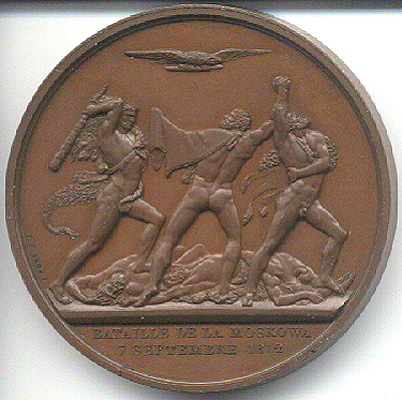
Obverse: NAPOLEON EMPEREUR ET ROI, laureate bust r.,
signed in field below, DROZ.
Reverse: Hercules battling two giants, overhead an eagle with
thunderbolt, corpses on the ground behind the struggling men.
Signed in the field, J.F. DROZ F. Exergue:
BATAILLE DE LA MOSKOWA 7 SEPTEMBRE 1812.
The contrasting styles of these two medals indicate the shift away from the neoclassicism of most of the Napoleonic medals to the romantic school which characterized much of the later art of the nineteenth century. The medal engraved by Jeuffroy eschews the Roman style. The artist has attempted to portray an incident from the battle, carefully detailing uniforms and animals. The neoclassical design of the medal by Droz is apparently inspired by the fabled battle of the giants, although it is strange to see several men with the club and lionskin of Hercules. However, it appears that the medal engraved by Droz is actually later than the one by Jeuffroy. Droz's medal was not produced at the French Mint until after 1830, and its size of 55 millimeters is not one of the usual sizes of Napoleon's medals, in addition to its lacking the name of Denon as director. Although it is possible that Droz engraved the dies for it in 1813, it seems more likely to me that this medal was designed and engraved well after the event it commemorates.
After the Battle of Borodino the defeated Russians retreated through Moscow and preparations were made to burn the city. After waiting in vain for a delegation from the city government to surrender to him, Napoleon entered the city.

Standard obverse by Andrieu.
Reverse: ENTREE A MOSKOU. The Kremlin,
with a French standard projecting above the wall.
Exergue: XIV. SEPTEMBRE MDCCCXII.
Napoleon and his staff were forced to leave the Kremlin when the
fires started by the Russians could not be controlled (one idiot
author stated that the violence of the fires was increased because
of stores of vitriol in the cellars!); after the fires burned
themselves out Napoleon returned to the undamaged Kremlin.

Standard obverse by Andrieu.
Reverse: A scantily draped river god leaps up in surprise at the
appearance of a French standard amid the bulrushes. To the right
a startled sturgeon (a very fine fish) sticks her head out of the
water. On the rocks on the left, DENON D.,
in the field to the right, MICHAUT F.
Exergue: L`AIGLE FRANCAISE SUR LE WOLGA M.DCCCXII.
This is the last of the Napoleonic medals celebrating reaching
rivers, a series begun with medals for General Bonaparte's first
Italian campaign. In this case, though, there was no significance
in French scouts' reaching the Volga, about fifty miles from
Moscow. Due to the lateness of the season Napoleon did not think it
advisable to attempt to march on Saint Petersburg. He hoped that
his occupation of Moscow would result in Alexander's agreeing to
talk peace terms.
Napoleon's attempts to make peace with Alexander fell on deaf ears; Alexander remained true to his vow not to treat with Napoleon until there were no French soldiers on Russian soil. With winter coming on and incredibly long supply lines, Napoleon finally gave up and began the famous retreat, the disastrous retreat.

Standard obverse by Andrieu.
Reverse: An armored soldier shrinks from airborne Boreas, who
squeezes a blast of wind and snow at him from a large bag. In the
foreground a dead horse and a dismounted cannon; in the background
a bare tree and a wagon. To the left, DENON D.,
to the right GALLE F.
Exergue: RETRAITE DE L`ARMEE. NOVEMBRE. MDCCCXII.
Although it may seem strange that Napoleon had a medal struck to
commemorate the retreat, there is an easy explanation. The standard
excuse for his failure in Russia is that he was defeated by the
weather, not the Russians. This medal illustrates that claim. Many
of the details of the retreat have been invented by adherents to or
detractors from the Napoleonic legend; Napoleon himself contributed
much to the legendary account. Already in January of 1813 Napoleon
in a circular letter to the members of the Confederation of the
Rhine (Corres. 19462) was writing "There has not been a single
fight where the Russians have taken a single cannon or a single
eagle", although his own bulletins give the lie to that statement.
See, for example, his 26th bulletin of the campaign (Corres.
19304), in which he admits the loss of 12 cannon and 20 caissons on
18 October to Orlov Denisov. Of course the January letter was aimed
at raising more troops to try again. Today visitors to the Kremlin
in Moscow can see beneath the wall of the armory a long row of cannon
obtained from Napoleon, although they may have been abandoned by
Napoleon rather than captued by the Russians. Perhaps the most
reliable eyewitness account of the retreat is given by Caulaincourt
in his memoirs, the unpublished manuscript of which was miraculously
preserved when Caulaincourt's chateau (where the manuscript was
hidden) was blown up by the German invaders during WW I.
Caulaincourt's memoirs were finally published in 1933. Morrow
published George Libaire's English translation of the part dealing
with the Russian campaign in 1935, with the title, With Napoleon in
Russia.

| previous | index | next |
|---|