The year 1806 found France at peace with every country except the
United Kingdom. Prussia in particular had signed the Treaty of
Basel with revolutionary France in 1796 and so had been at peace
with France for ten years. Goldsmith, in his spiteful Secret
History of the Cabinet of France, alleges that peace was bought by
a secret subsidy from France to Prussia, but no evidence for that
exists. Be that as it may, disturbed by Napoleon's first Austrian
campaign, King Friedrich of Prussia had mobilized his troops and
was preparing to act as an armed mediator when the Austrians
surrendered. Napoleon now prepared to retaliate.
To a large extent the plans of Napoleon for France were conceived
by earlier French political thinkers. A second invasion of England,
for example, had been an off-again on-again project ever since 1066
A.D. It is quite possible that many of young Bonaparte's ideas were
shaped by what he read about these plans in "Le Moniteur." The
issue of 25 August 1796 carried an unsigned article titled
"Diplomatie" in which the author foresaw a time when a united
Germany would attempt to recover the territories on the left bank
of the Rhine which French revolutionary troops had occupied. He
suggested forming the small German states on the right bank into a
new German league under the auspices of France, making the Weser
Prussia's western boundary, eliminating the ecclesiastical powers,
increasing the number of free cities.
In a letter of 2 October 1805 to Talleyrand (Corres. 9307),
Napoleon intends his German confederation to include Bavaria,
Darmstadt, Wurtemburg, and Baden. By 26 January 1806 (Corres. 9716)
he talks of a new German state which might include Hamburg, the
Duchies of Berg and of Cleves, Muenster, Hesse-Darmstadt, and all
the princes of Swabia. Letters of 10 April and 31 May (Corres.
10071 and 10298) show the final form of the plan. The Articles of
Confederation were published in "Le Moniteur" on 13 August 1806;
Article XXXV was the heart:
"XXXV. There will be between the French Empire and the
Confederate States of the Rhine, collectively and separately,
an alliance which will make any continental war which one of
the contracting parties has to fight immediately common to all
the others."
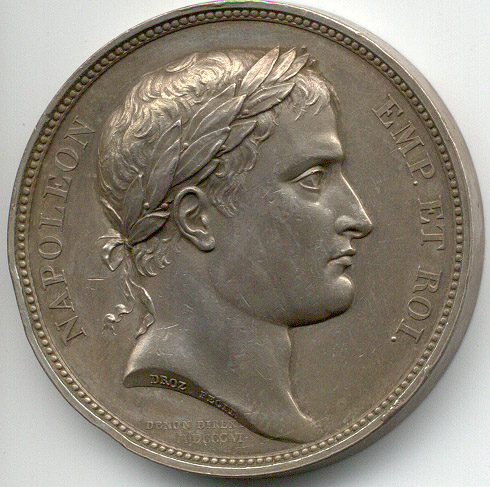
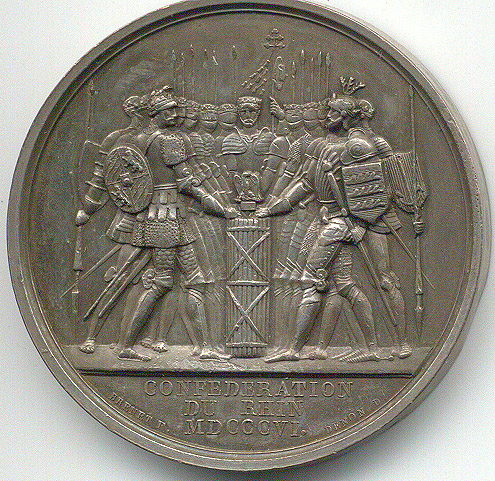
Standard obverse by Droz.
Reverse: A semicircle of warriors, their hands on a fasces.
Exergue: CONFEDERATION DU RHIN. MDCCCVI. BRENET F. DENON D.
The formation of the Confederation of the Rhine made King Friedrich
realize that Prussia was in danger. The hawks in his court finally
prevailed, and he issued an ultimatum to Napoleon: Get those French
troops out of the Rhineland. Napoleon gleefully announced to the
French people, "In accordance with the instructions of the Prussian
king our troops have left the Rhineland. They are marching on
Berlin."
The Prussians maneuvered to cut the French supply lines, which they imagined ran east to France. Napoleon was actually running his supply lines to the south. He swung his right wing forward and threatened the Prussian supply lines. The Battles of Jena and Auerstadt crushed the Prussian armies before their Russian allies could come to their support. Although the main part of the Prussian army was defeated by Marshal Davoust at Auerstadt, Napoleon's medals celebrate his own smaller victory at Jena.
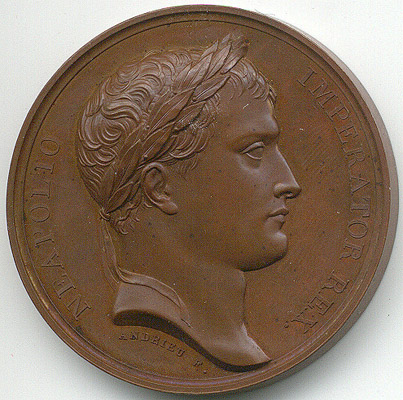
Obverse: NEAPOLIO IMPERATOR REX. Standard
bust by Andrieu.
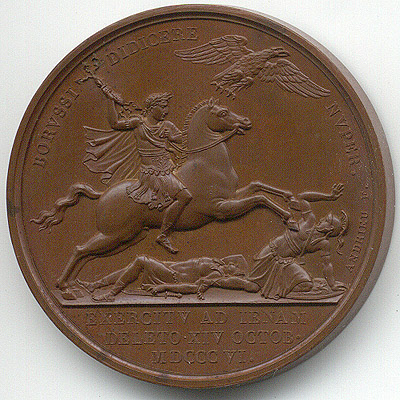
Reverse: BORUSSI DIDICERE NUPER.
The emperor on a horse prancing right, hurling a
thunderbolt at a falling enemy; beneath him corpses.
Signed ANDRIEU F. Exergue:
EXERCITU AD JENAM DELETO. XIV OCTOB. MDCCCVI.
The Latin inscriptions may be translated: NAPOLEON,
EMPEROR, KING; THE PRUSSIANS JUST LEARNED
A LESSON; THEIR ARMY WAS WIPED OUT AT JENA. Like Louis XIV,
Napoleon had a committee of learned men to design medals and
inscriptions for him. This is the one of the few of those
ever produced; the designs for the others can be seen in the
records left by the committee.
In addition to engraving the special die for this medal, Andrieu produce two obverse dies for the 40 mm. medals commemorating the Prussian campaign, with the inscription NAPOLEON EMP. ET ROI, Napoleon, Emperor [of the French] and King [of Italy].
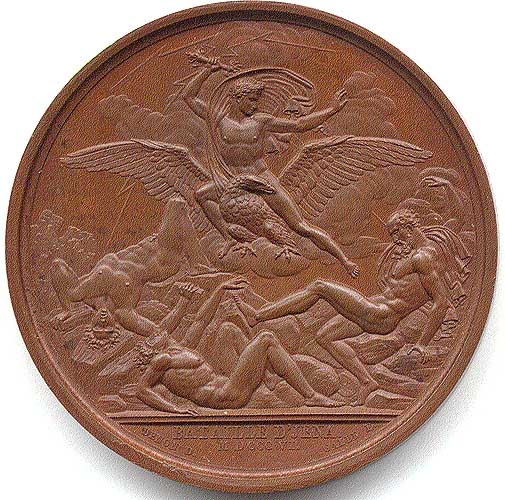
Standard obverse by Andrieu.
Reverse: The Emperor riding Jove's eagle, hurling a
thunderbolt at a falling man below. Two men already lie
dead amid rocks. Exergue: BATAILLE D`JENA. MDCCCVI.
DENON D. GALLE F.
Jupiter riding an eagle is a Roman motive, revived here in
accordance with the classical spirit of so many of these medals.
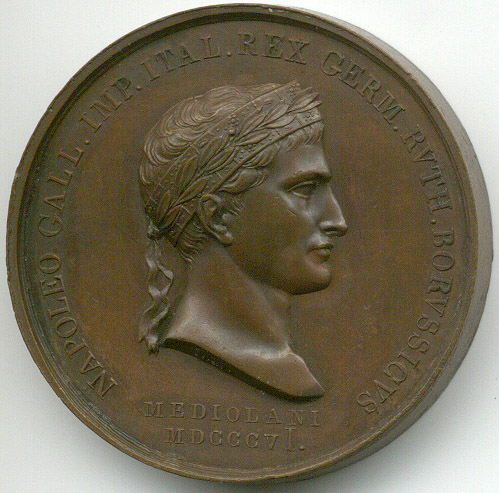
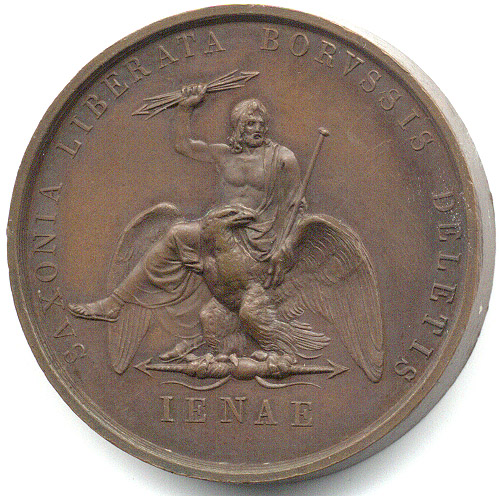
Obverse: NAPOLEO GALL. IMP. REX GERM. RVTH.
BORVSSICVS. Diademed and laureate bust right, signed
on the truncation L.M. In the field
below, MEDIOLANI, MDCCCVI.
Reverse: SAXONIA LIBERATA BORVSSIS
DELETIS IENAE. Jupiter riding an eagle, holding a scepter and
brandishing a thunderbolt.
The Latin inscription of the obverse concludes with honorifics
indicating that Napoleon had defeated the Germans, the Russians,
and the Prussians. The reverse is apparently Manfredini's
interpretation of the theme dictated by Denon; a comparison with
the previous medal indicates that the Milan mint was not as closely
controlled as the one in Paris. Perhaps the Paris version is a
better design.
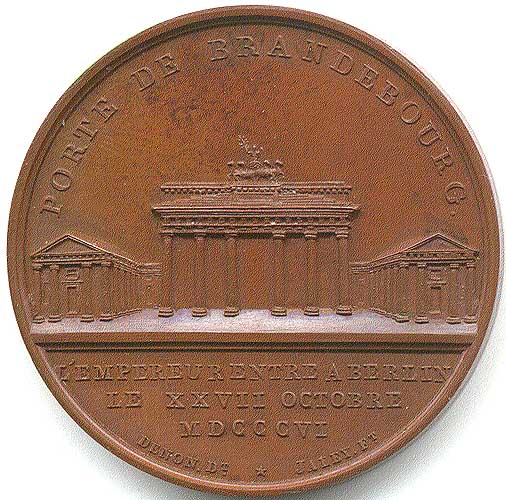
Standard obverse by Andrieu.
Reverse: THE BRANDENBURG GATE. The
famous eastern entry into 18th century Berlin.
Exergue: L`EMPEREUR ENTRE A BERLIN LE XXVII
OCTOBRE MDCCCVI. DENON Dt. * JALEY Ft.
Following the Battles of Jena and Auerstadt the Prussians fled in all directions, hotly pursued by the French. Berlin was abandoned to them and Napoleon entered in triumph. It was here that he issued the famous Berlin decree, banning British goods from his empire, declaring all products from British colonies subject to confiscation. (The Directorate had earlier banned the import of British goods, followed by the indignant official denials that the new robes for the legislative bodies were being made of British woolens.)
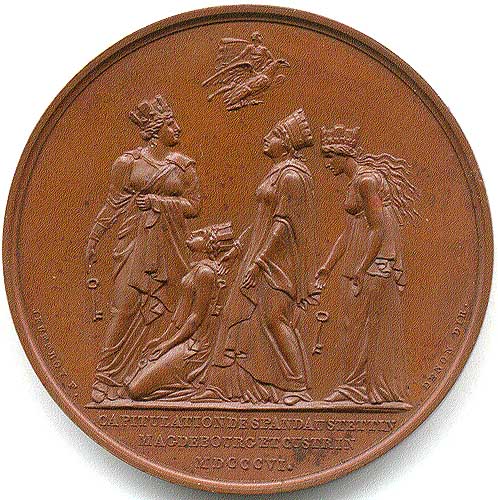
Standard obverse by Andrieu.
Reverse: Four women wearing civic crowns drop keys while
looking up at a sword-carrying man riding a
thunderbolt-bearing eagle. Signed in the field, JEUFFROY F. DENON
DIR. Exergue: CAPITULATION DE SPANDAU STETTIN MAGDEBURG ET CUSTRIN
MDCCCVI.
Denon's artist (Chaudet) had problems with the sketch for this
medal. Marx (Les medailleurs modernes) illustrates two preliminary
sketches for this reverse, showing changes in the positions of the
women, the size of the eagle, etc. I think that the design Denon
finally chose still leaves much to be desired.
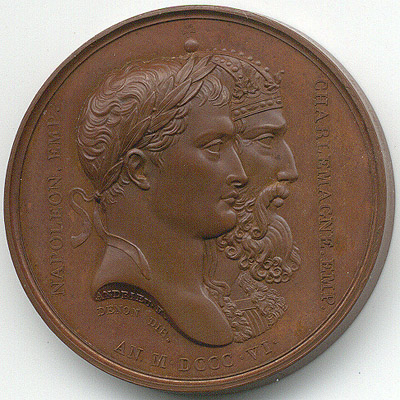
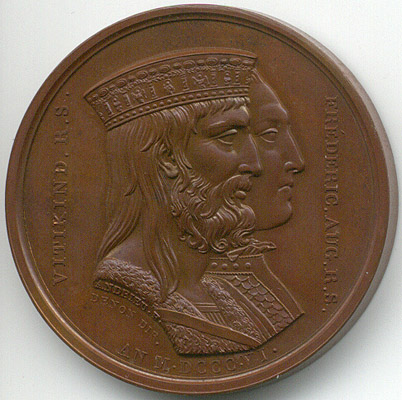
Obverse: NAPOLEON EMP. CHARLEMAGNE EMP. Accolate heads right, that
of Napoleon signed on the truncation, ANDRIEU F. In the field
below, DENON DIR. 1806.
Reverse: VITIKIND. R. S. FREDERIC. AUG. R. S.
Signatures as on the obverse.
In one of those historical parallels so loved by Napoleon, his
action in raising the present Elector of Saxony to the rank of king
is compared to Charlemagne's recognition of Witikind a thousand
years earlier. The action was designed to gain Saxon support for
France, separating Saxony from Prussia. The portraits of Charles
the Great and Witikind are, of course, imaginary. "On 11 December,
1806, the Elector of Saxony accepted the French alliance, entered
the Confederation of the Rhine, and received the title of King."
(Rose, The life of Napoleon, vol.2, p. 99)
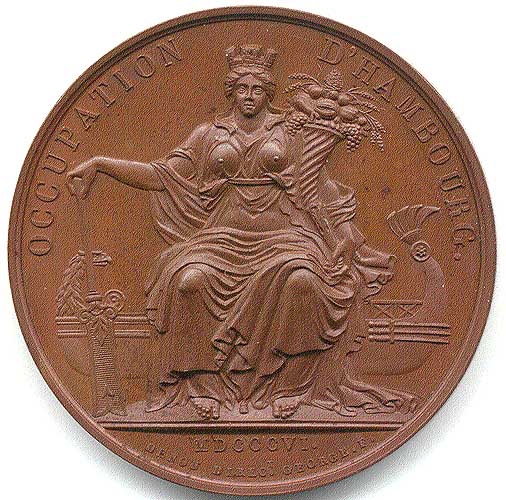
Standard obverse by Andrieu.
Reverse: OCCUPATION D'HAMBOURG. A seated woman full front,
a rudder in her right hand and a cornucopia in her left;
behind, a ship. Exergue: MDCCCVI. DENON DIRECT. GEORGE F.
The free city of Hamburg was one of the principal ports through
which British goods arrived on the continent, so it had to be
occupied by the French to put a stop to that pernicious traffic.
Napoleon gave his friend Bourrienne a chance to redeem himself by
putting him in charge of affairs in Hamburg; Bourrienne repaid him
by issuing licenses to smugglers and misappropriating funds.
Disgraced a second time, Bourrienne got his revenge years later by
publishing his imaginative memoirs, a mixture of truth and lies
ghost written by a couple of journalists which was rebutted by a
book titled Bourrienne et ses Erreurs volontaires.
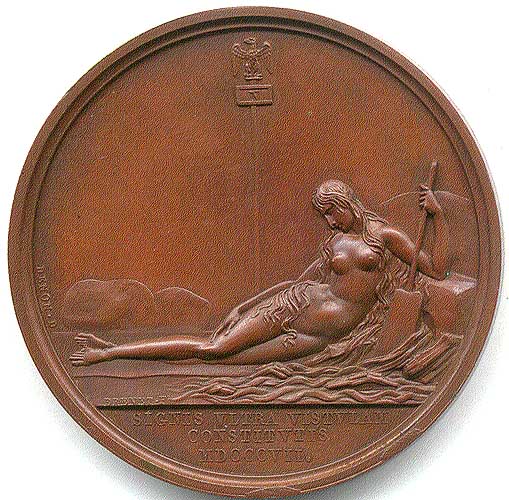
Standard obverse by Andrieu.
Reverse: A nude river goddess despondently reclining on a rocky
river bank and holding a ship's rudder, behind and above her a
French eagle standard. Signed in the margin of the field at the
left, DENON D.; above the exergual line on
the left, BRENET F. Exergue: SIGNIS VLTRA VISTVLAM CONSTITVTIS MDCCCVII.
The drawing of the figure is quite poor, suggesting a Petty or
Varga girl or a Barbie with her impossible anatomy. The date is
a year off, as is shown by Napoleon's proclamation to the army,
2 December 1806 (Corres. 11352):
"Soldiers! It was a year ago today, at this very hour, that you
were on the memorable field of Austerlitz; the Russian
battalions, terror-stricken, fled in disorder or, surrounded,
gave up their arms to their conquerors. The next day they spoke
words of peace, but they were deceitful; when they had hardly
escaped from the disasters of the Third Coalition, the result
of a generosity which was perhaps culpable, they were plotting
the Fourth. But the ally upon whom they based their principal
hope no longer exists. Their strongholds, their capitals, their
magazines, their arsenals, two hundred eighty standards, seven
hundred battle pieces, five great fortresses are in our power.
The Oder, the Warta, the deserts of Poland, the bad weather of
the season have not been able to stop us for a moment. You have
braved everything, surmounted everything; all fled at your
approach. In vain the Russians have wanted to defend the
capital of this ancient and illustrious Poland; the French
eagle flies upon the Vistula."
Note: Six years later a brief note in the "Mercure de France" stated, "The Emperor left Saint Cloud on the 9th of May, crossed the Rhine on the 13th, the Elbe on the 29th, and the Vistula on the 6th of June." The Russian campaign was beginning. In 1806, however, Napoleon needed a Russian alliance, so he delayed crossing the Vistula for the present.
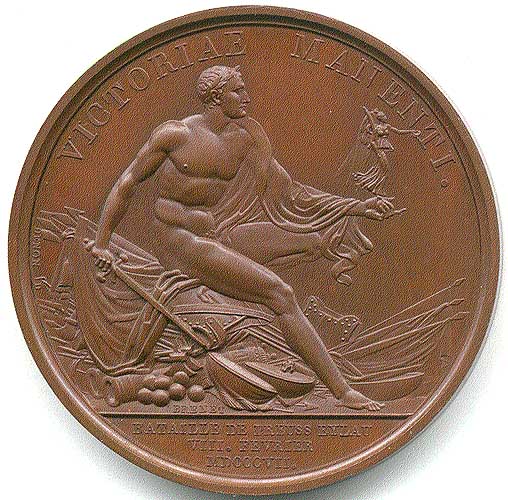
Standard obverse by Andrieu.
Reverse: VICTORIAE MANENTI. A heroic
nude seated on a pile of battle spoils, a sword in his right hand
and a Victory in his left. In the left field,
DENON D.; beneath the trophies,
BRENET. Exergue: BATAILLE
DE PREUSS EYLAU VIII. FEVRIER MDCCCVII.
The Battle of Eylau was another in which both sides lost, although
both sides claimed the victory and issued medals to prove it. It
was fought in a blizzard in mid-winter after both armies had
settled down to wait for spring but had been awakened from their
hibernation when Napoleon's Marshal Ney extended his men northward
in an attempt against Koenigsberg (Kaliningrad), where the Prussian
king had taken refuge. Bennigsen's Russians tried to break through
the weakened French lines to relieve besieged Danzig (Gdansk),
leading to the struggle for Eylau between two armies of seventy
five thousand men. Casualties on each side amounted to twenty five
thousand, counting dead, wounded, and stragglers.
Napoleon went all out to prove he had won the battle:
"Three plates giving a clear idea of the Battle of Eylau must be sent to the War Department in Paris. See to it that within three days these three plates are etched and spread through Paris. You can also order that a pamphlet be made up of the bulletins which describe that battle and the account of it by a French officer, with these three plates. You will send it to Milan, to Prince Eugene, who will have it translated into Italian, and to the king of Holland [Napoleon's brother Louis], who will have it translated into Dutch." Corres. 12160, 25 March 1807
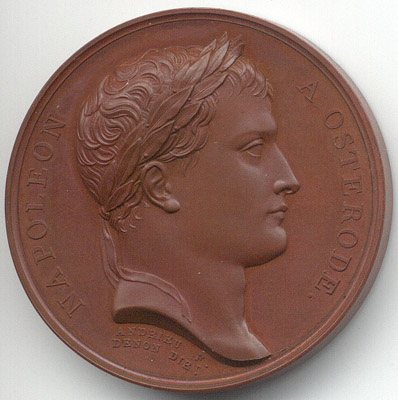
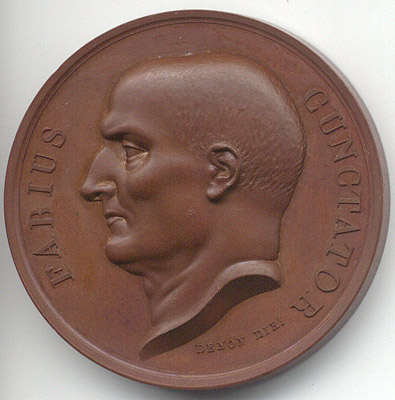
Obverse: NAPOLEON AT OSTERODE. Standard bust
by Andrieu.
Reverse: FABIUS CUNCTATOR. Bust left.
In field below, DENON D.
After the Battle of Eylau both armies spent considerable time
licking their wounds; Denon characterized this time by comparing
Napoleon's inaction to that of the Roman dictator, Fabius the
delayer (drawn by Jouannin), who defeated Hannibal by using
delaying tactics. But Napoleon was quite active at this period,
negotiating with the Sultan of Turkey and the Shah of Persia, as
well as shacking up with the wife of Count Walewska, by whom he
later had a son. To Josephine, who knew what was going on and
begged in vain to be allowed to come join him, he wrote, "You must
allow me my fancies."
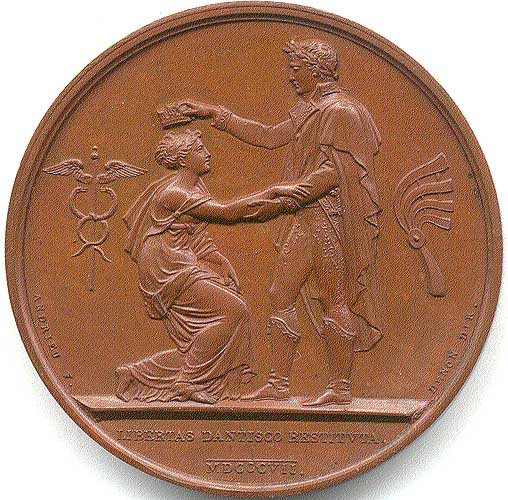
Standard obverse by Andrieu.
Reverse: The robed, laureate Emperor places a civic crown on the
head of a kneeling woman; behind her is a caduceus and behind him
an akrostolion. Signed in the field, ANDRIEU F.
and DENON DIR. Exergue: LIBERTAS
DANTISCO RESTITUTA. MDCCCVII.
The meaning of the reverse, drawn by Meynier, is clear. The snaky
winged staff of Mercury represents commerce here, although Mercury
is also the patron god of thieves and the AMA. The akrostolion is
the ornament placed on the stem of an ancient Greek ship, thus
symbolizes sea trade.
The capitulation of Danzig, which took place on May 24th, was
announced in Paris by the firing of cannon on June 5th and a notice
in "Le Moniteur" of that day. A couple of weeks later "Le Moniteur"
published an article supposedly reprinted from the British press:
"The taking of Danzig, which had been doubted at first but
which is unfortunately only too true, has brought new delays to
our great expedition. Most of the ministers and generals lean
toward an attack on Holland. Whatever the destination of this
army may be, it will be commanded by Lord Cathcart, famous for
his numerous defeats in Brabant and Holland in the years 1794
and 95." "Le Moniteur", 17 June 1807
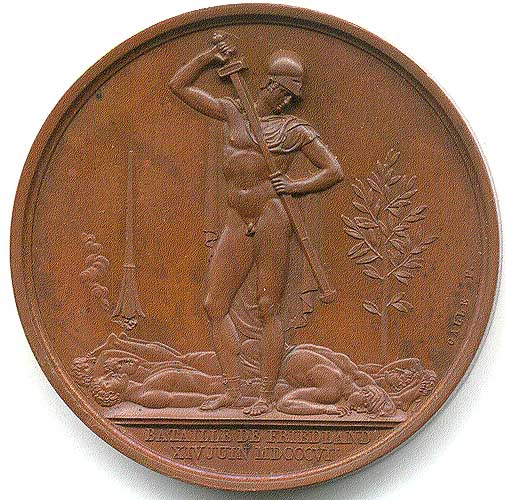
Standard obverse by Andrieu.
Reverse: A standing nude warrior sheathes his sword. Corpses are
stacked up behind him; on the right is an olive tree, on the left
an extinguished torch, inverted and still smoking.
Signed in the right field, GALLE F. Exergue:
BATAILLE DE FRIEDLAND XIV JUIN MDCCCVII.
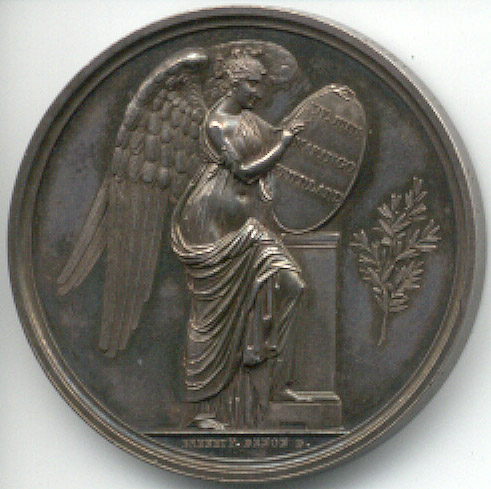
Standard obverse by Andrieu.
Reverse: A winged victory inscribing a shield:
XIV. JUIN MARINGO FRIEDLAND. In the right field, a laurel
branch.
Exergue: BRENET F. DENON D.
Just as the Battle of Marengo ended the second Italian campaign, so
the Battle of Friedland ended the Prussian campaign. Napoleon's
General Lannes was pursuing the Russian army with a twenty five
thousand man force; the Russians turned and crossed the River Alle
to attack him. Lannes fought doggedly and kept the Russians engaged
until Napoleon could bring up overpowering reinforcements. The
Russians were trapped on the wrong side of the river and
slaughtered. This strategic victory gave Napoleon the opportunity
to settle affairs with Prussia and led to his alliance with Russia.
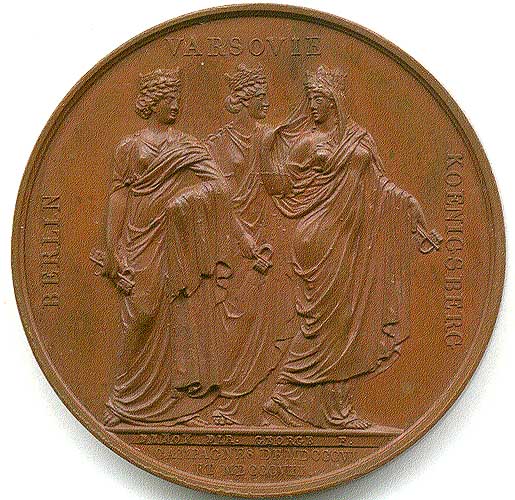
Standard obverse by Andrieu.
Reverse: BERLIN WARSAW KOENIGSBERG.
Three standing women wearing civic crowns, each holding a key in
her hand. Signed DENON DIR. GEORGE F.
Exergue: CAMPAGNES DE MDCCCVI ET MDCCCVII.
The design of this reverse is related to that of Bramsen 548,
above. Berlin was the capital of Friedrich as Elector of
Brandenburg, Koenigsberg as King of Prussia, and Warsaw as ruler of
the Prussian part of Poland.
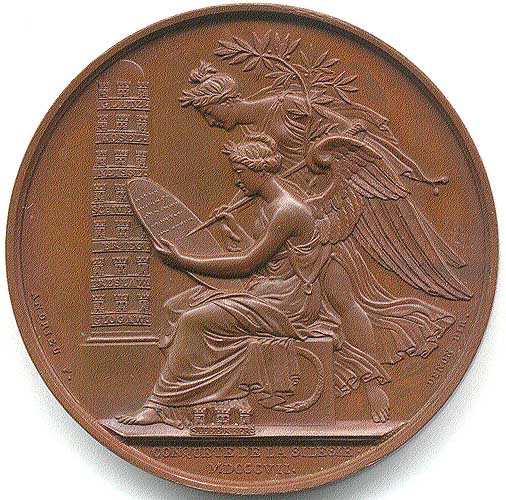
Standard obverse by Andrieu.
Reverse: Victory, seated left, writes on a shield. Peace,
behind her, stops her from writing. Behind, on the left,
is a tower made up of civic crowns labelled GLATZ, KOSEL,
NEISSE, SCHWEIDNITZ, BRIEG, GLOGAU. On the ground lies an eighth
crown, SILBERBERG.
Exergue: CONQUEST OF SILESIA MMMDCCCVII.
The reverse was drawn by Meynier. The cities are those conquered by
the French in the Prussian part of Silesia. Peace is stopping
Victory from writing until Silberberg can be added to the tower.
This seems to be a new twist on the Victory-writing-on-a-shield
type of classical times.
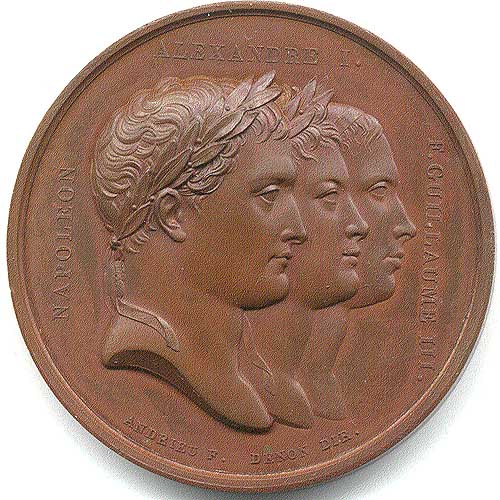
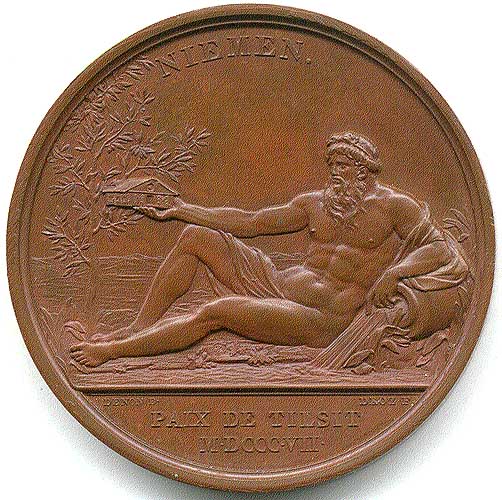
Obverse: NAPOLEON ALEXANDER I WILHELM III,
the right-facing superimposed profiles of the three rulers.
Reverse: A reclining river god, holding in his out-stretched right
hand a building on a raft, his urn labelled NIEMEN.
Exergue: PAIX DE TILSIT M.DCCC.VII. signed by
DROZ and DENON.
In a magnificent stage setting, Napoleon had a tent erected on a
raft floating in the Niemen River, where the two emperors met in
private. The French army was on the left bank, the Russian on the
right. No authentic account is possible of what the two emperors
said to each other, but Napoleon wrote to Josephine about his
meeting with the emperor of Russia:
"I have met the Emperor Alexander; I am very satisfied with him;
he is a very handsome, good, and young emperor; he has more
spirit than is commonly thought." Corres. 12825
The editors of the official publication of Napoleon's letters were
careful to censor everything which might be found objectionable.
Herold, in his Age of Napoleon, restored part of the quoted
sentence: "and he must be satisfied with me. If he were a woman, I
think I would make him my mistress."
The agreement reached between Napoleon and Alexander at Tilsit was
to have far-reaching consequences. France and Russia became allies
against Great Britain, and Prussia was reduced to a second-rate
power by taking half her territory and population from her. The
following two medals will show two results of the spoliation of
Prussia. Other results of the agreement were that Russia occupied
Finland and recognized France's right to Sicily and various other
lands.
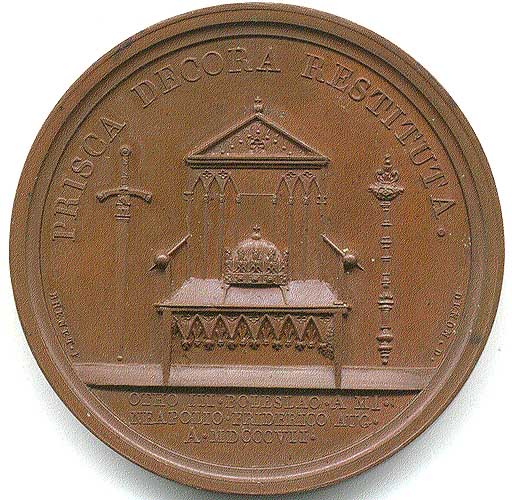
Standard obverse by Andrieu.
Reverse: PRISCA DECORA RESTITUTA. A
throne on which rests a crown; in left field a sword, in the right
a scepter. Signed BRENET and DENON.
Exergue: OTTO III. BOLESLAO. AMI. NEAPOLEO. FRIDERICO
AUG. A. MDCCCVII.
Again Denon has recourse to trappings from the theater to
illustrate an event. The Polish lands taken from Prussia were made
into the Duchy of Warsaw and given to Friedrich Augustus of Saxony,
the comparison being made to a donation centuries earlier by the
then emperor of Germany to the Saxon ruler of that time.
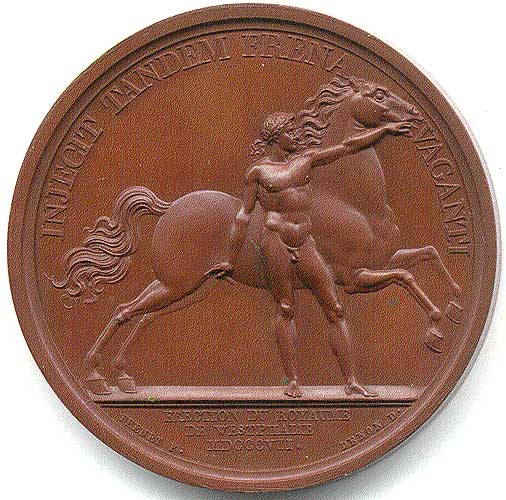
Standard obverse by Andrieu.
Reverse: INJECIT TANDEM FRENA VAGANTI.
A nude male stopping a free-running horse.
Exergue: ERECTION DU ROYAUME DE WESTPHALIA MDCCCVII.
Signed BRENET and DENON.
A French catalog compares the type to the Monte Cavallo statues in
Rome, but I don't see much resemblance. The wild horse was often
used on the coins of Hannover and Braunschweig. Hannover and the
western part of Prussia were made into a kingdom for Napoleon's
younger brother, Jerome. Napoleon married Jerome to Catherine,
daughter of the King of Wurtemberg. Bramsen 661 (not illustrated)
is apparently a rejected design to celebrate that wedding; it is a
copy of Bramsen 522 (the marriage of the prince of Baden to
Stephanie Beauharnais) with the names changed. The following medal
replaced it.

Standard obverse by Andrieu.
Reverse: Two putti, one with a quiver, standing by a basket of
roses and handing one to the other, seated, weaving a garland
of roses, behind him a torch. On the exergual
bar, ANDRIEU F. and DENON D.
Exergue: J. NAPOLEON C. DE WURTEMBERG.
The letter N in a glory. MDCCCVII.
The rather pleasant design for this medal was created by Prudhon,
to be engraved by Andrieu. Cupid is identified by his quiver; the
other putto represents Hymen, the nuptial god, identified by the
torch, symbol of weddings at least since Roman times.
Jerome already had one life behind him. Napoleon had planned to
make him an admiral. After training as a midshipman Jerome had
sailed to the West Indies as an officer on a French warship. The
British navy was active in the area of the French colonies and the
ship had retreated to New York, where Jerome jumped ship. Welcomed
by Baltimore society, Jerome fell in love with Elizabeth Patterson,
the heiress of a wealthy merchant there, and married her. The
couple made the obligatory trip to Niagara Falls, while the French
consul sent the news to the First Consul in France. Bonaparte was
furious. He sent a warship from the French West Indies to retrieve
Jerome, but it was captured by the British. Orders were issued to
every port in Europe under French control that if the couple should
turn up there Miss Patterson must not be allowed to disembark;
Jerome was to be sent directly to Paris. Consequently, when Jerome
and his pregnant wife attempted to land in Lisbon (April 1805)
Betsy had to remain on the ship and took refuge in England. Jerome
became an officer in Napoleon's army, docilely accepted the
annulment of his marriage, and was rewarded with the Kingdom of
Westfalia and the daughter of the King of Wurtemberg. Elizabeth
Patterson Bonaparte gave birth to a son in England and then
returned to Baltimore. This son, Jerome Napoleon Bonaparte, had two
sons by his American wife, the younger of which was Secretary of
State under Theodore Roosevelt and later Attorney General. The
American line of Bonapartes is now extinct.
| previous | index | next |
|---|