

With the plots to assassinate Bonaparte foiled and the French army
under General Moreau, which had been victorious at the Battle of
Hohenlinden (2 December 1800) and had liberated Bavaria, prepared to
invade Austria, the Austrians were ready to talk peace. Negotiations
at the French city of Luneville reached a satisfactory conclusion.
The Austrians agreed to recognize the Cisalpine, Ligurian, Helvetic,
and Batavian Republics and the terms of the Treaty of Campo Formio
were reaffirmed, giving France the left bank of the Rhine.
Obverse:BONAPARTE, PREMIER CONSUL, GENERAL A MARENGO.
Bare-headed bust l.
Reverse: LA FRANCE VICTORIEUSE. A helmeted woman offers olive
branches of peace to the river gods of the Rhine, the Danube, the Po,
and the Tiber. Behind her is a palm tree.
Exergue: PAIX CONTINENTALE A LUNEVILLE. Signed in ex., DUV[ivier].
The helmeted woman on the reverse is shown to be France by the cock behind her. The palm tree in the background is the date palm, characteristic of Egypt and perhaps a subtle reference to Napoleon's campaign there. Duvivier himself drew the sketches for his medals and refused to make dies from someone else's drawings; probably that is why, later on, Denon didn't give him many commissions. Bramsen, following the Tresor numismatique, states that although Duvivier cut the dies for this medal during the consulate, the medal was not produced at the French Mint before 1830. That statement is incorrect. This medal is illustrated and described in Millin's catalog, which was published in 1819, although this plain-edged example may have been struck after 1830.


Obverse: BONAPARTE PREMIER CONSUL DE LA REPUBLIC FRAN.
Uniformed bust right, signed ANDRIEU F.
Reverse: PAIX DE LUNEVILLE. A conventional
draped woman, probably intended to represent Peace, holding a
cornucopia and an olive branch, signed ANDRIEU F.
Exergue: 20 PLUVIOSE AN 9.


Obverse: BONAPARTE, PR. CONSUL DE LA REP. FRAN. J.P. Droz signed and
dated his portrait of Bonaparte, which was struck in impressively
high relief.
Reverse: BONHEUR AU CONTINENT. The sun is shining on the
continent but there is a storm over the British Isles. Exergue:
PEACE OF LUNEVILLE, YEAR 9, 1801.


Obverse: SPEM BONAM CERTAMQUE DOMUM REPORTO. HOR.
A standing, winged Mercury, caduceus in his left hand, presents a tablet
inscribed COS ITAL to a seated, draped Roman matron.
Behind her a putto seated on the ground plays with a pair of scales.
Signed on the exergual bar, L.M.F. (Luigi Manfredini
fecit). Exergue: COMIZI CISALP. IN LIONE ANNO 10.
Reverse: VOTI PVBLICI PER LA PROSPERITA ETERNA PER LA REPVBBLICA
ITALICA ASSICVRATA COLLA COSTITVZIONE AVSPICE BONAPARTE. (A variety of
this medal, Bramsen 190, substitutes CISALPINA for
ITALICA.)
In the treaty of Luneville Austria relinquished her claims to north Italy; France agreed that Italy would remain an independent country. Bonaparte found nothing in this incompatible with his assuming the presidency of his erstwhile Cisalpine Republic. The stage-dressing was done by assembling a group of 250 Italian delegates in Lyon, France (Paris would have made it too obvious) and having them adopt a new name, the Italian Republic; a new constitution, written by Roederer for Bonaparte; and a first president, Bonaparte. As Rose remarks, the name Italy again appeared on the map of Europe for the first time since the middle ages, and five states were united in a preview of modern Italy, although it did not survive the fall of Napoleon.
Not only was England now the only country at war with France; the Armed Neutrality League was contesting Great Britain's rule of the sea. A British fleet headed toward the Baltic to destroy the Russian fleet. Denmark, watchdog of the Baltic, had first to be overcome. Nelson was second in command, but he disobeyed Admiral Parker's order to disengage, obeying a higher law. A medal produced by Loos in Germany commemorated the event but gives a false impression of the outcome.
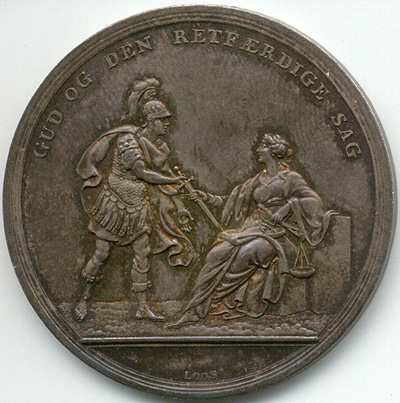

Obverse: "God and the just cause" in Danish. Justice, seated, hands a
sword to a standing warrior. Exergue: Loos.
Reverse: "The superior force of the enemy repulsed." Exergue:
Copenhagen, 2 April 1801.
Sweden did not send the promised help and the Russian fleet was still ice-bound at Saint Petersburg. The Danes were forced to sue for peace. While the victorious Nelson was discussing peace terms, the news arrived that Paul of Russia had been assassinated. The northern coalition collapsed. (I thank Numismatics International members Tyge Sondergaard and Lars Brix for the information they kindly sent me about this medal.)
In spite of this victory the British felt obliged to come to terms with revolutionary France; their main ally, Austria, had made peace with France, and British trade had suffered during the years of war.


After considerable negotiations, which were held in England, a peace treaty was signed at Amiens, in France.
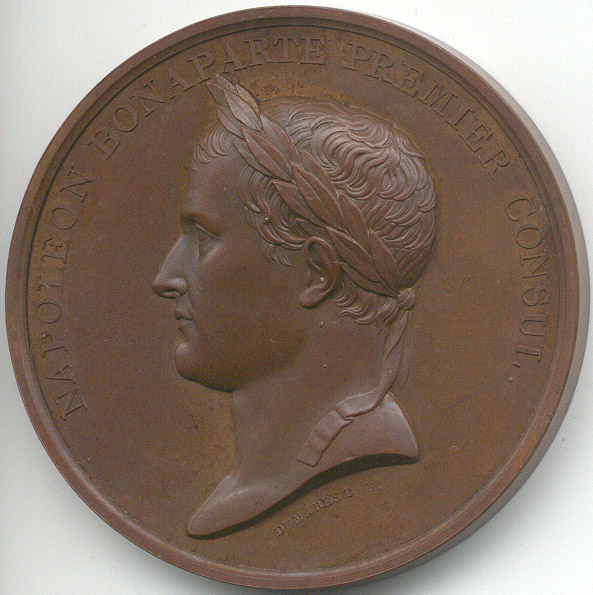

Obverse: NAPOLEON BONAPARTE PREMIER CONSUL.
Laureate bust r., signed DUMAREST.
Reverse: PAIX D'AMIENS. A standing, helmeted
warrior holds a victory in his left hand and offers an olive branch
to a half-dressed female reclining on a lion. Exergue: VI
GERMINAL AN X, 27 March 1802.
Again we have a medallist's copy of the head of the statue by Chaudet,
this time Dumarest did it. The reclining semi-nude on the reverse is
identified as England by the presence of her lion; presumably the
warrior handing her an olive branch is the first consul. As can be
seen from this medal, Dumarest was a skillful engraver. Unfortunately,
he died a few years later, leaving too few proofs of his talent.


Obverse: NAP. AL. BONAPARTE. P.P. COMSVL.PRIMVS. (Napoleon Alexander Bonaparte, Father of the Fatherland, First Consul) Uniformed bust right. Signed on truncation, M. BUCKLE F.
Reverse: HOHENLINDEN. MARENGO. Victory flying right, carrying an olive branch and wreath. Exergue: LVNAEVILLAE.AN IX. 1801/AMBIANI.AN.X. 1802./PACE.TERRA/MARIQVE./DATA.


Obverse: BONAPARTE PR. CONSUL DE LA REP. FRAN.
Bust l., signed on the truncation, DROZ.
Reverse: RETOUR D'ASTREE. The goddess of Justice
returning to earth, carrying the scales of justice in one hand and an
olive branch and small caduceus in the other. On the edge is an
inscription: PAIX GENERAL A AMIENS AN 10, 1802.
Droz, Swiss-born, was both artist and mechanic. He drew the sketches
from which he created the dies and he designed the press which was
used to strike this medal, using a five-part collar to form the edge
at the same time that the obverse and reverse were struck. After
working in France, Droz had worked at the Soho plant for Boulton and
Watts. Apparently they hired him only to get the secrets of his press
from him; he returned to France after winning a lawsuit against them
for breaking their contract. Later he toyed with the idea of becoming
director of the U.S. Mint but, to our country's loss, decided to
remain in France. He did sell us two coining presses, but the
incompetents running our mint couldn't produce properly tempered dies
and consequently modified the presses to reduce the power so as not to
break their inferior dies (Taxay, History of the US Mint but Robert Julian
told me he could find no authority for Taxay's statements).


Obverse: BONAPARTE PREMIER CONSUL CAMBACERES DEUXIEME CONSUL LEBRUN
TROISIEME CONSUL. The busts of the three consuls, signed in the field
below, JEUFFROY.
Reverse: LE CORPS LEGISLATIF AUX CONSULS DE LA
REPUBLIQUE FRANCAISE. In the field: PAIX INTERIEURE,
PAIX EXTERIEURE. ARRETE DU 30 FLOR�AL AN X 20 MAI MDCCCII.


Obverse; NAPOLEON BONAPARTE PREMIER CONSUL.
Bare-headed bust r., signed ANDRIEU FECIT on
truncation.
Reverse: RETABLISSEMENT DU CULTE.
A standing woman offers her hand to raise an elderly seated woman.
Background details include the Paris Cathedral of Notre Dame on the
left and a ruined church on the right. A trophy in the center rear is
surmounted by the French rooster. Beneath the scene is the date on
which the Concordat was signed between France and the Papal
government, 8 April 1802.
Catholicism became the official religion of France, with its priests
salaried by the government; the confiscation of church property by the
revolutionaries was accepted; while the Pope was recognized as supreme
in spiritual matters, France would control temporal matters affecting
the church. Those priests who had been persecuted for refusing to
accept the revolutionary government were pardoned.


Obverse: Bareheaded bust of Bonaparte r., signed ANDRIEU.
Reverse: A toga-clad young man seated on a cube is reading a scroll. At his feet
is a container with rolled scrolls. There is a star above his head and
a palm branch to his left.
This head of Bonaparte by Andrieu resembles that on Bramsen 213 but
has slight differences. Mechanical processes for multiplying a hub or
die in different sizes were not yet in use during the Napoleonic
period, so a new hub or die had to be cut for each different size. The
reverse is an example of the neoclasicism of the period. The star and
palm frond are unnecessary, ambiguous symbols.
One of Napoleon's claims to fame is his establishment of a uniform
public education in France. It is perhaps true that his idea of
education does not meet modern standards, but it is also probably true
that any education is better than none. "Until one learns from infancy
whether it is necessary to be republican or monarchist, Catholic or
atheist, etc., the State will not form a nation; it will rest on
uncertain and vague foundations; it will be constantly exposed to
disorders and changes." (Correspondence 8328, 16 February 1805.)


Obverse: NAPOLEON EMP. ET ROI. Laureate bust r.
signed GAYARD F.
Reverse: An eagle in flight, carrying a palm leaf; below,
UNIVERSITE IMPERIALE.
This small medal, perhaps intended as a prize medal or jeton de
presence, represents Napoleon's University, not a university as we
understand it but rather the totality of all instruction in the
country. The national educational system had been abolished by the
Convention, 15 September 1793. A defender of the system, asked what
the system accomplished, replied that they had published a book. The
Convention decided that one book did not justify the cost of the
system. Napoleon intended higher education to be managed the same way
the army was, with courses of study dictated and limited to what he
considered practical. Above all, patriotism and obedience to authority
were to be taught. The University of France was sketched by a law of
1802 supplemented in 1806; it was created by an imperial decree of 17
March 1808.
As for women, look at the schools he set up for female orphans of war veterans a few years later:
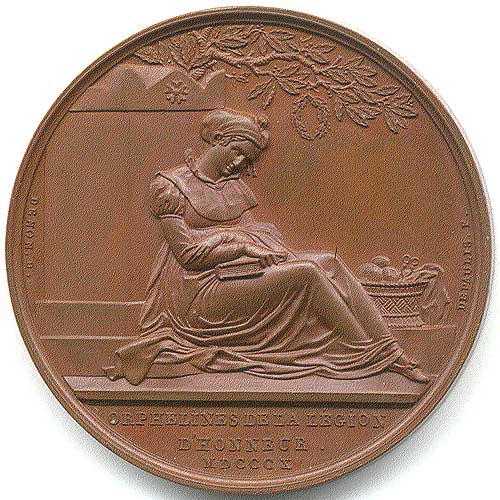
Obverse: NAPOLEON EMP. ET ROI. Laureate bust r.,
signed by Andrieu.
Reverse: A mourning girl, seated by a tree-shaded tomb, a book in her
lap and a sewing basket beside her, signed DEPAULIS F. DENON D.
Exergue: ORPHELINES DE LA LEGION D'HONNEUR 1810.
Napoleon's ideas about the proper education for girls were expressed
in a letter to General Duroc:
"The relatives should not be able to send a cent to their girls,
and the strictest equality should exist among them. The beginning
should be limited to teaching them to write well. In the general
rules it will be determined how much drawing they should be taught.
What I recommend principally to you is religion... It is necessary
that the pupils attend mass every day and go to say their prayers
together before going to bed... As for literature, it is also
necessary to go very softly, starting from the principle that the
first consideration is morals. But, provisionally, they can be
shown the French language and that part of rhetoric which does not
awaken the imagination of young people." (Correspondence 13284,
22 October 1807)
One wonders what part of rhetoric awakened the imagination of young
Napoleon.


Obverse: The Emperor Napoleon, seated left on his throne, holding a
laurel wreath in his right hand. Exergue: E. GATTEAUX.
ROME. 1812.
Reverse: ECOLE FRANCAISE DES BEAUX ARTS A ROME RETABLIE
ET AUGMENTEE PAR NAPOLEON EN 1803. Head of Athena l., wearing a
Corinthian helmet, in a laurel wreath surrounded by instruments of the arts: a
painter's palette, an architect's drawing tools, a lyre, engraving
tools for prints and medals, a sculptor's chisel and mallet.
The fellowships to the Royal School in Rome given by the French kings were for
painting, sculpture, or architecture; Napoleon added music, and
engraving of copper plates and medal dies. The Gatteaux who engraved
the dies for this medal was the son of the Gatteaux who did several of
the medals in the Napoleonic series. Fellmann states that this
medal was not struck until May, 1814, during the first restoration of
Louis XVIII; sales of it (and the other Napoleonic medals) were halted
after the second restoration, not to be resumed until after the
Revolution of 1830.

Standard obverse by Andrieu.
Reverse: ECOLES DE MEDECINE. Esculapius,
god of healing, leaning on his staff, around which a snake is wrapped
(for some reason the AMA has chosen as its symbol the rod of Hermes,
with two snakes. Hermes was the patron god of commerce and of
thieves). The small figure represents Esculapius' son, Telesphorus.
Signed in the exergue, DENON DIREX. JOUANNIN
(fecit).
The existing schools of medicine had to be organized, but I have found
no information on what that entailed.


The obverse shows a chemist's retort, surrounded by medicinal plants
and minerals.
The reverse is a simple wreath, suggesting that this
medal was intended to be used as a prize medal, with space left for
inscribing it to a recipient.
Six schools of pharmacy were established, in Paris, Montpellier,
Strasburg, and three other cities where schools of medicine had already
been established. These schools not only taught pharmacy but also
regulated the profession:
"Article XXVI. Every individual who shall have a pharmacy now open
without being able to prove the legal title which gives him the
right will be required to present himself within three months,
counting from the establishment of the schools of pharmacy or the
juries, to one of these schools or to one of these juries to take
his examination and to be accepted." ("Le Moniteur", 2 April 1803)

Standard obverse by Andrieu.
Reverse: Standing, togate Esculapius, a serpent-wrapped club in his right, his left arm around a woman resembling the Venus de Medici, her left arm bandaged. In the left field is a cow, and in the right a lancet and ampule. Exergue: VACCINATION, 1804. Signed ANDRIEU F. DENON DIR.
Vaccination was introduced into France from England in Napoleonic times. Today, with smallpox apparently eradicated, it is hard to understand what a blessing to mankind Jenner's discovery of vaccination was. The production of this medal, struck to commemorate the French commission to promote vaccination, shows its importance.

Standard obverse by Andrieu.
Reverse: The personified mountain seated among craigs, clouds
about his head. To the left below, two tiny miners are working.
Signed on the exergual bar, BRENET, DENON DIR.
Exergue: ECOLE DES MINES DU MONT BLANC.
Although Babelon considered this an inspired work, the idea of
picturing a mountain as a man had been used many times before. There
was a colossal statue of the Appenines as a man at Francesco de'
Medici's palace at Fontebuona (said to be by Giovanni di Bologna) and
another (by Ammanato) at the Castello di Quarto. (Murray's Handbook of
North Italy, 1847.) Millin says that Denon drew his design from the
former example. The Mont Blanc School of Mining was established by a
consular decree of 12 February 1802 ("Le Moniteur", 14 February 1802),
but this medal was not produced until four years later ("Le Moniteur",
4 March 1806).


Obverse: Bare-headed bust of Bonaparte r. signed Jeuffroy. Reverse: AUX ARTS LA VICTOIRE, the Medici Venus.
The almost completely different portrait of the first consul we see here was done by Jeuffroy. The statue of Venus on the reverse was acquired by treaty from Ferdinand, King of the Two Sicilies. The legend might be translated "The arts are the winner." but a more appropriate legend might be "To the victors belong the spoils." After the exile of Napoleon to Saint Helena, the French were forced to return this statue to Italy; a few years later the loss was repaired by the acquisition of the Venus de Milo. According to tradition this medal was prepared by Denon for presentation to the first consul on the occasion of his first official visit to the Napoleon Museum. The following medals perhaps marked the re-opening of the museum:


These two medals share a common obverse, one of Andrieu's standard heads of
Napoleon. A third medal, Bramsen 373, consists of the reverses of
these two. Further, Andrieu was paid for making new dies when the
first set broke; the old dies were for 31mm medals (Bramsen 371, 368,
374 respectively).
These medals celebrate the acquisition of the art treasures sent to
Paris by Napoleon, which resulted in changing the name from the
National Museum to the Napoleon Museum. For years favored artists had
been given lodgings in the Louvre; they were evicted and the building
enlarged and renovated to offer a splendid, although temporary, home
to these new treasures. The Apollo Belvedere and the Laocoon, from the
Vatican, were the prime attractions of these two galleries. Reichardt
(A Winter in Paris) quotes the label of the Apollo:
"The statue of Apollo which is elevated on this pedestal was found
at Anzio at the end of the fifteenth century, placed in the Vatican
by Julius II at the beginning of the sixteenth, conquered in the
fifth year of the Republic by the Army in Italy, and placed here by
order of General Bonaparte on the twenty first of Germinal, year
VIII, the first anniversary of his consulship."


Obverse: The bare-headed First Consul, here bearing a striking
resemblance to the Roman Emperor Augustus on some of his coins.
Reverse: A LA FORTUNE CONSERVATRICE. A woman seated
in a sailing vessel and managing the sail and rudder is identified by the
dedicatory inscription, "To Fortune the Protectress." Under it on the
medal may be seen traces of an erased inscription, FORTUNAE
MANENTI, while beneath the YEAR 4 OF BONAPARTE
are remains of DENON DIREXIT.
The change of the inscription from Latin to French was in accord with
Napoleon's desire that the man in the street could read his medals;
the removal of Denon's name is curious. Perhaps Denon realized how
poor this medal really is and did not want his name associated with
it. The drawing for the reverse of this medal, by Chaudet, is
illustrated in Roger Marx' Les Medailleurs Modernes, Paris: Henri
Laurens, ca 1900, from which can be seen how faithfully the medallists
followed the designs they were given. Marx said, "The medallist no
longer created his own models; he appealed to a sculptor like Chaudet,
to an architect like Percier; his role was that of an impersonal
interpreter of the thought of another." (The best engravers, like Duvivier,
Dumarest, and others, were quite capable of inventing their own designs.)
Millin remarked that this medal was struck during the preparations for
the invasion of England, from which some authors have named it,
"Negotiations with England", but that title hardly seems to fit the
picture. The date (Bonaparte's fourth year as First Consul began on 22
September, 1802) does not suggest an explanation. Scargill describes
this medal as celebrating the escape of Bonaparte from the assasination
attempt of 3 nivose an viii.

The obverse is the standard head of Napoleon Bonaparte by Andrieu, but
without inscription.
Reverse: GALLIA RENOVATA SUB AUSPICE NEAPOLEONE.
The decoration of the order. DENON DIRECTED, JALEY MADE IT.
The first article of the law creating the Legion of Honor: "In execution of article LXXXVII of the Constitution, concerning military rewards, and to reward also civilian services and virtues, a legion of honor will be formed." When the bill for this law was introduced there was outspoken opposition. In the Tribunate, Savoy-Rollin claimed that the bill "attacks the foundations of public liberty... contains all of the elements which have given rise, among all peoples, to a herediary nobility." He added, "This legion will awaken prejudices hardly extinguished... will help strengthen the absolute establishment of the ideas of barbarians who consider military the source of all other powers."
Lucien Bonaparte defended his brother's project: "In a public discussion, to present a project for a law from a different point of view than that under which it was offered, to find in it a sense completely opposed to its letter and spirit, this is for someone to try to delude others after having deluded himself." The Tribunate passed the bill 56 to 38. In the Legislature the vote was 166 for and 110 against. ("Le Moniteur", 16,20, and 21 May 1802.)
The story that General Moreau incurred the wrath of Napoleon by bestowing the Cross of the Legion on his dog is probably an elaboration of the story Reichardt (A Winter in Paris) heard in 1803, that Moreau had mocked the arms of honor previously given to outstanding soldiers by awarding a casserole of honor to his cook for an outstanding dinner. There is a note (Correspondance 7908) from Napoleon to Fouche, "I see in the 'Gazette de France' that Dessalines has created a Legion of Honor. It will be good to verify whether that is not a bad joke which a journalist wanted to make; it seems to me that it is out of place."

Obverse: NAPOLEON EMPEROR. A laureate, toga-clad statue of Napoleon, facing l., signed BRENET F. DENON DIR.

Reverse: EN L'AN XII LE CODE CIVIL EST DECRETE. A statue
of Athena facing r. Signed BRENET F. DENON DIR.
This is the famous Roman copy of a Greek statue, found at Velletri
(near Rome) in 1797, still in the Louvre today. Bramsen 292 is a
variety of this medal, differing only in that the statue of Napoleon
is shown from the front. This statue by Chaudet was erected in the
meeting hall of the legislature to honor Napoleon for creating the
code.
One of the great tasks accomplished during Napoleon's rule was the
codification of French law. Previously the motto of the French
notaries had been "Whatever we write down is the law". It was rather
that the king's will was law, so precedents counted for nothing if the
king changed his mind. The code commemorated by this medal was the
first of five codes Napoleon gave to France: The Napoleonic Code, the
Code of Civil Procedure, the Code of Commerce, the Code of Criminal
Instruction, and the Code of Crimes and Punishments. These codes were
used as models in Switzerland, Germany, Spain, Italy. Common law in
Louisiana today is the Napoleonic Code, although many provisions have
been superceded by Louisiana State law.
The men who selected, compiled, and reconciled laws for the civil code were Tronchet, Portalis, Bigot de Preamineu, and Malleville. Their work was presented to the First Consul on 30 January 1801. After a committee from the courts had annotated the proposed code, Bonaparte and the state council reviewed it in meetings which extended from July to October. Bonaparte took an active part in discussions, as can be seen from the minutes of these meetings, published in a supplement to "Le Moniteur", 7 December 1801; he shaped many details of the code. The code had been presented to the legislative body on 26 November but met with sufficient opposition that it was withdrawn (30 Dec. 1801 according to "Le Moniteur" of the next day but 2 Jan. 1802 according to Correspondance 5907). In a letter to Second Consul Cambaceres (Correspondance 5922, 18 January 1802) Bonaparte asks him to "disembarass us effectively of the... bad members we have in the constituted authorities. It is the will of the nation that the Government not be prevented from doing good and that the head of Medusa not show itself anymore." By replacing some members of the legislature and by presenting the code as a single bill, on a take it or leave it basis, the First Consul forced its acceptance.


Obverse: BONAPARTE Ier CONSl A VIE. AN X DE LA REPe
Bare-headed, uniformed bust left, signed on truncation,
POIZE.F. In exergue: CAMBACERES ET LEBRUN, 2e ET
3e CONSULS. A VIE.//CHAPTAL, MINISTRE/DE L'INTERIur.
Reverse: EN OUVRANT/LE CANAL D'ARLES/BONAPARTE/EPARGNE
AUX NAVIGATEURS/LES PERILS/DES BOUCHES-DU-RHONE,/REPARE L'ERREUR/DE LA
NATURE. In exergue: CRETET, CONSEILLER D'ETAT,/
DIRr DES TRAVAUX PUBLIQUES./CHARLES DELACROIX,/PREFt DU DEPt.
A network of rivers and canals makes almost all of France accessible by
boat or barge.


Obverse: NAPOLEONI BONAPARTE, PRIMARIO R.P.G.CONSVLI PERPETVO
Draped, bare-headed bust right, signed in field below bust,
ANDRIEU.F.
Reverse: LOCVPLETATORI GALLIAE On the left, a draped,
seated woman, on the right a standing draped woman points toward something.
Cradled in her left arm is a branch of olive leaves. There is a scenic background.
In exergue: PONTE DRUENTIAE DECRETO ET/INCOEPTO A.XI.J.A.CHAPTAL/
RECIM.INTER.ADM.M.A./BOVRDON VALCL./PRAEF. Signed on exergual bar,
ANDRIEU.F.
Local officials hired engravers like Andrieu to express their appeciation for
financial support from the central government. Often, as here, the inscriptions
were in Latin rather than French.

Standard obverse by Andrieu.
Reverse: A draped woman wearing a civic
crown, holding a horn of plenty on her left arm, seated on the prow of
a ship. A standing nude female pours water on her left arm from an urn
labelled VRCA while a kneeling nude pours water on
her feet from an urn labelled SEQVANA. Signed in
the field, ANDRIEU F. and DENON D.
Exergue: VRCA PARISIOS DEDVCTA XV AVGVSTI MDCCCIX
.
"Paris did not have enough pressure on the water supply to furnish
several fountains and to wash the squares and streets. In 1676
Colbert accepted a proposal of the famous Riquet and de Mouse to
divert the river of Ourcq into a canal of fifty thousand toises to
the point of Belleville, where is now the barrier of Vilette. The
canal was started, and traces of it still exist near Meaux, but the
troubles at the end of Louis XIV's reign and subsequent inertia let
the project be forgotten." ("Le Moniteur", 18 May 1802.)
A report of the minister of the interior to the consuls described the situation:
"For many centuries the government or the administration of the City of Paris has worked to supply this capital of the world with the water its inhabitants need and, in spite of the efforts made up to now, she is still reduced to not having any water except that taken up from the river to be carried into the houses; there is no resource against fires, no means of washing the streets and cleaning the sewers; in many quarters of Paris we keep rather as works of art than as objects of public utility monuments which we call, almost in derision, public fountains."("Le Moniteur", 20 August 1802.)
The same article goes on to print the 13 August decree of First Consul Bonaparte, ordering work to begin on the canal and providing that the necessary funds be raised by an additional tax of 1.25 francs per hectoliter of wine brought into Paris. The start of the work was celebrated on 23 September 1802 by parades, speeches, and a banquet. The canal was ten meters wide and two and a half deep, about one hundred kilometers long. It was expected to furnish a quarter million hectoliters of water per day. It was completed by 1808.
"For some days the public has been going in crowds to the Pantin Barrier to enjoy the beautiful sight presented by the waters of the Ourcq Canal, which are filling the Basin of Vilette. The waters are flowig in such abundance that in sixty two hours the level has increased nearly two meters in a basin which has an area of about fifteen acres." ("Journal de l'Empire", 10 December 1808, quoted from Aulard)
A canal to facilitate commerce was constructed between Mons and Conde.

Obverse: standard head by Andrieu.
Reverse: CANAL DE MONS A CONDE. Half-naked woman
seated in and guiding a ship, in her left arm a cornucopia. In the
background on the right a church. In exergue: LE COMMERCE
DE DEPARTEMENT/DE JEMMAPE. MDCCCXIII
Finally, three medals commemorate Napoleon's road-building:


Obverse: A NAPOLEON BONAPARTE L'EMPEREUR ET LE HEROS
DES FRANCAIS. Bare head left. Signed in field, H.AUGUSTE.
Reverse: J.G.F.LADOUCHETTE, PREFET, AU NOM DU DEPARTEMENT DES HAUTES ALPES. A monument like an obelisk, with an inscription below:
LE MONT GENEVRE OUVERT/22 GERMINAL L'AN XII/12 AVRIL MDCCCIV.
Napoleon's engineers faced many challenges in the Alps and this medal
commemorates one of their achievements.
There is some mystery about this medal. In de Fayolle's book there is a letter written by Denon about corrections to the die. The medal is not listed in my 1814 mint list, but Laskey includes it in his 1818 catalog. Millingen warns that a "false die" has been used. Apparently the medal was not included among the medals struck in gold for Napoleon. The 1978 Catalogue G�n�ral Illustre of the Monnaie de Paris lists a forty one millimeter Le Simplon by Am�d�e Durand.

Standard obverse by Andrieu.
Reverse: Personification of the mountain as a nude giant seated among
craigs. A train of pedestrians, horsemen, and wagons winds its way up
among the rocks, through the giant's beard, up his right arm. On a rock,
1807; on another rock, BR (for the
engraver, Brenet). Exergue: SIMPLON.
This medal commemorates a carriage road Napoleon ordered built across
the Alps to insure communications between France and Italy. Although
"Le Moniteur" had articles describing what a wonderful, all-weather
route it was, it proved to be impassible in winter, leading to another
engineering feat, the coastal route celebrated on the next medal.

Standard obverse by Andrieu.
Reverse: A half-draped woman seated on a ledge cut into a cliff, her left
arm resting on a wheel and her left foot touching the water below.
Exergue: ROUTE DE NICE A ROME. Signed on the exergual
bar, GAYRARD F. DENON DIR.
The lady is the Roman goddess of roads, Vibia, much as she is seen on
coins of the Roman road-building emperor, Trajan. This medal commemorates
the opening of the road Napoleon's engineers cut in the cliffs of the French
and Italian Rivieras, part of which is known today as la grande corniche,
not recommended for faint-hearted motorists. If you are driving from Nice
toward Rome, at places you find towering cliffs on your left and a sheer
drop to the Mediterranean on your right. In good weather the sea is a lovely deep blue.
| previous | index | next |
|---|
