

Obverse: SIEGES UND FRIEDENS MUENZE ZUM WIENER CONGRESS -
OCTOBER.1814,A triumphal arch surrounded by circles of text,
names and dates of battles,
Reverse: A winged victory, standing on the globe and holding aloft a
victor's wreath and a palm frond. Surrounding her are fourteen busts,
of emperors, kings, and generals.
The labors of the Allies were interrupted when they received the news that Napoleon had left Elba and was invading France, now the kingdom of Louis XVIII.


Obverse: A crowned eagle carrying the badge of the Legion of Honor
in its beak flies over the sea from an island in the distance.
Exergue: XXVI FEVRIER MDCCCXV. BREN. F. DEN. D.
Reverse: Napoleon, standing at the left, is welcomed by a civilian
and a soldier. Signed DENON DIR. ANDRIEU F.
Exergue: RETOUR DE L'EMPEREUR/MARS MDCCCXV.
The eagle, of course, represents Napoleon. The cross of the Legion
of Honor in the bird's beak alludes to the behavior of Louis XVIII.
One of the conditions on which the French Senate accepted Louis was
that he would retain Napoleon's foundation, the Legion of Honor.
Although Louis had kept that promise, he reinstituted the ancient
orders and decorations, giving them precedence over the Legion; he
discontinued the pensions which had been part of the award. Tens of
thousands of Napoleon's veterans were unhappy about this. One of
Louis' last acts before fleeing from approaching Napoleon was to
pass the following decree:
"Law concerning the military members of the Legion of Honor.
Louis, by the grace of God King of France and Navarre, to all to
whom these presents shall come, greetings. We have proposed, the
chambers have adopted, we have ordained and do ordain what
follows:
Art. I. The arrears due to all the military members of
the Legion of Honor, whatever may be their grades, will be paid
to them entirely on the basis of 1813.
Art. 2. All of the brevets of nominations made before the first
of April 1814 will be immediately issued, dated the same as the
proposals already received.
Art. 3. All of the soldiers promoted by us will be likewise given
the payments proper to their respective grades from the dates of
their nominations.
The present law, considered and adopted by the Chamber of Peers
and that of the Deputies, and ratified by us today, will be carried
out as a law of the state, we wishing in consequence that it be
guarded and observed in all our realm and in the lands and countries
obedient to us...
Given at Paris the fourteenth day of March in the year
of grace 1815, and of our reign the twentieth. Signed, Louis."
"Le Mercure", 18 March 1815.
This attempt by Louis to gain the support of the members of the
Legion of Honor came too late. The royal troops deserted their king
and flocked to the eagle standards of their returned emperor. Louis
and his followers fled to Liege. Napoleon entered Paris on 20 March
1815, ending the period of the first restoration of the Bourbons
and beginning that known as The Hundred Days. Although the medal
mint shifted back from royal to imperial, there wasn't time before
Waterloo to add many medals to Napoleon's medallic history.
During Louis' first rule Denon (before the revolution his title had been de Non) hired the same medal engravers who had cut dies for Napoleonic medals to cut dies for the king's medals; Griffiths published a list of Royal Medal Mint expenditures for medals during the fiscal year beginning 1 April 1814 ("The end of Napoleon's Histoire Metallique" in "The Medal", Spring 1991); these medals were included in sets of the Napoleonic medals sold by the mint in 1815 and early 1816. After the return from Elba the medal mint shifted back to the medallic history of Napoleon without missing a beat. Apparently the last medal of the series struck for Napoleon in gold is the one just described celebrating his return; that copy is the final one in the series of Napoleon's personal gold copies sold by Bank Leu.


Obverse: NAPOLEON EMPEREUR. Laureate bust facing l.
Signed in field below bust, DENON DIR./DROZ FECIT.
Reverse: A NAPOLEON LE CVI. REG.
A monument dedicated by the 106th Regiment to Napoleon. Exergue:
GOLFE JUAN/MDCCCXV.
This little medal purports to have been commissioned by an army
regiment which had gone over to Napoleon after he landed in France
(on 1 March 1815). I have not found any evidence that the monument
depicted on it was ever erected, but an article in "Le Moniteur",
21 May 1815, tells of its dedication and purpose:
"Antibes, 11 May. The 106th Line Regiment, in garrison at
Antibes, full of devotion for the Emperor, wanting to transmit to
posterity the memory of the happy event which brought him back to
the soil of the fatherland, has resolved to erect to him, at
their common expense, a monument on the place where on 1 March
1815 Napoleon landed, on his return from the Isle of Elba; on the
place where, close to the sea and the highway, he bivouacked
beneath an olive tree, happy symbol of peace, on the following
night with the 1140 soldiers who had always accompanied him.
"Guided by this noble design, after having obtained from His
Serene Highness, Marshal of the Empire the Prince of Essling and
the Duke of Rivoli, Lieutenant of the Emperor in the government
of the 8th and 23rd military divisions, the appropriate
authorization, they have laid the first foundations of this
monument and have prepared the materials necessary for finishing
it promptly.
"On 4 May the regiment, wanting to proceed with the
inauguration of this same monument, took up arms and, preceded by
its drums and band and followed by two cannon, marched at noon to
the Gulf Juan, to the place intended for it. There they met the
military, administrative, and judicial authorities and a number
of the inhabitants of the city and the surrounding communes.
After many speeches and the Domine salvum fac Imperatorem [God
save the Emperor], chanted by the cure of Valauris, the colonel,
acting in the name of the regiment, placed the first stone for
the monument, to the sound of many discharges of artillery and
muskets, to the sound of war-like music and cries of `Vive
l'Empereur" repeated a thousand times by military men of every
branch, by magistrates, and by the citizens who were present."
It is to be noted that Napoleon is no longer styled Emperor and King, he apparently being temporarily resigned to the loss of his kingdom of Italy.
There is some mystery about a dozen or so of medals dealing with the last events of Napoleon's reign. Apparently the dies for the reverses of several of these late medals, engraved by Brenet, were produced surreptitiously in France and sent to England, where they were used with a variety of obverse dies to strike examples of those medals. It seems clear that Denon was involved in the production of these dies, but it is not clear who paid for them, perhaps one of the British dealers who sold copies of these medals at that time. Although similar reverse dies were employed at the Paris mint after the Revolution of July 1830, at least some of these dies are not identical to those used in England, and some of them were copies made for the French mint after 1830. In a previous article I mentioned the three varieties of the Depaulis obverse, one of which was used in England and the other two in France, as well as the three varieties of the reverse of Bramsen 1229, one from the Paris mint in 1815, the second from England, and the third from the Paris mint after 1830.
Upon Napoleon's return from Elba he planned to hold a great ceremony, crowning Marie Louise as Empress and his son as King of Rome and confirming an addition to the French constitution which had made him a constitutional emperor, no longer the absolute ruler of France. The legislative branch of the government had been vested in a House of Peers and a House of Representatives, the latter 629 men elected by the people. By this time Marie Louise and Napoleon's son by her were effectively prisoners of the Austrians, so the proposed Field of May (which wasn't held until June) was limited to a ceremony in which Napoleon swore to uphold the revised constitution, the event commemorated by these medals.


Obverse: NAPOLEON EMPEREUR Laureate bust r.
Reverse: CHAMP DE MAI. An eagle displayed on a
thunderbolt. In the field below, I. JUIN/MDCCCXV


Unsigned anepigraphic laureate bust r. of Napoleon.
Reverse: FIDELITE ET PATRIE.
View of the stand erected in the Field of Mars in front of the
military school in Paris for the Field of May. Exergue:
CONSTITUTION D. 1815


Obverse: NAPOLEON EMP. ET ROI. Uniformed bust r., a wreath
above the head. In field below, DENON D./DEPAULIS F.
Reverse: Napoleon, standing on the right and dressed in his imperial
robes, raises his arm, apparently to swear his fealty to the revised
constitution. On the left are two men representing the senate and the
French people, who lower their arms, apparently to signify their
acceptance of Napoleon. This is taking place in front of a monument
bearing the inscription CONSTITUT FRAN�AISE and
the wreath-surrounded imperial eagle. Exergue: MDCCCXV,
signed BRENET F. DENON D.
Meanwhile, the allies rearmed and preparations were made to invade France and capture Napoleon, whom they now declared an outlaw. A manifesto circulated by the allies in France declared to the French nation that the allies were at peace with the French people and wished always to be so, that they did not pretend to lay down the law to them nor to oblige them to be governed by the Bourbons, letting them settle their own fate and choose any head other than the Emperor Napoleon, against whom they were determined to wage war for the peace of Europe and the happiness of the human race ("Le Moniteur", 18 April 1815).
The new empire collapsed with the defeat of Napoleon at Waterloo.
Thousands of pages have been printed about that event, perhaps
beginning with an account of the battle by the Duke of Wellington
published in London and date-lined Waterloo, 19 June 1815, the day
after the battle. A translation of this article was printed in
"Le Moniteur" of 27 June 1815. "Le Moniteur" had earlier (23 June)
printed an account probably dictated by Napoleon. Here is an
excerpt from the latter:
"At 8:30 the four batallions of the Middle Guard which had been
sent to the plateau beyond Mont St. Jean to support the heavy
cavalry were troubled by... [the enemy's] grapeshot and advanced
to take his batteries with their bayonets. Night fell; a charge
made on their flank by many English squads disordered them, the
fleeing men recrossed the ravine, the neighboring regiments who
saw some troops belonging to the Guard breaking ranks thought
they were the Old Guard and were shaken; the cries `All is lost!'
and `The Guard is overcome!' were heard; the soldiers even claim
that in many places malevolent infiltrators cried, `Save yourself
if you can!' However that may be, a panic terror spread
everywhere all at once over the battlefield; men precipitated
themselves in the greatest disorder onto the lines of
communication; soldiers, artillery men, caissons pressed to get
there; the Old Guard, which was in reserve, was assailed and was
itself entrained. In an instant the army was no more than a
confused mob, all the branches were mixed together, and it was
impossible to reform a single corp. The enemy perceived this
astonishing confusion, debouched columns of cavalry; the disorder
increased, the confusion of the night prevented rallying the
troops and showing them their error. Thus a battle terminated, a
day finished, false measures repaired, the greatest success
assured for the next day; all was lost because of a moment of
panic terror."
All was indeed lost as far as Napoleon was concerned. "Le Moniteur"
of 30 June 1815 contained the following:
"Copy of the letter written to M. le comte Bignon.
Headquarters, 28 June.
I have had the honor of receiving your letter dated the
25th.
I have already written to the commissioners named to treat
for peace with the allied powers on the proposal for a suspension
of hostilities, a response which Your Excellency has seen, and I
have nothing to add to that.
As for that which regards a passport and safe conduct for
Napoleon Bonaparte to go to the United States, I must advise Your
Excellency that I do not have any authority from my government to
make any response to that request.
I have the honor of being, with the most particular
consideration, Monsieur Count, of Your Excellency the most
obedient servant.
Signed, Wellington."
The French House of Representatives met to decide what to do.
Relying on the allied manifesto declaring that the French people
could choose their own government, the assembly decided to vote on
whether to make Napoleon's son, the King of Rome, the Emperor. But
"The President:'Many members have observed that a great number of
strangers have slipped into the hall and that they have taken
seats among the representatives of the people; I order them to
leave immediately; the people who will be recognized as not
belonging to the assembly will be conducted to the bodyguard.' A
long agitation reigns in the assembly. The ushers pass through
the rows of seats.
"The President:`There is a certain way to assure that there will
not be any strangers among us; I invite the entire assembly to
leave the place of its sessions; no one will reenter except by
showing the ushers the medal of 1815.'
This disposition was adopted and immediately put into execution."
"Le Moniteur", 4 July 1815
Although the assembly voted to make Napoleon's son emperor, the
allies were persuaded that the representatives did not represent
the French people. Napoleon's Houses of Peers and Representatives
were dissolved on 7 July; on 8 July Louis XVIII reentered Paris.
Napoleon II had been emperor for only a couple of days, although
coins were later issued privately for him. That medal of 1815
referred to is one of the medals regularly issued for
identification purposes to members of the legislature. The one in
question is listed as Bramsen 1635.
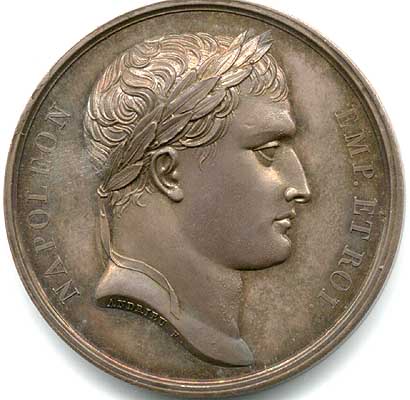

Standard obverse by Andrieu.
Reverse: bare-headed Napoleon, standing on the right, presents
his son to a draped female on the left. Exergue:
NAPOLEON DONNE SON FILS A LA FRANCE/JUIN MDCCCXV.
The use of a standard obverse by Andrieu on this medal betrays the
fact that it is one of the English strikes, since it gives Napoleon
the title of king (of Italy), although by this time, as I have
said, Napoleon was no longer king of Italy. This same reverse
appears on Bramsen 1662, another English strike which pairs this
reverse with an obverse portraying Napoleon II. Bramsen 1663 has an
unsigned, laureate head r. of Napoleon I with this reverse; Bramsen
1664 has the head of Napoleon I by Brenet with this reverse,
suggesting that it is a post-1830 strike by the Paris mint.


Obverse: Uniformed bust of Napoleon r.
Reverse: HANNIBAL on left edge; head of that
general left, signed DENON D.
The significance of Hannibal here is that Napoleon sent a request
for asylum to the prince regent in England, while defeated Hannibal
sought refuge from the Romans at various courts in Asia Minor. A
more parallel case, though, is that of Themistocles, to whom
Napoleon actually referred in his note. Bluecher's threat to hang
him if he got his hands on him made his eagerness to leave France
understandable. Scargill uses a medal similar to this for her last
entry, although apparently at that time the Hannibal medals were
being struck only in England. Scargill's version has a bare-headed
Napoleon r., with NAPOLEON at the r. edge,
for obverse (Bramsen 1692). Fellmann (1840) states that the obverse
die used with the Hannibal reverse in Paris was signed by Andrieu.
The Paris mint catalog of 1892 lists the medal but states that it
was struck in England.

Obverse: Standard obverse by Brenet.
Reverse: SURRENDERED TO H.B.M.S. BELLEROPHON CAPT MAITLAND.
In exergue: XV. JULY/MDCCCXV BRENET F. MUDIE D.