

Bramsen 350. The Emperor Anointed.
Obverse: PIUS VII P.M., HOSPES NEAPOLEONIS IMP. Bust right.
Signed in the field DROZ F. AN XIII.
Reverse: IMPERATOR SACRATVS.
The Cathedral of Notre Dame in Paris. In the left upper field,
the monogram of the Virgin Mary. Exergue: PARISIIS.II.DEC.MDCCCIV DEN.DIR. JALEY.FEC.
Of the other two varieties of this medal, Br. 351 differs only slightly, probably from a replacement die; Br. 349 omits the year from the obverse.

Standard obverse by Andrieu.
Reverse: LE SENAT ET LE PEUPLE. The
Emperor raised on a shield by two men, the one on the left
toga-clad and with a book inscribed LOIS LOIS behind him, the one
on the right uniformed and wearing a sword, in the field behind
him a plow. Exergue: AN XIII/ DENON DIR. JEUFFROY F.
The reverse design, drawn by Chaudet, illustrates the ancient
Frankish custom of acknowledging a new chief by raising him on
a shield. It also symbolizes the support of Napoleon by the
senate and people. It was in March of 1804 that the senate
offered First Consul Bonaparte the title of emperor. He accepted
and was henceforth denominated Napoleon, although he insisted
that a plebiscite be held to determine whether that office should
be hereditary in his family. Thus he risked little in the
plebiscite, although appearing to defer to the electorate.
Although it may seem strange today to hear of an emperor ruling a
republic, it is more or less in accordance with classical
tradition; in desperate circumstances the Roman Republic chose a
dictator to save the republic, although when the emergency
passed, power was restored to the two consuls. Napoleon's
anointing and coronation both took place on 2 December 1804.
The coronation medal was struck in four sizes. Several engravers
cut dies for these medals.


Bramsen 327. Andrieu/Andrieu. 32 mm.
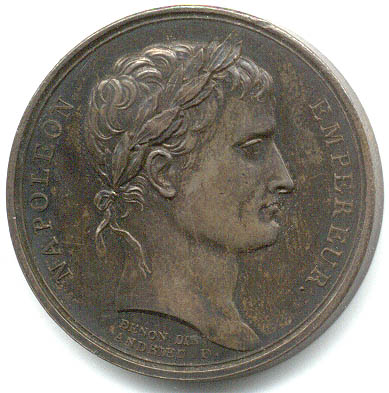

Bramsen 328. Droz/Galle. 27 mm.


Bramsen 329. unsigned. 14 mm.

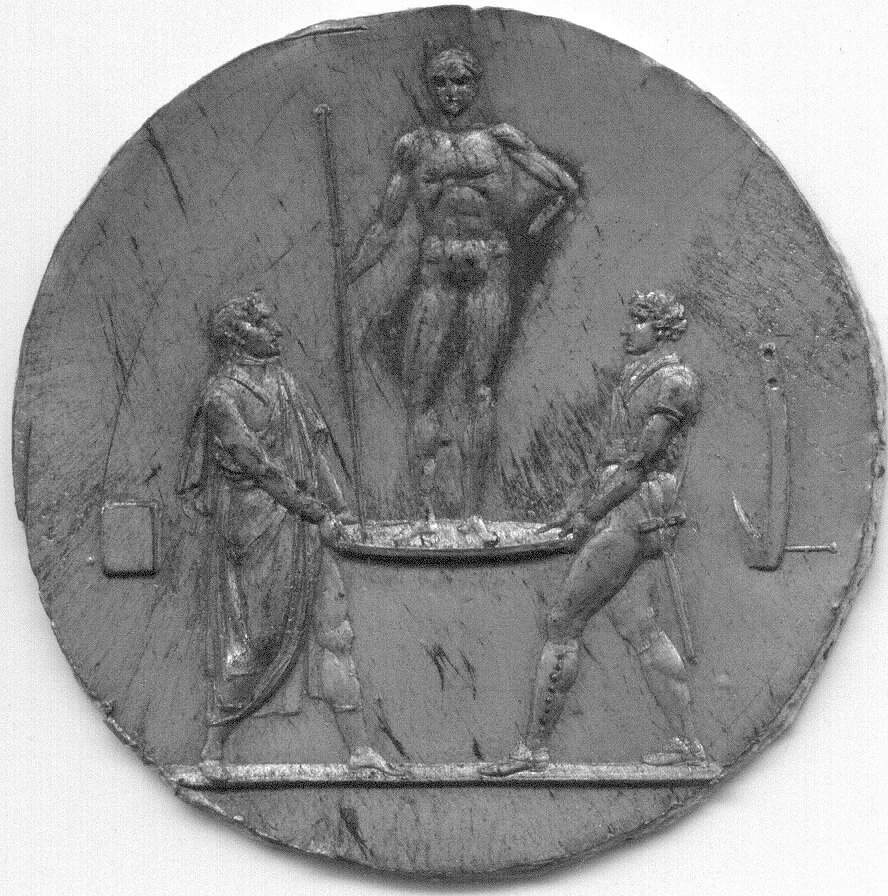
(Aside) In order to properly proportion human bodies, the die engravers customarily engraved nude figures into the die, then dug deeper to dress them. During the engraving process an engraver would periodically pour a little molten tin onto his workbench, then press the unfinished die into it to obtain a positive, enabling him to judge how the struck medal would look. Jeuffroy wickedly gave copies of a splash of his incomplete die for the 40 mm reverse to his fellow engravers:
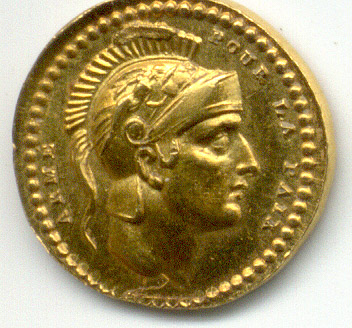
Bramsen 332. A SMALL MEDAL. 13 mm.

Bramsen 333. Coronation. 44 mm.


Obverse: BONTE DE TITUS SAGESSE DE M. AURELE GENIE DE CHARLES M.
The Emperor raised on a shield by four warriors, a cannon to the left and a hydra spitting daggers to the right. In exergue: AU NOM DU PLUS GRAND DES/HEROS FREMIT LE HYDRE/BRITANNIQUE. Signed, MERLEN F.
Reverse: In wreath NAPOLEON BONAPARTELE TRES GLORIEVX/ET TRES AVGVSTE EMPEREVR/SE FAIT SACRER ET OI/NDRE A PARIS PAR PIE VII SOVVERAIN PONTIFE. Below wreath MDCLLLXVVVVVVVIIIIIIIII.
I guess Merlen was trying for a job at the medal mint. "Bounty of Titus, wisdom of Marcus Aurelius, genius of Charlemagne" indeed. "The British hydra groans at the name of the greatest of heros." Well, the reverse inscription resurrects the abandoned chronogram, the wrong-font letters adding up to the year of the coronation.
An unofficial brass jetton perhaps came from Switzerland, perhaps from one of the Germanic countries.
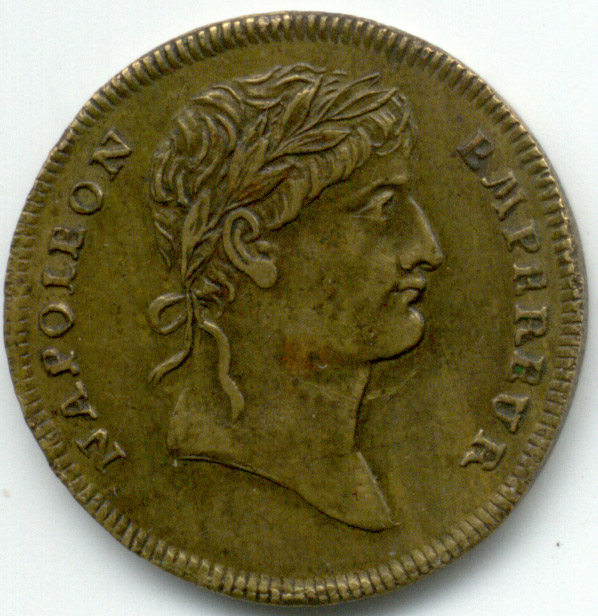

| 40 mm | Andrieu/Jeuffroy | Bramsen 326 | |
|---|---|---|---|
| 32 mm | Andrieu/Andrieu | Bramsen 327 | |
| 26 mm | Droz/Galle | Bramsen 328 | |
| 14 mm | unsigned | Bramsen 329 | |
| 14 mm | Jeuffroy/Jeuffroy | Bramsen 330 |
In addition, Bramsen lists two mules: 331 has the obverse of 267 (see War Again, November 1988) and reverse of 329; 332 has the obverse of 329 and the reverse of 267. Napoleon's personal copies in gold were the first four listed. Mint records cited in de Fayolle, Recherches sur Bertrand Andrieu, show the following initial quantities:
| GOLD | SILVER | |||||
|---|---|---|---|---|---|---|
| Size | Quantity | Cost | Quantity | Cost | ||
| 40 mm. | 100 | 18900 | 2400 | 21500 | ||
| 32 mm. | 200 | 18900 | 1050 | 4613 | ||
| 27 mm. | 200 | 9450 | 1000 | 2500 | ||
| 14 mm. | 12500 | 85500 | 70000 | 28000 | ||
The total number of gold and silver medals struck for the coronation was 87,450 (6000 of the 14 mm. gold medals were struck for presentation to the Imperial Guard). The mint charge, including the cost of the drawings and dies, was 203,363 francs. An article in "Le Moniteur" stated that it was Denon's idea to issue these medals. The larger medals were given to participants in the coronation, gold or silver according to their rank, while 14 mm. ones were thrown to crowds by heralds-at-arms. There seems to be no record of how many bronze medals were produced, although there is a note from Napoleon to Denon asking how much it would cost to produce 400,000 bronze coronation medals in the 40 mm. size! (Correspondence 8257).
Although the anointment of the Emperor had originally been planned for the week before the coronation, delays and difficulties in getting the Pope to Paris made it necessary to combine the anointment and the coronation. The common, malicious story, (apparently started by the Duchess d'Abrantes in her Memoirs) that Napoleon grabbed the crown from the Pope and crowned himself does not agree with the careful plans for the ceremony. According to the precis verbal of the master of ceremonies, Segur, the ceremony took place in accordance with the plans. After taking the crowns and other regalia from the altar and blessing them, the Pope returned them to the altar and then took his seat. Napoleon advanced and took his crown (a laurel wreath made of gold) from the altar and placed it on his own head. He then returned to the altar and took up the crown for Josephine. As he held this over his own head he stated that he was crowning Josephine as his wife, not by her own right. This is the moment illustrated in David's famous painting of the coronation. Napoleon then crowned Josephine.


Obverse: NEAPOLEO IMPERATOR. Laureate bust left,
signed below the truncation, GALLE FECIT.
Reverse: TUTELA PRAESENS. The Emperor
seated right, before him a standing woman wearing a civic crown.
Behind her is a putto guiding a ship (the symbol of Paris) while
watching a star above. On the exergual bar, PRUDHON DELINIAVIT;
JEUFFROY FECIT. In the exergue: EPVLVM SOLLEMNE
IMPERATORIS IN CVRIA VRBANE FRIM AN XIII.
This is one of the few medals from Napoleon's medal mint which credit the artist who drew the sketch copied by the engraver. Presumably in most cases Denon told the artist what he wanted and felt that an artist following his instructions didn't deserve any credit. In addition to the banquet celebrated by this medal, the City gave the newly-crowned Emperor an imperial silver service, gilt, containing over 500 pieces, weighing two hundred twenty five pounds. Made by the goldsmith Henri Auguste and others, the service was melted down by Charles X except for twenty two pieces which may be seen today at Malmaison, once the country house of Josephine and Napoleon.


Obverse: NAPOLEON JOSEPHINE. A pair of accolate busts right,
signed in the field below, BRENET.
Reverse: FIXA PERENNIS IN ALTO SEDES. A laureate eagle facing,
in a nest on a rocky peak, signed at the right by BRENET.
Exergue: FETES DU COURONNEMENT DONNEES A
L'HOTEL DE VILLE AN XIII.
This is the only medal from Napoleon's medal mint which bears a
portrait of Josephine. It does not convey her charm. Already
disillusioned by her infidelities, Napoleon may not have given a
second's thought to approving the medal's unflattering portrait
of her. This jetton-like medal may have served as a souvenir for
the guests at the city banquet. The obverse was used later for
Bramsen 360, the reverse of which had a plain field to be
hand-engraved, perhaps for use as a marriage piece.

Standard obverse by Andrieu.
Reverse: An eagle perched on a
thunderbolt, being crowned by a small flying victory. Below is
the letter N, surrounded by a glory. Signed in the field, DENON
DT and JALEY FT, 1807.
Most of the catalogers have said that this medal was produced to
celebrate the victories of 1807, apparently unaware that this is
the reverse of the great seal of the Napoleonic empire. The
medal, then, may have been issued to commemorate the adoption of
that seal, which can be found described in "Le Mercure de France".
The eagle resembles that on several coins of Ptolomaic Egypt.

NAPOLEON EMPEREUR. Laureate bust left. In the field below,
DENON
D./DROZ F.
Reverse: DRAPEAUX DONNES A L'ARMEE PAR NAPOLEON IER.
The toga-clad emperor presents new colors to the troops. Exergue:
AU CHAMP DE MARS/LE 14 FRIM AN XIII/DN.DIR. JE.F.
This little medal, the design perhaps inspired by a sestertius of
Nero, commemorates the ceremony in which Napoleon gave his
troops the new battle flags, surmounted by an eagle and destined
to lead his armies from France to almost every corner of Europe,
even to Moscow.

Standard obverse by Andrieu.
Reverse: NAPOLEON ROI D'ITALIE. A
crown, labelled AGILVLFVS.GRATIA.DEI GLORIOSVS.REX.
Exergue: COURONNE.A.MILAN/LE.XXIII.MAI.MDCCCV. DENON DT.
JALEY FT.
Agilulfus was crowned king of Lombardy in Milan, 561 A.D.
There is a variety of this medal, Bramsen 419, on which the
reverse inscription reads VIR.GLORIS.REX instead of
GLORIOSVS REX.


Obverse: NAPOLEO GALLORVM IMPERATOR ITALIAE REX. Laureate head
left, Signed on the truncation, L.M.
Reverse: VLTRO.
A draped
female on the left holds a cornucopia in her right and extends
with her left a crown to toga-clad Napoleon, on the right and
facing her. He points toward a scroll resting on a block between
them. In the field behind the woman is an Athenian helmet; behind
Napoleon is a winged caduceus.
Exergue: D.XXIII MAI A.MDCCCV.
It was only natural that once Bonaparte had become Emperor of the
French Republic his puppet Republic of Italy should beg him to
become its king. There was serious political danger in this; none
of the other European powers wanted to see France and Italy
united under one crown. In fact, France had agreed with Austria
in the Treaty of Luneville that this would never happen.


Obverse: NAPOLEONE, RE D'ITALIE. Crowned bust left, signed on the
truncation, L.M. In the field below, LA ZECCA DI MILANO, MAGGIO
MDCCCV.
Reverse: DIVENUTE COMPAGNE NELL'ORDINE, NELLA FEDE, NELLA
PROSPERITA. A quincunx of emblazoned shields.
On this medal Manfredini shows Napoleon wearing the Iron Crown, a
ninth century crown of the Lombard kings. This is the crown which
was actually used in the ceremony. Made of six gold placques
enamelled and set with jewels, it is mounted on a iron ring said
to have been made from one of the nails used in Jesus'
crucifixion. (On 7 April 1815 Francis, Emperor of Austria,
decreed that henceforth this crown would be used in the
coronations of Austrian emperors to represent their kingdom of
Lombardo-Venetia, composed of their recovered possessions in
Italy.) The five shields on the present medal represent
Napoleon's Kingdom of Italy, made up of the States of Milan,
Venice, the Papal Legations, Modena, and Novarra.

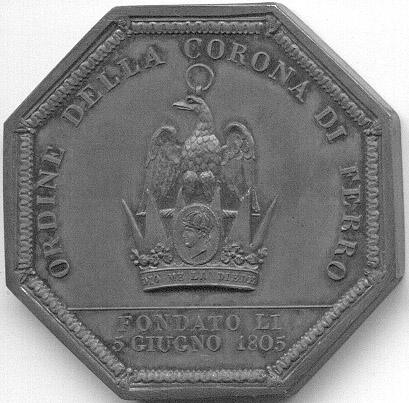
The French Legion of Honor was mirrored by King Napoleon's Order of the Iron Crown, but this jeton de presence was apparently designed by someone who did not know what that crown looked like!
| previous | index | next |
|---|