

Two draped female figures lean against a medal press. The one on the right represents the Roman goddess Moneta; she holds a medal in her right hand. The figure on the left is Clio, goddess of history; she records the striking of the medal on a tablet. In the exergue in the date MCCCIV (1804). The reverse of the medal is a simple laurel wreath surrounding a blank field. In later years the medal was struck with the head of Louis XVIII replacing the wreath; later still, after the Bourbons were gone, the medal was issued with the head of Louis replaced by that of Napoleon.
It looks as though Denon's program of medals for Napoleon started out small, although the mint was already selling copies of the medal Duvivier had presented to the National Institute, an impressive 56 millimeter work honoring one of the most popular men in France.

One of the most appealing portraits of the young revolutionary general, this shows the skill of Duvivier.

The reverse is the allegorical type so loved by medallists. The conquering hero rides a charger (no common word like horse befits a conquering hero) led by Minerva and Liberty. The Victory flying overhead crowns the victor with laurel, while he waves an olive branch. The Victory carries the Apollo Belvedere, part of the loot from Italy.


Obverse: BUONAPARTE GENERAL EN CHEF DE L'ARMEE D'ITALIE.
Uniformed, pig-tailed bust left, in field below CIV. ET ART. LUG. OFF.
Reverse: A BUONAPARTE L'ITALIQUE LE 26 Vre L'AN VI Draped woman seated in chair before an altar, an olive branch in her left and a drooping cornucopia in her right. In exergue, IL NE COMBATTIT QUE POUR LA PAIX ET LES DROITS DE L'HOMME. Signed on exergual bar, CHAVANNE F.


Obverse: BVONAPARTE ITALICVS Ugly uniformed, pigtailed bust right, signed in field below bust with the letter H.
Reverse: BELLO/GLORIOSO/PACIS AEQVVS/IDEM PACE PARTA/LIBERTATIS/ADSERTOR above laurel and olive branches.


Obverse: BUONAPARTE NE A AJACCIO LE 15 AOUT 1769. uniformed, pig-tailed bust left.
Reverse: In a wreath, LA FRANCE/LUI DEVRA/LA VICTOIRE/ET LA PAIX>
and below the wreath, AN 6 DE LA REPUBLIQUE.
This jetton has a milled edge.
Denon's first medals were less ambitious than these; there were apparently only five or six, 32 to 35mm in diameter. One commemorated the first battle of the first Italian campaign.


The portrait has been prettied up. The reverse is equally uninspired, already a clich� in ancient Roman times. The Battle of Montenotte began the separation of the two enemy armies which was completed by the Battle of Dego. Another medal commemorated the capture of Mantua, a subject already dealt with earlier, but this one celebrates Vergil, because that famous Latin poet was from Mantua.


The obverse is an imaginary head of the poet; the swan on the reverse refers equally to him.
The other medals of this first group from the Paris mint will be described later.
The five members of the Directorate, the executive body of France, were perhaps the least popular men in France. While Bonaparte was still in Italy there had been an attempt to reestablish the monarchy, to return the Bourbons to the throne. The counter-revolution had been defeated by invalidating the election of the royalists and arresting and deporting representatives who were of that party. The troops who supported the directors in this were led by General Augereau, who just happened to be in Paris on furlough from General Bonaparte's army in Italy.
The directors apparently realized the wisdom of not keeping the dangerous and ambitious General Bonaparte in Paris; they appointed him head of the army designed to invade England. After inspecting the France fleet, Bonaparte came to the conclusion that the resources of France were not sufficient to strike directly at the British. It was probably Talleyrand who sold Bonaparte and the Directorate on the idea of invading Egypt. Although France and the Turkish Empire had been allies for centuries, the Turkish province of Egypt was ruled by Mameluke princes, or beys, who paid only token allegiance to Turkey and spent their time fighting among themselves and harassing French merchants. The two dominant men in Egypt were Murad Bey and Ibrahim Bey. The beys had strong ties to British merchants. The French, then, tried the cover story that they were conquering the beys to return control of Egypt to Turkey.
The facts of the Egyptian Campaign have been exhaustively documented by Clement Etienne Lucien Marie de la Taffanel, Marquis de la Jonquiere, in his five-volume L'expedition d'Egypte 1798-1801 (1898-1906). Where I make statements concerning facts disputed by some historians I am relying on the overwhelming evidence presented by the marquis. Although Napoleon abstracted from the diplomatic archives and destroyed copies of his official letters of this period, the archives of the Ministry of War preserve letters of various generals involved, diaries of officers, the official siege journal kept at Acre. De la Jonquiere used these sources, as well as contemporary accounts by two Arabian historians.
The British fleet had temporarily abandoned the Mediterranean, and the French calculated that a surprise attack on Malta could give them a secure port on the way from Toulon to Alexandria. A large fleet was fitted out in Toulon, Marseille, Genoa, and Civita Vecchia. The destination was a well-kept secret; the British were inclined to think that the preparation were intended for the invasion of the British Isles. After the British learned that the French fleet had sailed, Nelson took a strong force and went hunting for it. Learning that the French had been seen near Malta, he guessed that their destination was Egypt, and took the British fleet to Alexandria. No one in Alexandria had seen them, so he headed north to see whether they were attacking Istanbul.
Meanwhile, the French captured and looted Malta. On the plus side, this enabled Bonaparte to tell the Moslems that he had destroyed their Christian enemies, the Knights of Malta. On the minus side, this antagonized the Czar of Russia, Paul, who had planned to spend 400,000 rubles to secure a treaty with the Knights, giving Russia a naval base in the Mediterranean. The French then sailed to Egypt. The troops went ashore and assailed and occupied Alexandria (2 July 1798). The Battle of the Pyramids, fought at Embabah near Cairo (21 July), defeated the Mamelukes and sent Murad Bey fleeing to upper Egypt and Abrahim Bey toward Syria.


A male figure personifying the Nile reclines against a sphinx, surrounded by seven children. On the reverse, in the background are the three pyramids of Gizeh. The type is copied from a statue of the Nile in the Vatican Museum. The medal is signed by Brenet and by Denon, Director-general of the Central Museum of the Arts.
Nelson returned to Egypt and demolished the French fleet in the Battle of the Nile. From this time on Britannia ruled the Mediterranean. Communication between France and Egypt was almost impossible, and Bonaparte had to rely on the country he was occupying to supply money, material, and food.


Obverse: REAR-ADMIRAL LORD NELSON OF THE NILE A standing, draped female holding a laurel branch and displaying a portrait of Nelson labelled EUROPE'S HOPE AND ENGLAND'S GLORY.
The reverse of this privately produced medal depicts the battle, with the inscription ALMIGHTY GOD HAS BLESSED HIS MAJESTY'S ARMS and the legend VICTORY OF THE NILE. AUGUST 1. 1798. Exergue: VICTORY OF THE NILE AUGUST 1.1798.On the edge is inscribed A TRIBUTE OF REGARD. FROM ALEXR DAVISON ESQR ST. JAMES SQUARE.
This medal was produced for Davison and presented by him to the British officers and men who took part in the battle.
Bonaparte claimed that the French defeat was caused by the failure of Admiral Brueys to take the French fleet to Corfu. De la Jonquiere cites abundant evidence that the fleet lacked food and water to make such a voyage, and common sense tells us that Bonaparte would not, at that point, have sent away his only means of retreat in case of reverses.
While the General in Chief subdued lower Egypt his lieutenant, General Desaix, pursued Murad Bey into upper Egypt and established control in that part of Egypt.
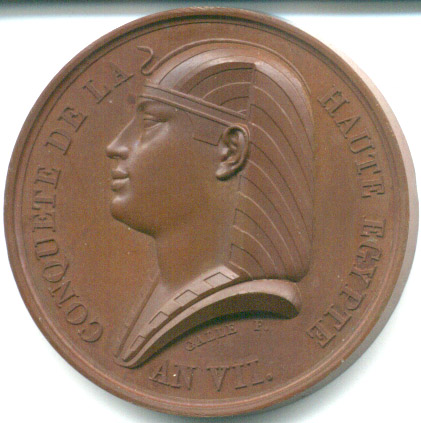

The head of an Egyptian pharaoh, facing left. (In all the older books this is called Isis, but in Egyptian iconography Isis wears cow's horns and a lunar disc on her head, while here we see the uraeus crown of upper Egypt.) Below, AN VII. GALLE F. Reverse: A crocodile chained to a palm tree, copied from Roman coins struck at Nimes for Augustus and Tiberius. Signed DENON DIREXIT and GALLE.

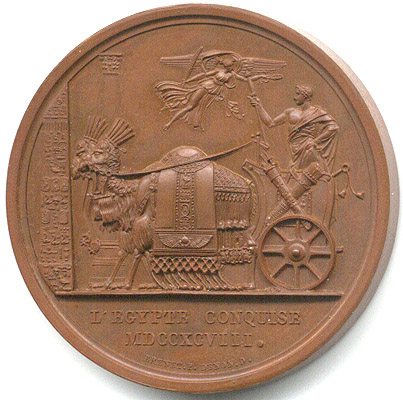
Head of General Bonaparte facing, crowned with a lotus wreath, signed J. JOUANNIN F. and DENON D. Reverse: L'EGYPTE CONQUISE MDCCXCVIII. General Bonaparte in classical costume and holding a sword, in a chariot drawn by two richly caparisoned camels, passes between the Column of Ptolemy and the Needle of Cleopatra. A victory flying above carries a palm leaf and offers the victor a laurel wreath.
The fact that this medal is larger than the other two for the campaign indicates that it was not among the first medals struck after Denon began directing the Medal Mint. This suspicion is confirmed by the fact that the drawings and dies were ordered and paid for in 1809. Fragonard did the drawing, Brenet the die-cutting (de Fayolle, Recherches sur Bertrand Andrieu, p. 34.)
Desaix was still dominating upper Egypt when General Bonaparte invaded Syria to ward off a threatened attack from that part of the Turkish Empire. He did not exactly cover himself with glory there; the main event was his failure to capture Acre, a stronghold of resistance. A British squadron under Sir Sidney Smith protected that port. Curiously, a French military engineer named Phelipeaux, who had been in the royal military school with Bonaparte, assisted in the defense of Acre.
In a letter Sir Sidney sent back to England he took a dim view of the situation (9 May 1799):
"Bonaparte will undoubtedly make another attack, the breach being practicable to a column fifty men wide. The city is not and never has been capable of being defended according to the rules of the art, but it will be defended by every other means, not because it is itself worth the pain but because we foresee that is is by this breach that Bonaparte will march to new conquests. On the issue of this combat hangs the opinion of the multitude of spectators on the surrounding mountains, who only await the outcome to join the victor. With such reinforcements for the execution of his known projects, Constantinople and even Vienna will feel violent shocks.
"Be assured, Milord, that the greatness of our obligations does but increase the energy of our efforts and our zeal to fulfil our duty , and although we may and probably shall be defeated, I dare say that the French army will be so weakemed before that event that it will not be able to profit from a victory which will have cost it so dearly." (De la Jonquiere, Vol. 4, p. 485.)
Sir Sidney was too pessimistic. Abandoning the siege (20 May 1799) after the garrison was reinforced by a Turkish army sailing toward Egypt but conscripted by Sir Sidney, and decimated by the plague, the French returned to Egypt, leaving troops in the fortress of El Arich to prevent an invasion from Syria. Those soldiers still able to march made a grand entrance into Cairo with banners flying and the band playing. General Bonaparte announced that Acre had been destroyed and the enemy beaten.
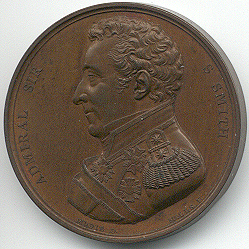

Obverse: ADMIRAL SIR S. SMITH Bust left. Signed MUDIE D. and MILLS. F.
Reverse: The British lion defending the Syrian camel from the French panther. Exergue: ACRE DEFENDED. BUONAPARTE REPULSED SYRIA SAVED. XXth MAY MDCCLXXXXIX BRENET. F. MUDIE. D.
On the 21st of June, 1799, Bonaparte issued orders to his chief naval officer, Gauteaume, to keep the two frigates Muiron and Carrere ready to leave for France. It is probable that while camped before Acre Bonaparte had received the letter which his brother Joseph had paid a courier 20,000 francs to deliver, a letter which determined him to return to France as soon as possible.
Before Bonaparte returned to France, however, he had to deal with an invasion by sea of a Turkish army. In the Battle of Aboukir Bay (25 July 1799) the invaders were wiped out. Shortly thereafter General Bonaparte seized the opportunity afforded him by the temporary absence of the British ships which had been blockading Alexandria. Gathering his papers, a guard of about two hundred men, several of his generals, and a few of the scientists who had accompanied the expedition, he embarked from the coast outside of Alexandria (22 August 1799) and his small fleet headed for France and 18 brumaire.


Obverse: The Roman god of happy outcomes, nude, standing, grain stalks in one had and a patera in the other. Signed, GALLE F.
Reverse: ARRIVEE A FREJUS, XVII VENDRE AN VIII. (9 October 1799). The two frigates and two small ships which brought General Bonaparte and his party back to France. Signed GALLE F. and DENON D.
The popularity of Napoleon was immense, not only in France but also in many of the German states. Several jettons portraying Bonaparte were issued in north German states, although in the Austrian Empire people found with medals portraying him were arrested. A note from "Le Moniteur", 2 December 1798, reads, "In the hereditary lands of the house of Austria an order has been published which enjoins the customs officials to seize all medals with a portrait of Bonaparte and to indicate in their reports both the persons from whom the medals were confiscated and those to whom they were being sent. It seems that the Elector of Saxony has also forbidden the sale in the free city of Leipzig of a picture of this same Bonaparte which was engraved by Uhlemann in Dresden.... All that is lacking now is for the grave sovereigns of Europe to form a coalition against the glory of a great man, like those peoples of the Nile who imagine that their savage cries can stop the course of the sun."


BUONAPARTE LIBERATOR DE L'EGIPTE Uniformed pig-tailed bust left.
LE HEROS RENDU A SA PATRIE Mercury, messenger of the gods, flies left, carrying a scroll. Behind him are pyramids. In exergue, IETTON/1799
The result of the Egyptian expedition came on the 9th of November, 1799 (18 brumaire year 8 in the republican calendar), when General Bonaparte defeated the directors and assumed command of the country. Before the Egyptian expedition General Kleber had sounded out Bonaparte about mounting a military coup d'etat; this helps explain why Kleber was left in charge of the army back in Egypt when Bonaparte returned to France. Another rival, Bernadotte, had his own plans to overthrow the directors; years later when Bernadotte was crown prince of Sweden he told Sir Walter Scott that he had tried to have Bonaparte court-martialed for deserting his troops in Egypt, but his attempt was unsuccessful and the hero who had returned from Egypt had overpowering support when he made his move.
| previous | index | next |
|---|