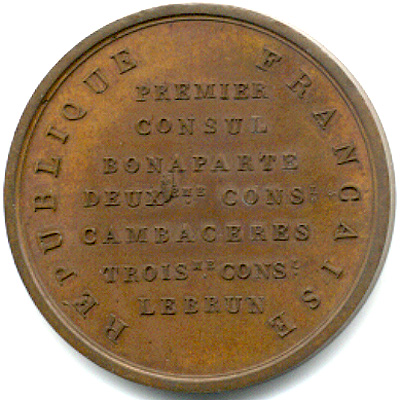
The Second Italian Campaign.
While General Bonaparte was waging his Egyptian Campaign the directors were changing France. The conference with Austria in Rastadt to arrange details left unsettled by the Treaty of Campo Formio had ended with the murder of two of the French plenipotentiaries; the third escaped the ambush. French armies converted the Papal States into the Roman Republic and south Italy into the Parthenopean Republic.
A coalition against France was formed by England, Austria, the Kingdom of the Two Sicilies, Portugal, Turkey, and Russia. An Austro-Russian army under Suvarov invaded northern Italy and defeated the French forces there, forcing the withdrawal of the French from Naples and Rome as well as north Italy.
Hennin 903 Russian Victor. 48 mm.


Obverse:ALEX. SUWAROW PRINC. ITAL. COM. RIMNIKS. Bare-headed, uniformed bust right.
Reverse:ITALIAE LIBERATOR. An armed warrior, holding a staff with four crowns in his right hand and offering to raise with his left a seated, draped woman. On the left a man on his knees, weapons, flags, and a shield on the ground beneath him. In the exergue MDCCXCIX and a festoon.
Although General Suvarov is here hailed as the liberator of Italy, in fact he just restablished the Austrian domination of north Italy. Because of rivalry between the Austrians and Russians, the French General Massena was able to defeat the Russians in Switzerland. Only ten days after Bonaparte landed at Frejus (returning from Egypt) French forces had compelled the British to withdraw their troops from the Anglo-Russian army operating in the Netherlands, resulting in the withdrawal of Paul of Russia from the Second Coalition. Suvarov took what remained of his Russian troops and went home to Russia. The Austrians, however, managed to trap Massena and half his troops in Genoa, where they were besieged. The Austrian army now threatened southern France from north Italy. An Austrian army in Germany was advancing toward France, fighting against a strong defense by General Moreau.
The message Joseph had sent to Napoleon which brought him back to France dealt mainly with the internal state of the country. The legislators were fighting with the directors, the civil war had become more violent in northwest France, the financial situation was desperate. A third-rate political theorist, Sieyes, had been elected a director (May, 1799) and was planning to overthrow the government. He had the support of two of the four other directors, Roger Ducos and Paul Barras.
Although the war with Austria demanded attention, domestic matters had first to be dealt with. General Bonaparte joined forces with Director Sieyes, bringing with him the backing of most of the generals and the armies. He was able to gain the support of Tallyrand (who had been relieved of his position as foreign minister the previous July in connection with the bribe of $250,000 requested from the American diplomats in Paris to settle our war with France, the XYZ plot) and Fouche (head of the police and always looking to the main chance). The legislators made up two houses; the Council of Ancients (senate) and the Council of Five Hundred (representatives). The latter, although many of them didn't support Napoleon, had Lucien Bonaparte as president, while the former were anti-directorate. On the 17th of brumaire the Ancients were conned into calling a meeting of the councils at Saint Cloud the next day, outside of Paris and away from the influence of the mob. The excuse was national security, and General Bonaparte was put in charge of security. Talk about foxes guarding hen houses!
A stormy and dramatic confrontation took place at Saint Cloud. The report in "Le Moniteur" of what took place on the 18th of Brumaire (9 November 1799) is too extensive to print here, but it resulted in General Bonaparte's becoming First Consul, chief magistrate of France. Sieyes became Second Consul and Ducos Third, but their positions were only temporary; after a new constitution was drawn up Sieyes and Ducos were replaced and retired from politics.
BRAMSEN 57. THE EIGHTEENTH OF BRUMAIRE. 61.5 mm.


On the obverse of this rather peaceful medal the rising sun dissipates the clouds over a tranquil sea. (General Bonaparte returns from the East, quiets the unrest in France.) A cliche of this obverse is listed as Bramsen 1. The simple inscription in the exergue states XVIII BRUMAIRE AN VIII.
The reverse is an inscription in a wreath: TO THE CITIZENS OF GARD WHO DIED FOR THE FATHERLAND, 14 JULY 1800. FIRST CONSUL BONAPARTE, SECOND AND THIRD CONSULS CAMBACERES AND LEBRUN. MINISTER OF THE INTERIOR L. BONAPARTE, PREFECT OF GARD J.B. DUBOIS.
This medal was apparently struck for 14 July 1800. Bramsen called his uniface example of #1 a clich�. Hennin informs us that some proofs in silver of Bramsen 57 bear the engraved inscription "Mercie a Lyon", telling us that Mercie of Lyon was the engraver.
Once the First Consul had his government organized he was able to deal with the Austrians. General Moreau was commanding the French troops opposing the Austrians in Germany and refused to use the attack plans Bonaparte gave him (and was perhaps too old fashioned to understand them). From the need to try something else was born the audacious decision to form a secret army and carry it across the Alps to cut the supply lines of the Austrian army which had reached across north Italy to Nice in its thrust to invade south France and support the royalists there. Melas, the Austrian commander, had halted his advance until Massena and the remnant of his French army, besieged in Genoa, would surrender. First Consul Bonaparte crossed the Saint Bernard Pass with an army of 40,000; in addition a detachment of 11,500 from General Moreau's army came through the Saint Gotthard Pass. Small diversionary forces attacked from Mount Cenis, the Simplon Pass, and the Spleugen Pass, effectively confusing the Austrians.
BRAMSEN 33. THE ARMY CROSSES THE ST. BERNARD/ THE BATTLE OF MARENGO. 58 mm.


An ambitious die was designed by Andrieu, based on a famous painting by David. This die was never hardened, and it was used by Andrieu only to make cliches. The present medal was struck from dies made by Montagny, who gave Andrieu credit for the obverse.
BRAMSEN 37. THE ARMY CROSSES THE ST. BERNARD/ THE BATTLE OF MARENGO.


This original design shows the expedient used to get the cannon across the Alps; the dismounted cannon were placed in hollowed out logs and dragged across. Contrary to the picture, however, the cannon were dragged by mules or men. Dubois created the die, directed by Denon.
The reverse shows the result of the battle of Marengo. The eleven keys symbolize the twelve fortresses surrendered to the French, assuring French control of north Italy. Perhaps the engraver mistook the number of keys required.
BRAMSEN 38. THE BATTLE OF MARENGO. 50 mm.


The obverse portrait of First Consul Bonaparte was done by Brenet (signature on the truncation of the bust), but the border is signed by H.Auguste, suggesting that originally the medal had been intended to be smaller.
The reverse bears a quotation attributed to the First Consul: THE FIRST CONSUL, COMMANDING THE ARMY OF RESERVE: REMEMBER, BOYS, THAT I AM ACCUSTOMED TO SLEEP ON THE BATTLEFIELD.
Rose suggests that the general's sleeping habits could hardly be counted on to make his soldiers fight more fiercely. According to the Constitution of the Year Eight, the First Consul could not command troops; this was Napoleon's first violation of the constitution he had given the French the previous December. Before the battle it had been stated that General Berthier was commanding the army, so the medal had to clear that up.
Although the battle began badly, success was pulled from defeat when General Desaix's troops stopped the advance of the Austrian columns and General Kellermann's cavalry charged and demolished them. The Austrians were happy to renounce their designs on the Piedmont and southern French and to be allowed to retire to the Venetian territory which had been given to them by the Treaty of Campo Formio. First Consul Bonaparte returned through Lyon to Paris, stopping in Lyon to arrange for the reestablishment of that city, which had been harshly treated during the revolution, as an industrial center.
Bramsen 58. LYON RESTORED. 44 mm.


Obverse: A BONAPARTE REEDIFICATEUR DE LYON.
Head left. In field below, R.VERNINAC PREFECT/AU
NOM DES LYONNOIS/RECONNOISSANS. Signed on truncation of head, MERCIE F. LUG.
Reverse: Within a wreath, VAINQUEUR/A MARINGO/DEUX FOIS CONQUERANT/
DE L'ITALIE/IL RETABLISSONT LA PLACE/BELLECOUR/DESORMAIS BONAPARTE/ET EN POSOIT LA
Ire PIERRE/LE I0 MESS. AN 8 DE LA/REPUBLIQUE/PREMIER DE SON/CONSULAT./I800 V.S.
Bramsen 59. LYON RESTORED. 43.5 mm.


Obverse: A BONAPARTE VAINQUEUR ET PACIFICATEUR Uniformed
bust right, signed on truncation, CHAVANNE F.
In exergue, LES LYONNAIS/RECONNs.
Reverse: In a wreath, LE X MESSr./AN VIII/BONAPARTE/A POSE
LA Iere PIERRE/DE LA GRANDE PLACE/DE LYON/DETRUITE/EN L'AN III
BRAMSEN 42. THE CISALPINE REPUBLIC RESTORED. 52 mm.

Obverse: BONAPARTE PRIMVS CONSVL. ANNO VIII.
The official portrait has not yet been established; Lavy's version may be compared with that of Brenet above and that of Manfredini below. Latin inscriptions were used on the medals from Italy, although almost every medal from Napoleon's Paris mint discarded the traditional language of medals for French.

Reverse: XII MVNITISSIMIS OPPIDIS VNA DIE AD DEDITIONEM COACTIS. (Twelve highly fortified cities were forced to surrender on the same day.) RESPVBLICA CISALPINA RESTITVTA. Hercules (who carelessly let his lion skin fall to the ground) is raising Italy to her feet. The Cisalpine Republic was renamed the Italian Republic and Bonaparte became its president.
Although most of Napoleon's Italian medals came from the mint in Milan, this one may have come from Turin, since Lavy was a medalist there. The design of the reverse was drawn by Appiani. Apparently the dies were lost; Tiolier cut new hubs, which are almost an exact copy and which are the only ones which have been used by the Paris Mint. The illustrated example was made from a set of the Italian dies, not the set copied by Tiolier.
One of the problems of war is what to do with the corpses. Paramount after Marengo was the body of General Desaix, for that unfortunate general had been killed when his troops engaged the Austrians. Napoleon respected four French generals, Moreau, Kleber, Bonaparte, and Desaix, but of the four he liked only Bonaparte and Desaix. He sent the following letter to Desaix during the Egyptian Campaign, quite unlike his correspondence with his other generals:
"Headquarters, Gaza, 27 February 1799
I haven't received any of your letters, Citizen General, for more than forty days, except indirectly from the commandants of Cairo and Beny-Soueyf. We are, I think, nearly three hundred leagues apart. The staff will have let you know about the military actions which have taken place here. We have crossed seventy leagues of desert, which has been extremely tiring; brackish water, often none at all. We have eaten dogs, asses, and camels. For three days we had a terrible wind and the rain has been pouring down; the sky is overcast; the climate is like Paris. The citrus groves, the forests of olives, the roughness of the terrain resemble the landscape of Lanquedoc; one would think he was on the coast of Beziers. We found more than thirty thousand of gunpowder and a great quantity of bullets of every calibre. We leave tomorrow for Jaffa. The Mamelukes and Ibrahim-Bey have taken refuge in the mountains of Naplouse.
I impatiently await your news.
Bonaparte"
BRAMSEN 44. THE BATTLE OF MARENGO. 50 mm.


The obverse of this medal is like that of Bramsen 38, by the same medalists, but Desaix's portrait is substituted for Bonaparte's. The reverse inscription purports to be Desaix's dying words, GO TELL THE FIRST CONSUL THAT I'M SORRY NOT TO HAVE DONE ENOUGH TO LIVE IN POSTERITY.
The body was embalmed (unusual in those days) and stored in Milan; eventually it was decided to entomb him at the monk's hospice at the Saint Bernard Pass.
BRAMSEN 426, 427. TOMB OF DESAIX. 32 mm.


The two medals share an obverse by Droz of Napoleon Empereur. One reverse shown the monument. The scene is the death of Desaix on the battlefield, a bas relief
which was exhibited in Paris by the sculptor before being taken to the remote final resting place. The lying inscription states that Napoleon laid the cornerstone of the tomb; he was delayed in Italy and delegated that job to one of his generals. The ceremony was held on the 24th of Prairial, Year XIII, the fifth anniversary of the Battle of Marengo according to the revolutionary calendar. The alternate reverse of the medal has only an inscription in a wreath; the date has been changed in the die to the 25th of Prairial because in 1805 that corresponded to the 14th of June, the Gregorian anniversary of the battle.
General Desaix was honored earlier, on Bastille Day of 1800, by dedicating a quay on the Seine to him.
BRAMSEN 68, 69. FOUNDATION OF THE QUAY DESAIX.


Obverse of 68: FRENCH REPUBLIC. In the field, FIRST CONSUL BONAPARTE SECOND CONSUL CAMBACERES THIRD CONSUL LEBRUN
Common reverse: 25 MESSIDOR AN VIII DE LA REPUBLIQUE FRANCAISE. In the field: PARIS. FOUNDATION OF THE QUAY DESAIX. TO THE MEMORY OF THE GENERAL KILLED AT MARINGO. 14 JUNE 1800.
Bramsen 69 has the same reverse and the obverse differs only slightly, adding L. BONAPARTE, MINISTER OF THE INTERIOR.
The fact that the medal bears only inscriptions indicates the haste with which it had to be prepared. The illustrations are from later strikings, although most of the medals photographed for this series were struck in or before 1815. Napoleon's gold copy of #68 shows the same obverse die flaws, indicating that the #69 obverse is later. The misspelling of Marengo is an example of the difficulties Napoleon's medal designers had with the names of foreign places he made famous.
Desaix was also honored by a fountain paid for by public subscriptions, designed by Perrier and Fonraine, and erected in the Place Dauphine on the Ile de la Cite in 1803. Apparently no medal was struck for that. Finally, a sixteen foot statue of him was erected.
BRAMSEN 976. STATUE OF DESAIX.


The obverse of this medal is the official portrait of Napoleon, Emperor of the French and King of Italy, with the signature of the medallist, Andrieu, on the truncation. Slight variations of this obverse (some of them from other engravers) were used for most of the forty millimeter medals struck at Napoleon's medal mint. These obverses were modelled after the head of a statue of Napoleon by Chaudet, hence their similarity.
The reverse shows the sixteen foot statue of Desaix, the die having been produced in 1809 by Brenet after a drawing by Fragonard. The statue aroused a storm of protest when it was unveiled; the "Mercure de France" relates some of the stories going around Paris about it. "What is Desaix pointing at?" "He's pointing at the haberdashery over there and saying, "Somebody bring me a shirt." There were other, more vulgar stories.
Due to public criticism of the statue a shed was erected to hide it "while corrections are being made." The plan was to get rid of it by transferring it to the city where Desaix was born, but before that could be done the Bourbons returned to power. This statue and one of Napoleon were melted down to cast a statue of Henry IV. The story of this statue parallels that of a half-naked statue of Washington, erected on the Mall in about 1850, hidden in a shed, then banished to the basement of the Library of Congress, hidden behind copyright copies of pulp magazines. But, Washington has now been resurrected and occupies a place of honor in the Museum of Science and Technology.
Although the capitulation of the Austrians restored French control in north Italy, peace with Austria had to await the defeat of the Austrian army along the Rhine. General Moreau commanded the French army there, and First Consul Bonaparte did not dare to test his power by interfering with that popular and competent general. Meanwhile, Bastille Day, 1800, was the occasion for great celebrations on Paris and throughout France. A high point of the day was the dedication in each departement of a column to the heroes of the French Revolution.
BRAMSEN 61. THE NATIONAL COLUMN 41mm


BRAMSEN 63. THE NATIONAL COLUMN. 56mm


This medal exists in two sizes. Here is another portrait of Bonaparte by Duvivier. The Second and Third Consuls have to be content to have their names on the obverse. The reverse inscription tells us that on 14 July 1800 Lucien Bonaparte, Minister of the Interior, placed the first stone of the National Column, dedicated by the French people to their defenders. Although Lucien had had much research done on a suitable stone to use (he decided on a French granite) this column was never erected.
BRAMSEN 64. COLUMN OF THE DEPARTEMENT OF THE SEINE. 60 mm.


On this medal Gatteaux included the heads of the Second and Third Consuls, as well as celebrating the constitution which France had accepted in the year VIII. The reverse is an inscription: THE WAR FOR LIBERTY, DEPARTMENT COLUMN. LUCIEN BONAPARTE BEING MINISTER OF THE INTERIOR, N.TH.B. FROCHOT, PREFECT OF THE DEPT. OF THE SEINE, PLACED THE FIRST STONE ON THE 24TH OF MESSIDOR, YEAR VIII, ELEVEN YEARS AFTER 14 JULY 1789. THE DEPARTMENT OF THE SEINE TO ITS BRAVE MEN.
BRAMSEN 66. COLUMN OF THE DEPT. OF SEINE AND MARNE. 42 mm.


This medal consists only of inscriptions. Obverse: FRENCH REPUBLIC; FIRST CONSUL BONAPARTE, 2ND CONS'L CAMBACERES, 3RD CONS'L LEBRUN. Reverse: DEPARTMENTAL COLUMN. ANDRE LAROCHEFOUCAULT, PREFECT OF THE DEPT. OF SEINE AND MARNE PLACED THE FIRST STONE ON 14 JULY 1800. The same obverse as 68, 69 above.
BRAMSEN 67. COLUMN OF THE DEPT. OF THE RHONE. 33 mm.


BRAMSEN (-). COLUMN OF THE DEPT. OF THE JURA. 32 mm.


From the trumpet of the winged victory hangs a banner reading "To the brave men of the Departement of the Rhone". The exergue informs us that the prefect was Verninac. In the lower right field in the signature of Mercie, the medalist. The reverse states IN EACH DEPATMENT THERE WILL BE ERECTED A COLUMN TO THE MEMORY OF THE BRAVE MEN OF THE DEPARTMENT WHO DIED IN DEFENSE OF THE FATHERLAND AND OF LIBERTY -- DECREE OF 29 VENTOSE YEAR 8 OF THE REPUBLIC; CONSULS BONAPARTE, CAMBACERES, LEBRUN; MINISTER OF THE INTERIOR LU. BONAPARTE.
The unlisted variety was produced by altering dies for Bramen 67. Jura replaced Rhone on the banner and Poncet replaced Verninac in the exergue. This specimen came from the collection of the Prince Napoleon.
BRAMSEN 71. HONORS RENDERED TO TURENNE. 50 mm.


The most famous marshal of Louis XVI is depicted here. The obverse inscription and legend state HONORS RENDERED TO TURENNE BY THE GOVERNMENT. HIS GLORY BELONGS TO THE FRENCH PEOPLE. The reverse inscription explains: TRANSFER OF THE BODY OF TURENNE TO THE TEMPLE OF MARS BY THE ORDERS OF FIRST CONSUL BONAPARTE ON 22 SEPTEMBER 1800, FIRST ANNNIVERSARY OF THE CONSULATE, LUCIEN BONAPARTE MINISTER OF THE INTERIOR.
Marshal Turenne was given the unprecedented honor of being buried in St. Denis, the resting place of the royalty of France. When that chapel was desecrated during the revolution and the remains of the royals removed from their tombs; a man from the Jardin des Plantes begged the body of Turenne as an example of a modern mummy. After a horrified legislator reported that the illustrious marshal was on exhibit beside a stuffed camel, the body was moved to his tomb, which had become an exhibit in Lenoir's Monuments of French Art. The First Consul decided to have the body moved to a place of honor in the Madeleine, which he had had converted into the temple of Mars. But notice, he felt it necessary to justify honoring a supporter of the Bourbon regime by declaring the Turenne's glory belonged to the French people. After the return of the Bourbons, Saint Denis was restored and Turenne returned. Requiescat in pace.
BRAMSEN 72. EXPEDITION TO DISCOVER. 38mm.


Obverse: BONAPARTE, FIRST CONSUL OF THE FRENCH REPUBLIC. Uniformed bust left. Beneath, EXPEDITION FOR DISCOVERIES, YEAR 9.
Reverse: THE CORVETTES THE GEOGRAPHER AND THE NATURALIST, COMMANDED BY CAPTAIN BAUDIN.
Rose's Life of Napoleon I. has a chapter on Bonaparte's colonial plans, from which I extracted the following: "Although France and England were at war, the British Admiralty permitted scientific voyages. In September of 1800 a group of twenty-three scientists embarked on a voyage to explore Australia. These Frenchmen were the first to map Van Dieman's Land and northwestern Australia, as is evidenced by the French names in that part of the seventh continent. Particularly to be noted is the Bay of Rivoli, named for one of the battles of Bonaparte's First Italian Campaign. Encounter Bay is where the French expedition met an English expedition going the other way." Although in the 1807 publication of the results of this scientific voyage half of Australia was claimed for France (and the first good map of Australia appeared), the principal result was to spur on British settlement there.
In the autumn of 1800 Czar Paul of Russia did an about face, reviving the Armed Neutrality League with Denmark, Sweden and Prussia against England and offering to join France in an invasion of India.
On 3 December 1800 General Moreau led his French army into Munich, after finishing the fight against Austria in Germany with the Battle of Hohenlinden. The Paris mint today sells copies of two medals celebrating Moreau's exploits, Bramsen 55 and 56. The Tresor Numismatique states that the dies were prepared in 1800 or 1801 but that they were not used in the Paris Mint before 1830. The two medals are large, measuring 58mm.
The Austrians were still reluctant to begin treaty negotiations. They hoped the royalists would win out in France and almost certainly knew of the plots to assassinate Napoleon.
BRAMSEN 76. THE INFERNAL MACHINE. 50 mm.

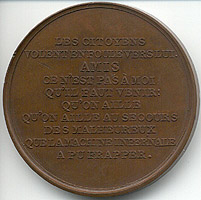
Obverse: THE LOVE OF THE FRENCH PEOPLE FOR THE FIRST CONSUL.. Uniformed bust left, signed H. AUGUST on the truncation. Below the bust, THE ATTEMPT ON THE LIFE OF BONAPARTE, 24 DECEMBER 1800.
Reverse: A CROWD OF CITIZENS RUSH TO HIM. 'FRIENDS, IT IS NOT I TO WHOM YOU SHOULD COME; GO AND HELP THOSE UNFORTUNATES WHOM THE INFERNAL MACHINE WAS ABLE TO HIT'.
BRAMSEN 77. THE LEADER SAFE FROM THE PLOTS. 60 mm.


Obverse: BONAPARTE, PRESIDENT OF THE ITALIAN REPUBLIC. THE YEAR 3. [North Italy was liberated by the French in 1797.] Signed L. M., for Luigi Manfredini.
Reverse: The three winged females on the left are the Three Fates, the goddesses of classical mythology who determine the course of one's life. "Clotho holds the distaff, Lachesis forms the thread, and Atropos holds the spindle, on which she places the thread." (Millin. The Metallic History of Napoleon.) The male figure seated on the right represents Destiny; he holds the scissors but is apparently refusing Atropos' order to cut the thread. This medal is from the Milan mint.
Of the several attempts on Napoleon Bonaparte's life, that one which took place late in 1800 was the most spectacular. This event, like everything else in his life, is confused by the conflicting stories told about it. It was known that the First Consul would attend the performance of an oratorio by Hayden; the plotters had loaded a small cart with barrels of gunpowder and iron scraps and planned to have the horse-drawn device block the First Consul's carriage, then explode. As Napoleon told the story later on Saint Helena, his coachman was drunk, whipped up the horses and crowded past the obstruction. Napoleon had been napping in the carriage; awaked by the pitching of the carriage, he thought at first he was back in north Italy, at a time when he had ordered his coachman to ford a flooded river at night and the going had been rough. His party was far enough away when the cart exploded that only his rear guard was shaken by it. Several innocent bystanders were killed or injured, and buildings were destroyed. Outside of that, Citizen First Consul, how did you enjoy the oratorio?
A notice by the police appeared in "Le Moniteur"; Would anyone who thought he might identify the horse's body please come around and look at it? Please hurry; it is beginning to smell. The dead horse was identified, and that led to the identification and execution of the conspirators.
Known radicals were rounded up and sentenced to exile or death for a crime they hadn't committed; then the royalists who had engineered the plot were identified, seized, and punished. The security measures taken a couple of years later were described by J. F. Reichert (Director of the Royal Opera in Berlin) in his A Winter in Paris during the Consulate, 1802-03, first published in Hamburg in 1804:
"A word here about the precautions taken when the First Consul goes to the theater. A detachment of horse-guards gallops ahead of the carriage to receive the Consul at the door of the theater; a second detachment follows, so that the Consul may be completely surrounded. Inside the theater foot-soldiers serve, forming a double row from the entrance to the hall to the loges. As soon as the Consul gets out of the carriage, the horsemen rapidly dismount and, leaving their horses in the charge of a few men, march along, their sabres at the ready, behind the Consul; they take their station in front of the door of his loge during the performance. At the exit, the same drill in reverse order."
fin