
Three documents concerning the medals struck by Napoleon's Medal
Mint to commemorate the 1809 Austrian campaign have been published:
Denon's 1811 list of planned medals, Daru's observations on these
plans, and Denon's response to the observations. De Fayolle, in his
Recherche sur Bertrand Andrieu (1902), published the list and a
letter written by Denon concerning these medals. Mr. Antony
Griffiths, in Part 1 of an article about the design and production
of the Napoleonic medals (British Art Medal Society,"The Medal",
No. 16, Spring 1990, pp. 16-30), republished this and published
several other letters between Denon and others concerning the
medals, as well as illustrations of the artists' sketches copied by
the die engravers. In the following descriptions I have quoted
Daru's comments and Denon's responses from those letters.
In the spring of 1809, many French troops having been withdrawn
from Germany to fight in Spain, the Austrians decided that the time
had come to avenge the humiliation heaped on them by the Treaty of
Pressburg in 1805.
Obverse: The Temple of Janus, the doors smashed. Signed ANDRIEU F. and DENON DIR. Exergue: TRAITE DE PRESBOURG ROMPU PAR L'AUTRICHE IX AVRIL MDCCCIX.

Reverse: ABENSBERG * ECKMUHL. A laureate warrior standing between two trophies. Signed DENON D. BRENET F. Exergue: BATAILLES DES XX ET XXII AVRIL MDCCCIX. XL.M. PRISONNIERS.
Since the Treaty of Pressburg had been commemorated by a medal showing the Temple of Janus with closed doors, Denon decided to use that temple with broken doors for this medal, the idea being that the God of War had broken out of his temple, where he was shut up during times of peace. The reverse design was strongly influenced by Roman coins, although this Temple of Janus bears no resemblance to the one in Rome (see that one illustrated on a sestertius of Nero, "Numismatics International Bulletin", April 1989, page 90.)
Daru: The first medal is well conceived.
Denon: The medal of the Treaty of Pressburg ... [has] already been
ordered and started.
Napoleon had stayed in Paris, taking care of the plot by Talleyrand, Fouche, and Caroline to replace him by Murat, while his chief of staff, Berthier, directed the positioning of French troops to oppose the Austrian advance. When Napoleon went to the front he found that Berthier had spread the troops over a sixty-mile front, from Ratisbon to south of Augsburg. He rapidly concentrated his forces, stalled the Austrian advance and in five battles, only two of which are commemorated on this medal, split the Austrian army in two. Invading Austria, he forced Vienna to surrender.


Obverse: PORTE ST MARTIN. A city gate of Paris.
Signed ANDRIEU and DENON. Exergue: L'EMPEREUR PART DE PARIS LE XIII AVRIL MDCCCIX.
Reverse: PORTE DE CARINTHIE. A city gate of Vienna.
Exergue: L'EMPEREUR ENTRE A VIENNE LE XIII MAI MDCCCIX.
ANDRIEU F. DENON DIR.
A new twist is given to the city-gate theme here to emphasize the speed with which Napoleon conquered Vienna. Vienna, not Austria.
Daru: The second expresses leaving Paris and arriving in Vienna with a correctness
and precision which make it extremely remarkable.
Denon: The medal... of the Entry into Vienna has already been ordered and started.
It was incidental to this campaign that Napoleon annexed the Papal States and Rome to the French Empire. Although Napoleon had given instructions to General Miollis and Murat (Corres. 15018, 5 April 1809) "to finish the affair of Rome and to destroy that hotbed of insurrection", he expressed displeasure that the Pope had been arrested and sent to France (Corres. 15218, 17 May 1809); he ordered him returned to Savona (Corres. 15555, 18 July 1809). Then he complained about that (Corres. 15615, 6 August 1809), showing his doubts about the whole affair.
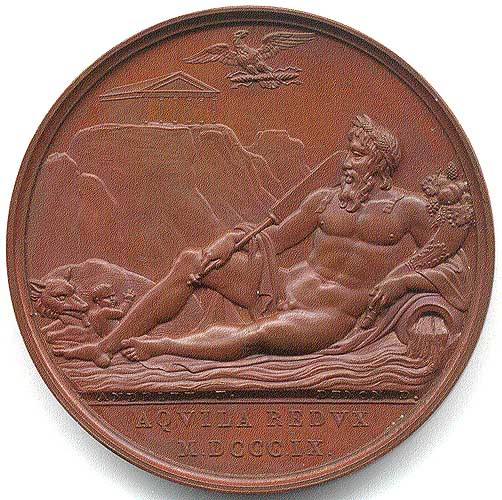
Standard obverse by Andrieu.
Reverse: A river god reclining l., a
wolf and child before him, a temple on the heights in the left
background. Aloft is an eagle carrying a thunderbolt. Signed on the
exergual bar, ANDRIEU and DENON.
Exergue: AQVILA REDVX MDCCCIX.

Standard obverse by Andrieu.
Reverse: ROME PARIS. Two accollate busts l.,
that of Paris signed on the truncation DEPAULIS. In the
field below, DENON D. and MDCCCIX.
These two medals commemorate replacing the temporal power of the Pope by that of Napoleon. On 17 May 1809 Napoleon issued a decree from Vienna uniting the Papal states to his empire and making Rome his second capital. The river god on 848 is, of course, the Tiber, with the legendary wolf which nursed Romulus, founder of Rome. There is a variant of 849, recorded as Bramsen 850, on which the headdress of Paris is not so far out.

Daru: Rome declared the second capital of the empire is represented in a simple
but appropriate manner. I do not know whether the legend has a very direct connection
with the figure represented, but the Latin expression should, it seems to me,
be replaced by a French one, and in it I would substitute for revendique the
word _______[illeg.].
Denon: For the medal of Rome I shall make the inscription French in
accord with your observation.

Obverse: DANVVIVS PONTEM INDIGNATVS. A river god destroying a
pontoon bridge, on which are a cannon and two French standards.
Exergue: PROELIVM AD ESLINGAM XXII. MAI MDCCCIX. Unsigned.
The Austrian forces were across the Danube from Vienna; secure in his strength, Napoleon had bridges built from Vienna to the Island of Lobau and from Lobau to the far bank of the river. Napoleon once said that the most difficult military operation is crossing a river in the face of an enemy, and he illustrated that here. While the first part of his army was battling the Austrians on the far bank, the bridges connecting the island with Vienna were broken, cutting the French supply lines and leaving part of Napoleon's army hopelessly outnumbered on the far bank, fighting a losing battle against one of the few military men he admired, the Archduke Charles. The badly mauled French successfully retreated to Lobau, bringing with them among other casualties the fatally wounded Marshal Lannes, Duke of Montebello. Lannes was a personal friend of Napoleon, had served him well in the second Italian campaign (hence his title), at Austerlitz in the first Austrian campaign, and at Jena and Friedland in the Prussian campaign. His death on the Island of Lobau was a great loss to Napoleon, personally as well as tactically.


Obverse: NEAPOLIO IMPERATOR. Bust left of Napoleon by Galle.
Reverse: An inscription giving details of the ceremony.

Reverse: ITERVM IBIDEM. French troops crossing a bridge, a victory flying overhead. Exergue: TRAIECTVS V. IVLII MDCCCIX. Signed BRENET F. DENON D.
Apparently Denon had so many medals to cover for this campaign that he had to double up on some, like this one. It is not recorded what Napoleon had to say about the medals which do not have his portrait on the obverse. The reverse of Bramsen 859 commemorates the successful crossing after the bridge from Vienna to Lobau had been rebuilt and five bridges were thrown from Lobau to the left bank at a place which outflanked Archduke Charles' defenses.
Daru: It seems to me the Battle of Essling is not represented so happily.
It requires a commentary, which is inconvenient. The subject is complicated;
the separation of the two parts of the army and the second crossing are very
difficult to express. As for the inscription Iterum, His Majesty had always
wanted medals struck in France to have French exergues, and that rule can have
no exception except when the Latin offers a happy allusion, like the medal of
Czar Peter. I believe that you yourself, when in Vienna you talked with me about
it for the first time, showed some scruples about translating that inscription
by French words.
Denon: With regard to the one for the Battle of Essling, may I have
the honor of pointing out to you that I had an accident to express
here, that it was necessary to present the river which caused it by
breaking the bridge, which divided the army, which is expressed by
the two standards which the reverse shows; the remedy which
repaired this misfortune is a great example at the same time of
confidence and subordination. In general medals have a hieroglyphic
manner of explaining themselves, and if they often are an aid to
history, history itself often, also quite naturally, sometimes
comes to the aid of the medals. That of the Battle of Essling
presents at the same time two important facts; it looks fine and
offers no political inconvenience, so permit me to retain it.

Standard obverse by Andrieu.
Reverse: A reclining, scantily draped river god, behind him
a French standard. Exergue: LES AIGLES FRANCAISES AU DELA DU
RAAB. MDCCCIX. DUBOIS F. DENON D.
Napoleon's step-son, Eugene, was operating with French troops west of Vienna. This medal commemorates the capture by that force of the town of Raab, situated on the river of the same name, near the point where it joins the Danube. Since Napoleon did not take part in this fight, it was classified as a combat, not a battle. It was fought on 15 June 1809 and cut the Austrian communications with Hungary, at that time part of the Austrian Empire. By the actions of Eugene's troops the troops under Archduke John were prevented from supporting those under Archduke Charles during the final battles of the campaign.
Daru: The taking of Raab is well characterized, but in spite of my respect
for Latin methods I would prefer to put the arms or the emblems of Raab in the
exergue rather than in the field of the medal, and I would prefer a French legend
to the Latin one.
Denon: For the Conquest of Raab, I thought I was adding something
to the explication of the medal by putting in the field the type of
the ancient coins of Pannonia. I can suppress this type but cannot
allow myself to put it in the exergue. That innovation would
intrude the composition of the subject into a place which should be
absolutely dedicated to the inscription. I shall change that to
French, which I would always prefer.

Standard obverse by Andrieu.
Reverse: Hercules, raising his club to finish off a supine figure,
holds with his left a winged Victory taken from the fallen foe.
Exergue BATAILLE DE WAGRAM VI JUILLET MDCCCIX. DENON
D. GALLE F.


It is interesting that Manfredini's version consists only of the Victory from the Paris medal. She resembles a wall painting from Pompeii. The reverse inscription may be translated, "The enemies were everywhere thunderstruck, cut down, captured." In this bloody battle, fought on the fifth and sixth of July, 1809, the French had about 180,000 men, from whom 25,000 were casualties. The Austrians had about 140,000; their losses were also about 25,000. This was the last battle of the campaign commemorated by a medal. Archduke Charles was granted the armistice he requested on July 12.

A standing draped female faces right. Her left foot rests
on the deck of a ship. With her right hand she grasps a spear,
holding it like a staff; in her left is a snake-wound winged staff.
In the right field is a symbol, the mint-mark of the Antwerp mint.
Signed DENON. D. DEPAULIS F.
Exergue: ANVERS ATTAQUEE PAR LES ANGLAIS M.D.CCCIX.

JUPITER STATOR. Jupiter seated on his
throne, a staff or spear in his right and a thunderbolt in his
lowered left.
Exergue: NAPOLEON A SCHOENBRUNN MDCCCIX. signed
DENON. D. DOMARD F.
The British decided to attack Antwerp, one of the centers of ship
building for the French, while Napoleon was engaged in Austria.
"The British Government succeeded in eclipsing all its former
achievements in forewarning foes and disgusting its friends...
Official favouritism handed over the command of 40,000 troops to
Earl Chatham, who wasted precious days in battering down the
walls of Flushing when he should have struck straight at the
goal... Antwerp. That fortress was therefore ready to beat him
off; and he finally withdrew his army into the Isle of Walcheren,
into whose fever-laden swamps Napoleon had refused to send a
single French soldier. A tottering remnant was all that survived
by the close of the year: and the climax of our national disgrace
was reached when a court-martial acquitted the commanders.
Napoleon would have had them shot."
John Holland Rose. The life of Napoleon I, vol. II, p. 183
The reverse of the medal commemorates Napoleon's unconcern, he remaining in Austria during the botched British invasion, confident that the forces he had left behind to protect the coast were sufficient.
Daru: The attack on Antwerp during the Emperor's sojourn at Schoenbrunn is
very fine and the idea very happy. I do not have any criticism to make except
for the arms of Antwerp, which I do not like to see placed in the field of the
medal, because there they require explanation.
Denon: I am perfectly of your opinion with regard to the arms of
the City of Antwerp in the field of the medal; I shall suppress it.

Standard obverse by Andrieu.
Reverse: Napoleon, standing, with his right hand places an olive
branch on an altar and with his left applies a torch to a heap of
debris from the war. Signed ANDRIEU F. D[enon]. D.
Exergue: PAIX DE VIENNE MDCCCIX.
Although the fighting of the second Austrian campaign ended with an armistice on the second of July, the political negotiations dragged out for three months. It was only after the British setback in Spain after Wellesley's successful Battle of Talvera and the failure of the British attack on Antwerp that the Austrians felt forced to break their agreement with England and to agree to a separate peace with France. Austria was forced to recognize Joseph as king of Spain, cede Salzburg to Bavaria, return part of Poland to the Duchy of Warsaw, part of Galicia to Russia, yield Trieste and lands along the Adriatic to the French Empire. Worst of all, perhaps, was the abandonment of Tyrol, which the Austrian emperor had promised to defend to the death. The Treaty of Schoenbrunn was finally signed on 14 October 1809. In addition to the loss of lands, Austria was to pay an indemnity of $17,000,000 and limit her army to 150,000 men. There is apparently no basis for the common story that a secret agreement was made at this time that Napoleon would be given the Austrian archduchess Maria Louisa in marriage.
Daru: You have portrayed the Peace of Vienna by a hero who holds an olive
branch in one hand and with the other sets fire to weapons now become useless.
But that second part of the emblem does not make sense, and a torch does not
seem proper to burn cuirasses, which seem to be metal, since they are supported
by their own weight. Although I accept your thought, I do not find it expressed
clearly.
Denon: For the one of the Peace of Vienna I shall substitute for
the iron arms, cannon and mortars of which the supports begin to
catch fire.

Standard obverse by Andrieu.
Reverse: A cow observing its nursing calf; in the field above, a club.
Exergue: CONQUETE DE L'ILLYRIE/
M.DCCXIX./ DEPAULIS F. DENON D.
The type of the reverse is from ancient coins of the region.
Daru: The sixth medal represents an ancient emblem of Illyria. It is a cow.
I swear to you that I don't find much nobility there. According to Homer the
garden of Alcinous was on the Island of Corfu, and it seems to me that the king
there had no claim to ancient Illyria, which is in the hands of the Turks today.
The Illyria conquered by the House of Austria no longer carried that name in
the time of the Romans. I submit all these doubts to you and want them to give
you a reason for choosing as remarkable an emblem as that of the preceding medal.
Denon: I have been very perplexed about the medal for Illyria; its
conquest, made by an article of a treaty, does not offer any
subject to represent. That is what made me have recourse to all the
types of the ancient coins of that country; I shall suspend the
execution of that one until I shall have found a subject. If one
comes to you, I shall be obliged to you, Count, if you will kindly
communicate it to me.
***** APPENDIX 1: List of the medals Denon planned for 1811. (This list was found by de Fayolle in the French archives and
published in his prize-winning Recherches sur Bertrand Andrieu.
Bramsen catalog numbers and the designers' or engravers'names have
been added, the designers from Griffiths.) Austrian campaign of 1809. designer engraver Fr. Bramsen 844 The Treaty of Pressburg broken. (Andrieu) 1000. Bramsen 844 The Battle of Abensburg & Eckmuehl. Bergeret (Brenet) 1800. Bramsen 847 Leaving Paris & Entering Vienna. Zix. (Andrieu) 1000. Bramsen 847 Entry into Vienna. Zix. (Andrieu) 1000. Bramsen 859 The Battle of Essling. Fragonard. (Brenet) 1700. Bramsen 859 Crossing the Danube. Fragonard. (Brenet) 1700. Bramsen 854 The Taking of Raab. Fragonard (Dubois) 1800. Bramsen 870 The Attack of Antwerp. Lafitte. (Depaulis) 1600. Bramsen 870 The Sojourn at Schoenbrunn. Lafitte. (Domard) 2000. Bramsen 879 The Conquest of Illyria. (Depaulis) 1600. Bramsen 860 The Battle of Wagram. Fragonard. (Galle) 3000. Bramsen 876 The Peace of Vienna. Lafitte. (Andrieu) 2000. Bramsen 849 Rome the second capital. " (Depaulis) 1600. Bramsen 721 Reunion of Etruria to the empire. " (Brenet) 2000. Bramsen 688 The Simplon route. " (Brenet) 2000. Bramsen 848 Rome & Holland reunited to the empire. " (Andrieu) 2000. Bramsen ??? The birth of a prince or princess. (2 dies) 3000. Head of the Emperor for this collection. (2 dies) 660. Wax models, finished designs, and sketches for the above medals. 2740. Total 20 dies. Fr.34200.
DARU TO DENON, 24 January 1811.
I have had the honor of presenting to His Majesty the drawings for
the new medals intended to continue the medallic history of His
reign. His Majesty has not had the time to examine them; He has
just expressed to me the desire that in the make-up of these medals
all proprieties be observed, so I invite you to examine them again,
and although I have not perceived anything which could be censored,
I charge you to look at your work again, with as much more
closeness as His Majesty has shown more confidence in you.
As for me, I am going to give you my observations as a
fellow member of the Institut, examining your work only in its
literary aspect. You will allow me some errors, and you will not
forget that I do not belong to the class particularly charged with
inscriptions and medals.
Your plan for the birth of the King of Rome offers an
ingenious composition, and the subject is expressed in the happiest
manner.
On the medal for the birth of a princess, the snake who
raises himself above a column or an altar does not perhaps express
well enough the idea of security you wanted to convey. This emblem
does not express security as much as prudence, health, medicine,
etc. If one saw in the field of the medal the star which precedes
the sunrise, that emblem would have some connection with what is
indicated by the cornucopia placed on the other side of the
principal figure....
I applaud the one which represents the uniting of Etruria
to France.
The Simplon route has reminded you of that giant by which
Camoens represented the Cape of Good Hope. You have made that
allusion, but the image of that giant is lacking in nobility, and I
object to the very composition of your allegory. It seems to me
that although one may conceive of wagons passing over the shoulders
of the giant one does not see why they pass under his legs.
Correctness of the emblem demands that they pass above, because
subterranean roads have not been tunnelled into that mountain.
You see, M. Director General, that the only object I have had in thus multiplying my criticisms has been to prove to you how much pleasure I have had in examining all the details of your work. Moreover, I do not see anything which could wound propriety in the plans which you have sent me, and these are only observations which I send to you.
Accept, M. Director General, the assurances of my distinct consideration and sincere attachment.
DENON TO DARU, 29 January 1811.
I have gratefully received the advice which you have kindly wanted
to give me about the medals of which you have presented the plans
to His Majesty. I thank you for the interest you have displayed for
me in that regard. I had already ordered the one for the birth; it
was Health and not Security that I wanted to express with the
serpent. But I think that emblem useless, and in accordance with
your suggestion I suppress it and shall replace it with a star as
you advise....
For that of the Simplon [Br 688] I have already given more
nobility to the pose of the giant. Relative to the other
observations about that medal, I respond that that chain of
mountains rises between Lake Geneva and Lake Maggiore, which serve
as a base; the road runs along the edges of these lakes; it is
elevated over rocks and traverses a subterranean gallery in one of
its parts, which inspired that train of little figures which go up
to the feet of the giant.
I repeat my thanks to you, Count; it is my desire to merit the
confidence which His Majesty has been pleased to place in me. Thus
I always attach great value to advice dictated by enlightenment and
friendship. May you always retain those toward me, and accept the homage
of my deep respect.
Denon
N.B. It is curious that the medals do not reflect the changes Denon told Daru he would have made, particularly changing Latin inscriptions to French.
| previous | index | next |
|---|