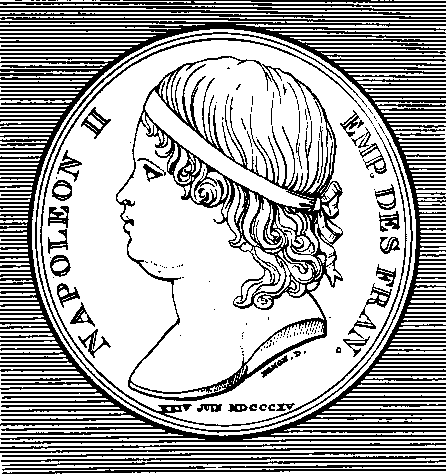
The last twelve Napoleonic medals.
The production of medals commemorating the reign of Napoleon
came to an abrupt end after his defeat at Waterloo and
subsequent exile to Saint Helena. Or did it? In the 1820 book
supposedly authored by Ann Mudie Scargill the statement is made,
`It was the artists most attached to him that made the records,
and it was by his own express desire that they did so. "Finish
the Series," said he to Denon, "whatever happens; and let
posterity be told that I abdicate in favor of my son."'
In the first weeks after Napoleon surrendered to Captain Maitland, beginning
his terminal voyage to Saint Helena, there was little thought of medal making.
Vivant Denon, in charge of the fine arts and chief architect of the series of
Napoleonic medals, fought valiantly but unsuccessfully to preserve the artistic
treasures obtained from foreign countries which were housed in the Louvre; he
probably had also to defend himself from the proscription which banished famous
artists like David to foreign exile, an exile so stringent in that instance
that David's relatives were forbidden to return his body to France for burial!.
The Medal Mint did a thriving business selling sets
of the Napoleonic medals (the curse taken off by finishing the set with medals
portraying the sovereigns victorious at Leipzig, the 1813 Battle of Nations,
medals which had been prepared while Napoleon was on Elba) until Louis XVIII's
government put a stop to that by taking the dies away from the mint (1816).
These sets were not definitive collections of all of the medals produced by
the Napoleonic Medals Mint but rather a collection of the medals from whatever
dies were readily available; some of the dies were in private hands and others
broken or misplaced. The collection of the mint included many thousands of dies.
Originally the sets were accompanied by a handwritten
inventory; later sets were accompanied by an engraved inventory.
Even though the French government wished to eradicate the memory of their
first emperor, somehow private means were found to prepare to produce twelve
medals to complete the series. It seems unlikely that the facts behind these
additional medals will ever become know, but new light has been thrown on the
subject by the appearance of a scrapbook which turned up in a miscellaneous
lot of books in the Rollin-Feuardent library sale a couple of years ago. This
book appears to be an abortive attempt to produce a catalog of the Napoleonic
medals similar to those produced to display the medals of Louis XIV and of Louis
XV. It contains a mixture of penciled and pen and ink drawings, apparently most
of them taken from the finished medals. Almost without exception the medals
are of designs which Denon directed. In many cases there are proofs of etchings
prepared from the drawings, a few of them signed by Normand fils or Gounod,
artists known to have been paid by Denon to produce etchings of his medals. The etchings of the twelve medals added to the mint list of 1814 are like all
the other etchings, although a handwritten list containing only them is included
in the scrapbook. There are orthographical errors in this list which lead me
to speculate that whoever wrote it was not French.
The etchings of the twelve medals added to the mint list of 1814 are like all
the other etchings, although a handwritten list containing only them is included
in the scrapbook. There are orthographical errors in this list which lead me
to speculate that whoever wrote it was not French.
Some of the twelve medals added by Scargill to the 1815 mint
list published by Laskey do not appear in any collection.
Although most of them have the head of Napoleon as obverse, both
#4 and #6 are represented by two medals in the Bramsen catalog.
Scargill does note that the reverse of #4 is sometimes found
with the head of Napoleon but is silent about the other three
sides in the form Bramsen knows them, that is, with the head of
Napoleon on the other side. It seems apparent from mint records
printed by de Fayolle that Denon planned to produce twelve
medals a year and that he sometimes doubled up, as with these
two, to keep within his quota. In normal times he submitted
sketches and his list of planned medals to Napoleon or his
representative, but that was hardly feasible with these last
twelve. Whether Napoleon left Denon the great amount of money
required to produce the medals is unknown; years earlier
Napoleon had learned from the prince of Hesse not to leave
financial records for his conquerors to find. It is not known
where these medals were produced. It is generally accepted that
they were first produced in England, which may well be true.
There is no evidence that #8 was ever produced.
Except for Scargill's verbal description and this etching it is simply unknown.
There are other "Champ de mai" medals listed by Bramsen, but not this one.
The Battle of Mont St Jean, #10, is another surprise.
Although most of these medals have a diameter of forty or forty one millimeters,
the drawings are sixty five. The published medal represented in #10 has a diameter
of fifty millimeters and is signed by Petit, with the design attributed to Denon,
DENON INV.