The three preliminary sketches.

A few years ago the library of the defunct Rollin-Feuardent numismatic firm
was auctioned off. The books were sold in large lots, and more or less
hidden in one of those lots was a scrapbook of a most unusual nature. It contains what seem to be the remains of an abortive attempt to produce an illustrated catalog of the medals produced by Napoleon's Medal Mint: proofs of engravings of the medals together with drawings of some of the medals and a few tracings of drawings used to transfer the designs to the plates for the engravers. The illustrations of medals are uniformly about sixty five millimeters in diameter, although most of the medals from which these illustrations were made measure about forty. A few of the engravings are signed in the plate by the engraver; two artists are represented, Normand and Gounod. Inserted or tipped into the volume are several items, a brochure advertising the Bigi castings of Napoleonic medals, a list of one hundred twenty five of the canonical medals, a list of twelve later medals which are not included in the 1814 canon, a "Note des M�dailles non dessin�es", and, finally, three preliminary sketches for medals. These three sketches are in ink, on paper measuring 160 to 220 x 175 mm. Where did this scrapbook come from?
At an ANA convention several years ago Richard Margolis introduced me to a fellow collector of Napoleonic medals, Jerry Cohen. Jerry was so proud of his acquisition of an early book about the medals that he left the convention to go home and fetch the book for me to admire. The book was Ann Mudie Scargill's Medallic History of Napoleon Bonaparte, published in 1820. As soon as I saw it I knew I had to have a copy, and another friend gave me the address of John Drury. An inquiry to that firm produced the response: "I believe I may have a copy of that at the binder's." The volume was retrieved from the binder, expertly rebacked with a brown paper spine matching the boards. It contains a flyleaf bearing the inscription "Thursday 20 July 1820 of Matthew Young ....... 10/6". (The reverse of this leaf shows traces of the title page which originally followed it, a variant of the title page actually present. The original title page was cancelled.)
This book by Scargill was discussed in some detail by Antony Griffiths in his articles in "The Medal". Relying on some notes in a copy of the book, he suggests that the introduction to the book was actually written by James Mudie and accepts the implication that the descriptions of the medals were written by Vivant Denon (who directed the preparation of the medals). While those points are open to question, Mr Griffiths supplies important information about Ann Mudie Scargill and the medals. First, he quotes a passage from Sir Edward Thomason's Memoirs which states that Mudie's daughter was a governess
of the Baron Denon's children in Paris in 1817. Secondly, Griffiths found and reports records showing that Denon paid Gounod and Normand for engraving plates of the medals.
Although pages in the scrapbook were reserved for all the medals in the 1815 medal mint list as well as the twelve additional, only one hundred nine medals are represented by engravings, the medals which were produced under the direction of Denon and the twelve. This fact leads me to suspect that Denon was connected with this scrapbook and the extra twelve medals, and the faulty orthography of the French documents included with the scrapbook, added to the apparent connection of Ann Mudie to Denon makes me wonder whether the scrapbook actually belonged to her. (At that time it was customary to use the title "Miss" for married women, hence "Miss Ann Mudie Scargill".) Two of the engravings are of medals of which standard copies are unknown; in fact one of the engravings represents a medal which seems to be completely unknown except for its description in Ann's book.
The sketch for the medal commemorating the meeting between Napoleon and Francis of Austria (Bramsen 452) is close to the actual medal. The standard in the sketch has had RF erased; the standard on the medal as produced has N.
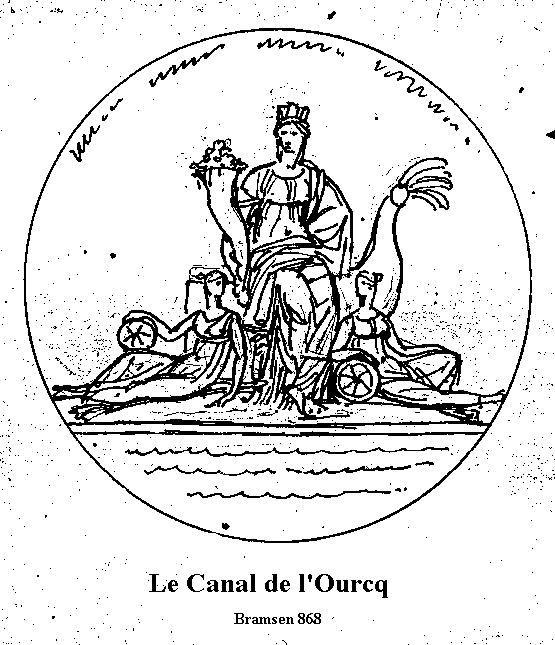
The sketch which is apparently for the Ourcq medal (Bramsen 868) differs markedly from the medal as struck. Here the two rivers which contributed their waters to the city are tamely seated at her feet; on the medal as struck they are bathing her with their waters, an inspired image!

The third sketch was identified for me by Vern McCrea. It represents one of the medals designed by the Institute, one of that great series which for the most part have never been produced. The use of Latin rather than French for the inscriptions is a characteristic of those Institute medals: Imperium trans Alpes propagatum; gentibus subalpinis in civitatum receptis. The presence of this sketch is perhaps due to the fact that Vivant Denon was more than the director of the medal mint; in fact he was the Director of Fine Arts for the Empire.
Ernest Babelon. Les M�dailles historiques du r�gne de Napol�on le grand, empereur et roi, publi�es sous les auspices de la Soci�t� de Numismatique de New-York. Paris, 1912.
Antony Griffiths.
The design and production of Napoleon's Histoire M�tallique.
The Medal, Spring 1990, pp 16-30.
The origins of Napoleon's Histoire M�tallique.
The Medal, Autumn 1990, pp 28-38
The end of Napoleon's Histoire M�tallique.
The Medal, Spring 1991, pp 34-49.