The strongest idea which Horace could give of the durability of his work, was to say, that he had built himself a monument more lasting than brass. He had so; because love is stronger than anything; and we may conceive the admirers of such a writer continuing to multiply copies of him, when the most iron substances have passed away. But it was lucky for Horace, that he fastened himself as he did upon the social affections; for contemporary poets, who appear to have been greater than him, have nothing to shew to posterity but their names; and the coins of Lesbos, which were stamped with the head of Sappho, ran a hard race, even with the loves and graces of that ardent poetess. If it had not been for Longinus, who extracted one of her odes, and Dionysius of Halicarnassus, who was in love with another, scarcely a hair of her immortal head would have been saved.
In the meantime, coins have come down to us that are said to have been struck two hundred and fifty years before Sappho, who flourished about six hundred years before Horace and the Christian era. There are medallic coins, or coins bearing portraits of the Macedonian kings, and the successors of Alexander;-- a complete series of the Roman emperors, from C�sar to the Goths;-- a variety of heads of eminent persons, not princely, both of Rome and ancient Greece;-- and a shoal of semi-barbarous heads, that reigned in the districts comprising Modern Hungary, Prussia, and Turkey, and upon which no civilized eye would ever have looked, but for the help of this representative brass. Medals, indeed, of all monumental substances, are the most durable. The protections about them are more secure than the desarts about the pyramids. If they be small. and liable to be lost; on the other hand, they are preserved easily and with fondness; they suffer nothing from the air; and they are capable of being innumerably multiplied. The medal was an anticipation of the printing press; and in proportion as the latter has extended the means of know;edge and renown, the former has increased with it in facility of diffusion.
Regular sets of coins of the different kings of modern nations are common enough; but it is no incurious feature in the history of art, and the human race, that there has perhaps never been a complete set of recording medals of the history of any one particular reign or individual, till the time of Napoleon. The series described in the work now before the reader, begins with him in his youth, when he first entered upon command, and follows him down to his overthrow. On this account, as well as others, it is distinguished from every set of medals in the world. The latter were struck only to commemorate some great man generally, or some particular occasions in his life, not at all involving any thing like a regular biography.There seems, it is true, to be an exception in the case of Marlborough, of whose victories his grateful mistress, Queen Anne, struck a regular series of medals: and it is an exception, as far as the successive commemoration of one entire part of a man's life is concerned. But in the Napoleon Series, with the exception of the shameful outrage on Spain (an eloquent omission!), you have his whole history, from his rise to his downfal. Even the magnanimity of this is new. It is the first time in the history of the world, that a prince and conqueror had been any thing upon his medals but glorious or vain-glorious. It was reserved for Bonaparte to pierce through the mere lustre of an event, and hold forth the substantial body though eclipsed. If he was planet-struck at first with the splendour of his star, it may be said of him that he struck the planet in return, and held it in his own hand to be looked at, like his imperial globe found rotten.
Nor is the credit of Napoleon, in this instance, of a negative order. He did not merely suffer the medals to be done; merely wink st the records of his change of fortune, and think the artist was doing an interested or equivocal thing. It was the artists most attached to him that made the records, and it was by his own expressed desire that they did so. "Finish the Series," said he to Denon, "whatever happens; and let posterity be told that I abdicate in favor of my son." They did honor both to him and themselves, and took him at his word.
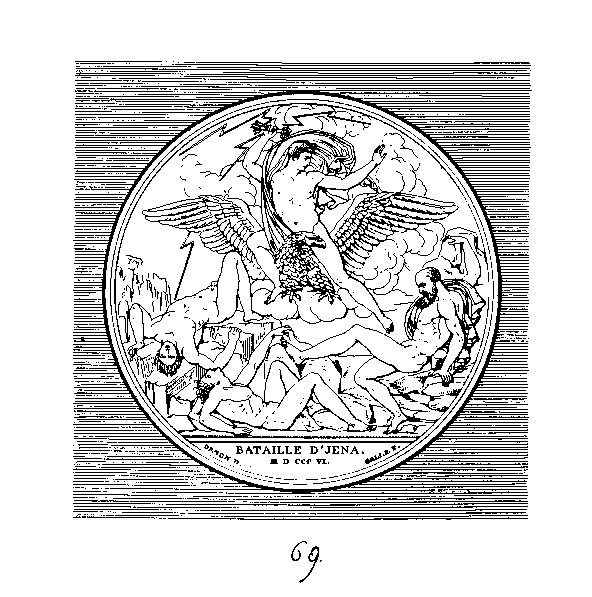
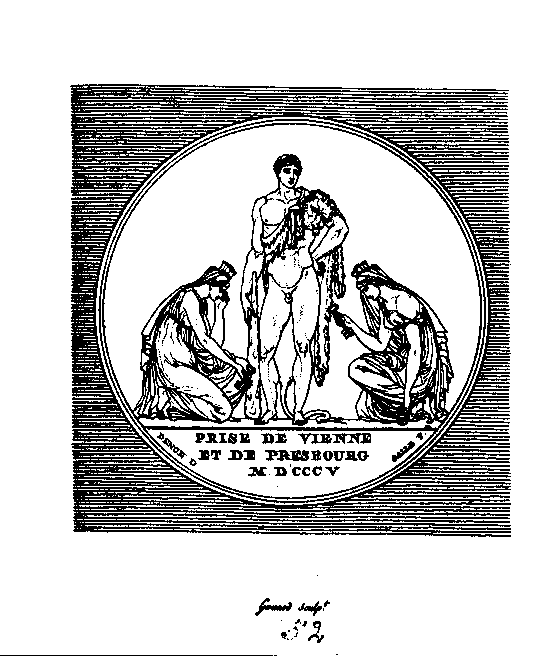
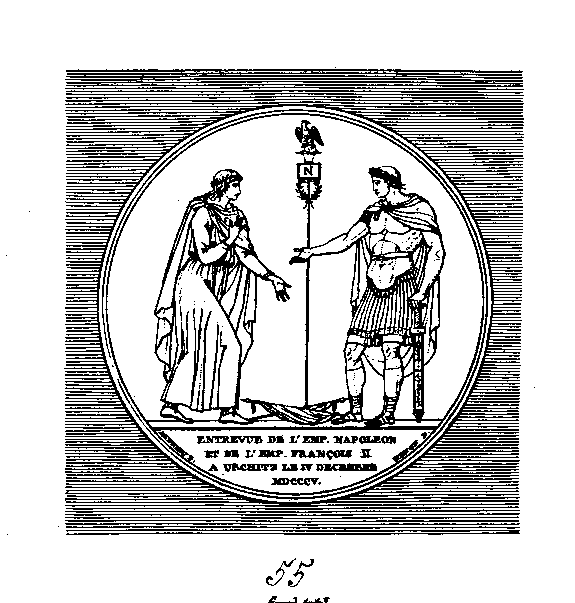
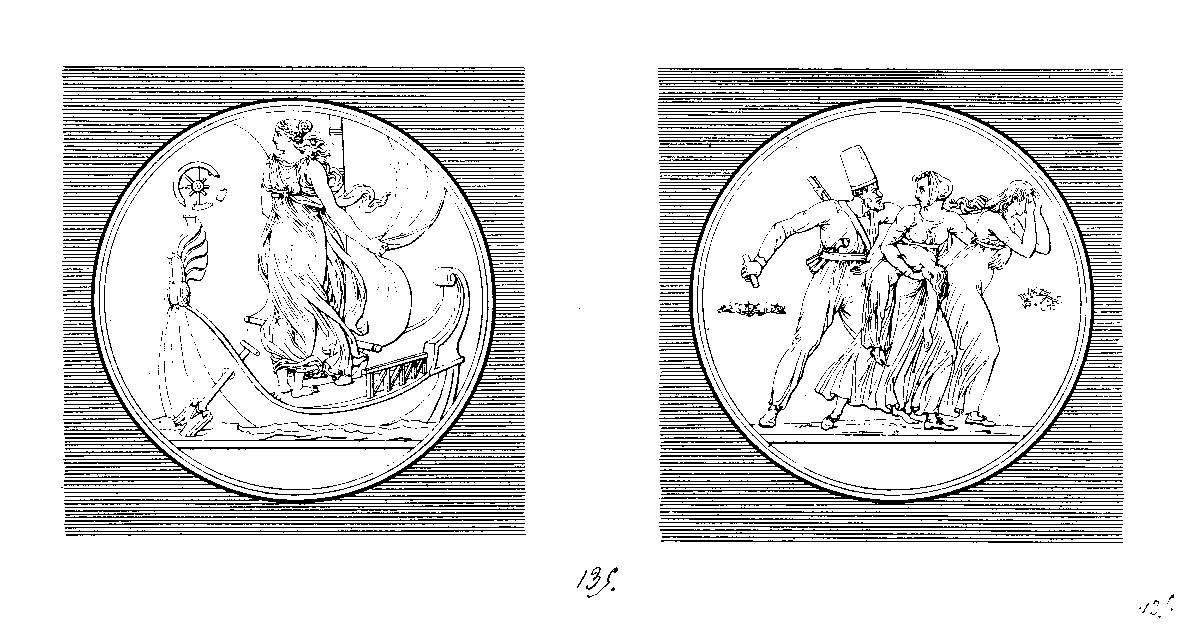
We are no worshippers of Napoleon's ambition. We would rather have had him always call himself Bonaparte. and think he might have done much more for the world than he did. But adversity is not the time to speak ill of a man; and as we object to his ambition, not out of prejudice, but on principle, we can afford to admire in him what was really admirable, and to separate what essential greatness he had, from the pollution of his education, and from his own mistakes. It is on occasions like the one just mentioned, that we feel impatient at his not having sooner discerned, or acted upon the finer capabilities of his nature. But the truth is, he was bred a soldier by the very dynasty which he displaced:-- it was under the auspices of the Bourbons, that he became what they most rued. It was in the same school, under a system which first creates and then deplores evil, that his imagination was excited by the examples of the C�sars and Alexanders; and that it yearned back upon the glory of past ages and established reputations. with a zeal beyond what the most interested opposers of new �ras would have deemed it expedient to cultivate, had they known the other novelties that were coming. But his education rather prepared him for hurting and humbling his teachers, than for falling in with those who might have taught him better. Napoleon's whole life was a retrospect of antiquity. He advanced toward fame, with an eye continually looking back to the elegancies of the Greek leaders, and the sweeping dominion of the Roman. Like Pericles, he patronized the Fine Arts; like Crassus and Sylla, he wished to carry his ensigns everywhere; and those ensigns were eagles. When he conquers those who threaten his empire, his medals represent him as Jupiter destroying the Titans (No. 50). Hercules receives the submission of the conquered (No. 34). He receives the submissive Austrian Emperor, in the attitude and habiliments of Marius admitting a barbarian to an interview (No. 38): and when all this grandeur is broken up, it is Fortune, Retro Meretrix, who turns her back upon him, and shifts her sails for another quarter (No. 2)(No. 113). It was in the same spirit that he uttered one of those grand sayings, which are inspired by extraordinary occasions in minds that know how to give themselves up to them. "Fifty ages," said he to his soldiers in Egypt, "are looking at you from those pyramids."
Advancing thus towards posterity, he stumbled against the ground which posterity itself had altered. He was beyond the mere vulgar prejudices of his time. Like C�sar, he was free from bigotry: like Marcellus, he knew how to value science, and to carry away intellectual plunder. But he had not given his age the credit of being able to doing anything beyond the perceptions of a liberal soldier; and he became wise too late. He ought to have known what the admirers of past ages and the quoters of authority are always so liable to forget, that men are great in proportion as they originate greatness and carry forward their own times, not in proportion as they identify themselves with the past. Epaminondas and Socrates did not propose to themselves to be Cadmus and Cecrops, but Epaminondas and Socrates; and if these great men lived now, and had the same spirit as formerly, they would still be centuries in advance; great men for the year two thousand and twenty, not for this or that century before Christ.
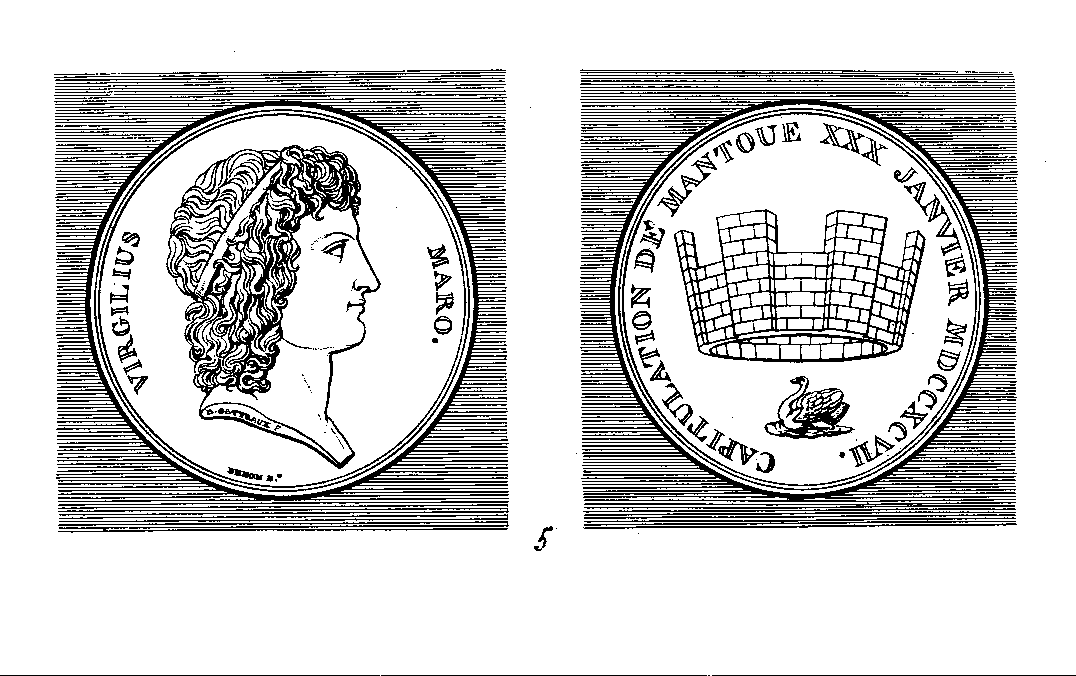
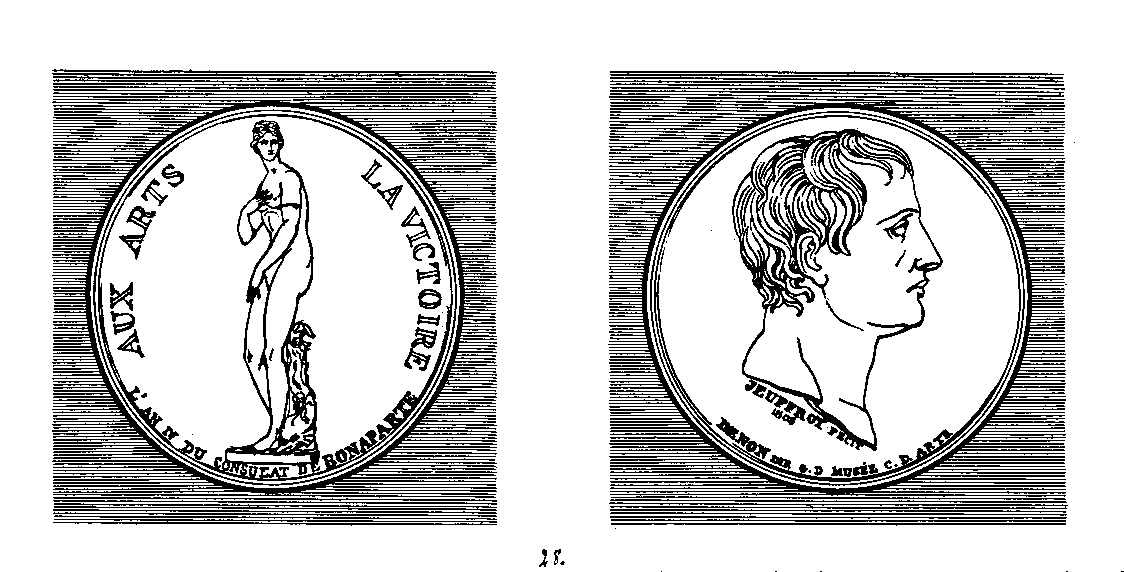
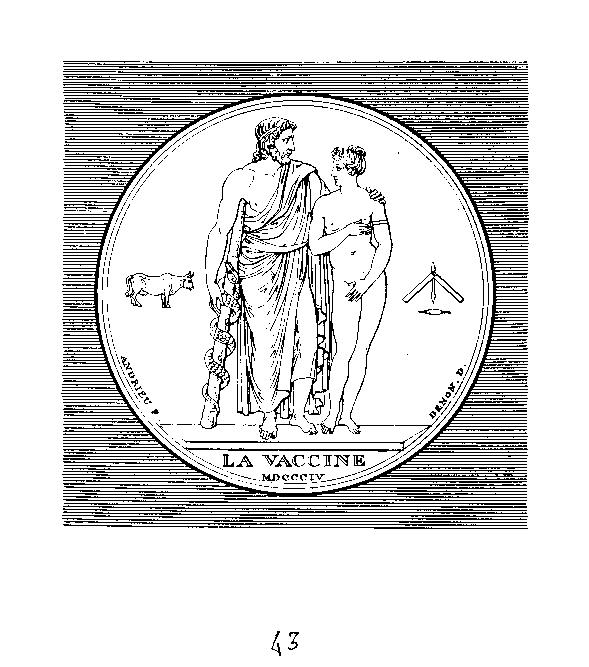
On the other hand, any perception of the growing value of intellect was welcome to an intellectual age; and it is saying perhaps more to the discredit of Bonaparte's rivals than to the credit of himself, that he had an advantage over them in this respect which has never forsaken him. His patronage of intellect was in some measure an instinct of self-preservation; and had he carried it on upon its most enlarged sale, as a great lift to everybody, instead of an ornament and safeguard to himself, had he even had such men as Carnot about him for marshals, the elements of a better ambition might have been drawn out of him. and his name stood forever at the head of a new age of mankind, instead of a great game at soldiers. When he took Mantua, he flattered at once his own self-love and that of the natives, by apparently devoting the medal, commemorative of the event, to the honor of Virgil (No. 2). The Venus de Medicis appears upon another (No. 14), which was struck to record the rape of that goddess from Florence; and another devoted to the discovery of vaccination, an English discovery, has the God of Healing upon it, protecting the same deity, as the goddess of beauty (No. 25). This habit, however created or modified, of appealing to a certain taste in the public, and of making common cause with whatever is superior to mere custom, was alone sufficient to interest the self-love of the intelligent. It is repeatedly acknowledged to have done so; and yet the reader would be astonished to hear how more than indifferent some of his most illustrious and successful opponents have shewn themselves to a sympathy of this kind. We smile when we see the Napoleon medal, which so confidently anticipates the possession of our country, and purports to be "struck at London:" but our smile does not know whether it ought not look grave, and count itself very lucky, when we hear from the importer of these medals, how his own exertions in honor of the military achievements of his countrymen were met by the genteel indifference of leaders and statesmen; how answers were left out for him in doorways, through the flattering mouths of butlers and porters; how one great man did "not understand such things as medals;" and another construed all his required patronage into the impossible idea of "taking another set;" and another was exceedingly happy to furnish his portrait to be immortalized, and accept a copy for the loan of it! Surely this is little less than being incapable of one's own victories, and shewing an indestructible jealousy of those which they have (not) obliterated.
One of the main reasons for the extraordinary superiority of the Greeks was their not educating people for this or that profession exclusively, or rather not regarding such and such a talent as exclusively professional. Every Greek was a politician and a soldier. Epaminondas could sing other men's victories on his harp; and Socrates saved the lives of Alcibiades and Xenophon in the field of battle. Whatever was laid before such men, they would enter into the merits of it, though foreign to their immediate occupation. Imagine then their sensibility at whatever touched it or redounded to the national glory. To earn a statue for themselves, to set up one to an illustrious friend, or to stamp the national coin with his head, was a sentiment as much to be understood by everybody as the rudiments of his native language; and to appreciate the spirit of it has ever since been held the mark of a liberal ambition. Men may go beyond it, and be allowed not to care for the symbol if they do not care for the glory; but to care for the glory, and be careless in what taste it is to be perpetuated, is either a confusion of notoriety with celebrity, or a still more extraordinary confidence in the all-sufficiency of a name. Those who are in the other extreme from philosophy, and have not even arrived at a wish for reputation, explain themselves well enough. In England, as in other countries, the taste for medals will almost invariably be found to have been confined to individuals of undoubted intellect. The principal collectors have been such men as Camden, Cotton, and Selden. Charles the First, who was a lover of literature, was fond of them; Cromwell had the good fortune to possess and appreciate the first medallist of modern times, Simon; and Charles the Second, who was a man of wit, emulated him in his taste. The most celebrated foreign collectors were the Medici family of Tuscany, a name synonimous with the love of genius; but latterly they met with little to celebrate. From the time of Queen Anne to that of Napoleon, the medallic history of Europe is a blank.
Individuals (who do more and have less done for them in England than in any other country in
the world) have in the meantime struck medals here and there; but it had been in honor of some
partizan or sectarian, and upon cheap and perishable materials. It is hoped that the great
increase in taste in other matters will soon afford decent encouragement to those who have
endeavoured to enlarge the sphere of medallic enjoyment, and enable them to turn their attention
to heads that will at any rate understand them, those of the poets, artists, and philosophers. Till
then the superiority, both in the theory and practice, must be acknowledged to remain with the
French; for, with a spirit beyond their usual national contentedness, they have produced a series
of the heads of the eminent men of all nations, thus realizing the prophecy, which Pope fondly
hoped no doubt would be borne out by his own countrymen, of
"A Virgil here, and
there an Addison."
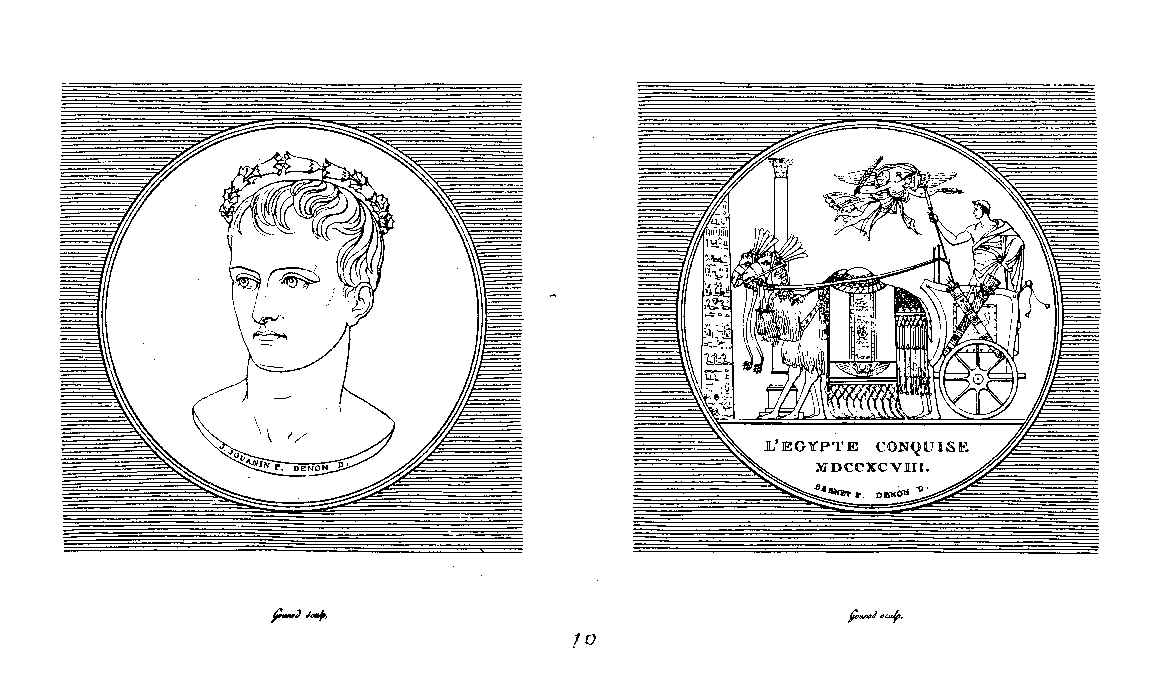
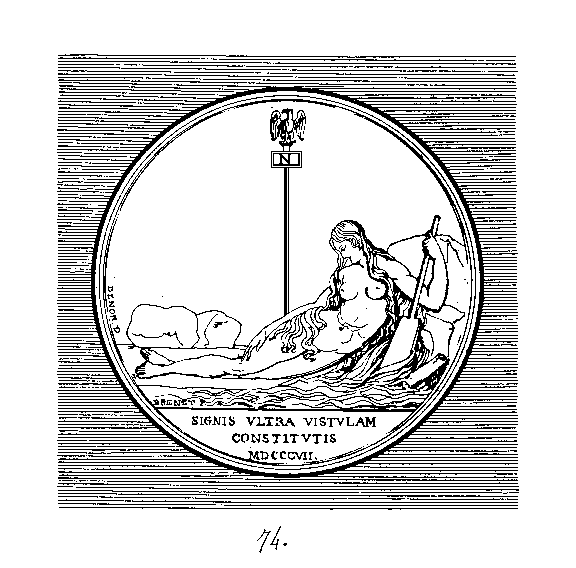
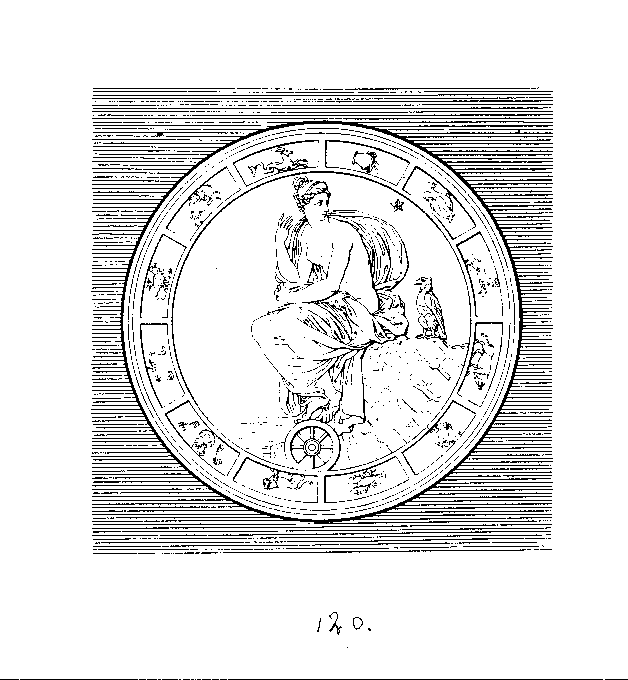
The Napoleon Series is a proof of the advantage they have over us in point of execution. They ought not to have it; for we have designers, such as Flaxman for instance, superior to theirs; and our School of Art, generally speaking, is in a less formal and hard a taste than theirs, which partakes of the classical fascination of their late Emperor, and turns all their figures into copies of statuary. The reader will see a prevailing cast of this sort in the Napoleon Series; but he will observe, at the same time, how the directing and more improved taste of M. Denon struggles with this propensity of his countrymen, as in the tapestried pomp of the camels in the Egyptian medal (No. 5); and the beautiful figure of the female lying down with her head bent downward and her arm extended; (No. 55); not to mention a variety of others. Of the more mechanical beauty of execution, rising into genius by its discernment of "the differences of things," there is an exquisite specimen in the Sojourn at Elba (No. 116), where the smooth surface of the female, the wrinkled one of the drapery. and the stratified one of the rock, are all as distinct and palpable as in nature. The very eagle has his little body as much to himself, as he seems to have his thoughts.
What a full and wonderful piece of history is here presented to the reader in the course of a few pages! The mind seems as briefly, yet forcibly, stamped with each successive event, as the medals themselves are struck with the dies.